









Introduction
In the evolving landscape of artificial intelligence and robotics, Physical Embodied Intelligence (PEI) has emerged as one of the most transformative research frontiers. Unlike narrow AI systems that operate within static digital environments—such as language models or game‑playing agents—physical embodied intelligence focuses on how intelligent systems perceive, reason, and act within the real world through a physical body. It is the intelligence that arises not merely from computational algorithms but from the continuous interaction among perception, action, and environment. PEI is about making machines that truly understand and navigate the physical world—whether that world is an industrial warehouse, a cluttered household kitchen, a hospital ward, or unpredictable outdoor terrain.
This article presents a comprehensive, in‑depth exploration of breakthrough physical embodied intelligence. It covers the conceptual foundations, historical trajectory, enabling technologies, core research challenges, integrative architectures, case studies, industry and academic efforts, ethical and safety considerations, and future directions. The goal is to provide a rigorous yet accessible resource for researchers, engineers, students, and practitioners interested in the next generation of robotics and AI—where intelligence is not just abstract computation but embodied capability.
1. Defining Physical Embodied Intelligence
1.1 Embodiment as a Core Principle
Physical embodied intelligence refers to the concept that cognition, perception, and action are deeply interwoven and that true intelligence emerges only when an agent is physically grounded in its environment. This perspective challenges the traditional AI paradigm that places computation at the center and views perception and action as peripheral.
In embodied systems:
- Perception is active: sensory data is gathered purposefully through movement and exploration.
- Action is informed by continuous perception and internal goals.
- Learning arises from trial, error, and physical experience.
- Adaptation occurs in real time through feedback loops that span body, environment, and neural control.
The central idea is that intelligence is not a static representation but a dynamic adaptation process grounded in physical interaction.
1.2 Why Embodiment Matters
Consider how humans learn to walk, grasp objects, or navigate new spaces. These skills are not innate—they result from developmental learning where sensory experiences and motor actions are continuously integrated. Similarly, for robots to operate effectively in unstructured environments, they must:
- Sense the world through multimodal sensors (vision, proprioception, tactile, depth).
- Act using bodies with degrees of freedom and force control (legs, arms, wheels, grippers).
- Learn through interaction, not just from static offline datasets.
Embodiment enables situated intelligence, wherein the robot’s knowledge is a product of its physical context.
2. Historical Background and Evolution
The idea of embodied intelligence is not new—it has deep roots in cognitive science, developmental psychology, and philosophy.
2.1 Early Theoretical Foundations
In the mid‑20th century, scholars such as Rodney Brooks challenged symbolic AI, arguing that intelligence could not be decoupled from the physical world. Brooks’ behavior‑based robotics emphasized reactive systems that respond to sensory input without centralized symbolic reasoning.
Simultaneously, researchers in cognitive science proposed that cognition arises from action, echoing in work by Francisco Varela, Eleanor Rosch, and others who emphasized perception–action coupling in human intelligence.
2.2 Embodiment in Robotics Research
Robotics research adopted these ideas progressively:
- Reactive control architectures (1980s–1990s) focused on sensor–motor loops.
- Hierarchical and hybrid control integrated low‑level reflexive behaviors with higher planning layers.
- Dynamic locomotion and manipulation studies demonstrated that mechanical design and control must co‑evolve for robust embodiment.
- Developmental robotics explored how robots could learn through experience, mimicking infant learning.
Despite early insights, physical embodiment remained constrained by limitations in sensors, computation, and algorithms.
2.3 Recent Acceleration
The past decade has seen explosive growth in physical embodied intelligence due to:
- Deep learning for perception and decision making
- Reinforcement learning (RL) and imitation learning for behavior acquisition
- Physics‑aware simulation tools such as MuJoCo, Gazebo, and Isaac Sim
- Affordable, high‑fidelity sensors (LiDAR, depth cameras, tactile arrays)
- Edge computing and AI accelerators enabling real‑time inference on robot bodies
Combined, these advances now make it possible to build robots that learn, adapt, and plan in ways that approach human‑like proficiency in certain tasks.
3. Core Components of Physical Embodied Intelligence
Physical embodied intelligence emerges from the interaction of several foundational components:
3.1 Perception Systems
Perception is the gateway to the physical world. Robots rely on:
- Vision sensors (RGB, depth, stereo)
- LiDAR and radar for spatial mapping
- Tactile and force sensors for contact and manipulation
- Proprioceptive sensors for internal state estimation
Perception systems produce representations of the environment that are actionable—meaning they support decision making and control.
3.1.1 Multimodal Perception
Real environments demand fusion of multiple sensory streams to disambiguate noise, occlusions, and uncertainties. Multimodal perception is a core research area that integrates vision, depth, proprioception, and touch to create reliable environmental models.
3.2 Control and Motion Systems
A robot’s body must execute actions predicted by its cognitive systems.
- Actuators provide torque, precision, and adaptive compliance.
- Control algorithms translate high‑level goals into joint trajectories and forces.
- Stability and balance systems ensure dynamic movement without falls.
Control systems for embodied intelligence often incorporate adaptive feedback loops that adjust actions based on sensor streams in real time.
3.3 Representation and Memory
Embodied systems require representations that are:
- Spatial (maps, occupancy grids)
- Semantic (object categories, affordances)
- Temporal (histories of actions and outcomes)
Memory systems enable robots to contextualize sensory data within past experience, improving prediction and planning.
3.4 Decision Making and Planning
Embodied intelligence integrates perception and control into goal‑directed behavior:
- Local decision making handles immediate reaction to sensory changes.
- Global planning sets task sequences and strategic direction.
- Task decomposition breaks high‑level tasks into executable segments.
Planning frameworks often rely on hierarchical models that combine symbolic reasoning with physics‑aware control optimization.
3.5 Learning Mechanisms
Learning is central to embodied intelligence:
3.5.1 Reinforcement Learning (RL)
RL enables robots to learn action policies through rewards and penalties. Challenges in RL include sample efficiency, long‑horizon planning, and safe exploration in physical environments.
3.5.2 Imitation and Demonstration Learning
Imitation learning allows robots to learn from human demonstrations, transferring skills without exhaustive trial‑and‑error.
3.5.3 Self‑Supervised and Unsupervised Learning
Self‑supervision generates training signals from the robot’s own experience, reducing dependency on labeled datasets.
3.5.4 Hybrid Learning Architectures
Hybrid systems combine model‑based reasoning with learned policies, enabling robust performance across varied tasks.
4. Simulation and the Reality Gap
Simulation plays a vital role in advancing physical embodied intelligence:
4.1 High‑Fidelity Simulators
Tools such as NVIDIA Isaac Sim, MuJoCo, and Webots allow researchers to train and validate algorithms in virtual environments that approximate real physics.
4.2 Bridging the Reality Gap
Despite high fidelity, simulated experience must generalize to real robots—a challenge known as the sim‑to‑real gap. Methods to bridge the gap include:
- Domain randomization: varying simulation parameters to force robust learning
- Sim‑to‑real transfer techniques
- Data augmentation
- Real‑world fine‑tuning
Bridging this gap is essential for embodied intelligence to succeed beyond labs.
5. Architectural Paradigms for Embodied Intelligence
A successful embodied intelligence system typically adopts one of several architectural styles:
5.1 Modular Perception‑Action Pipelines
These pipelines decouple perception, representation, and control into modules. While interpretable and manageable, they can struggle to optimize end‑to‑end performance.
5.2 End‑to‑End Learning Systems
Inspired by deep learning, some approaches train an integrated neural network that maps raw sensory data directly to actions. End‑to‑end models can capture complex dependencies but often require massive data and careful regularization.
5.3 Hybrid Architectures
Hybrid architectures combine modular components with shared latent representations, balancing interpretability and flexibility. For example:
- A perception backbone produces embeddings
- A planner uses embeddings for high‑level reasoning
- A controller executes actions optimized for physical dynamics
Hybrid models are increasingly favored in embodied intelligence research.
6. Case Studies: Breakthrough Embodied Intelligent Systems
6.1 Dynamic Legged Robots
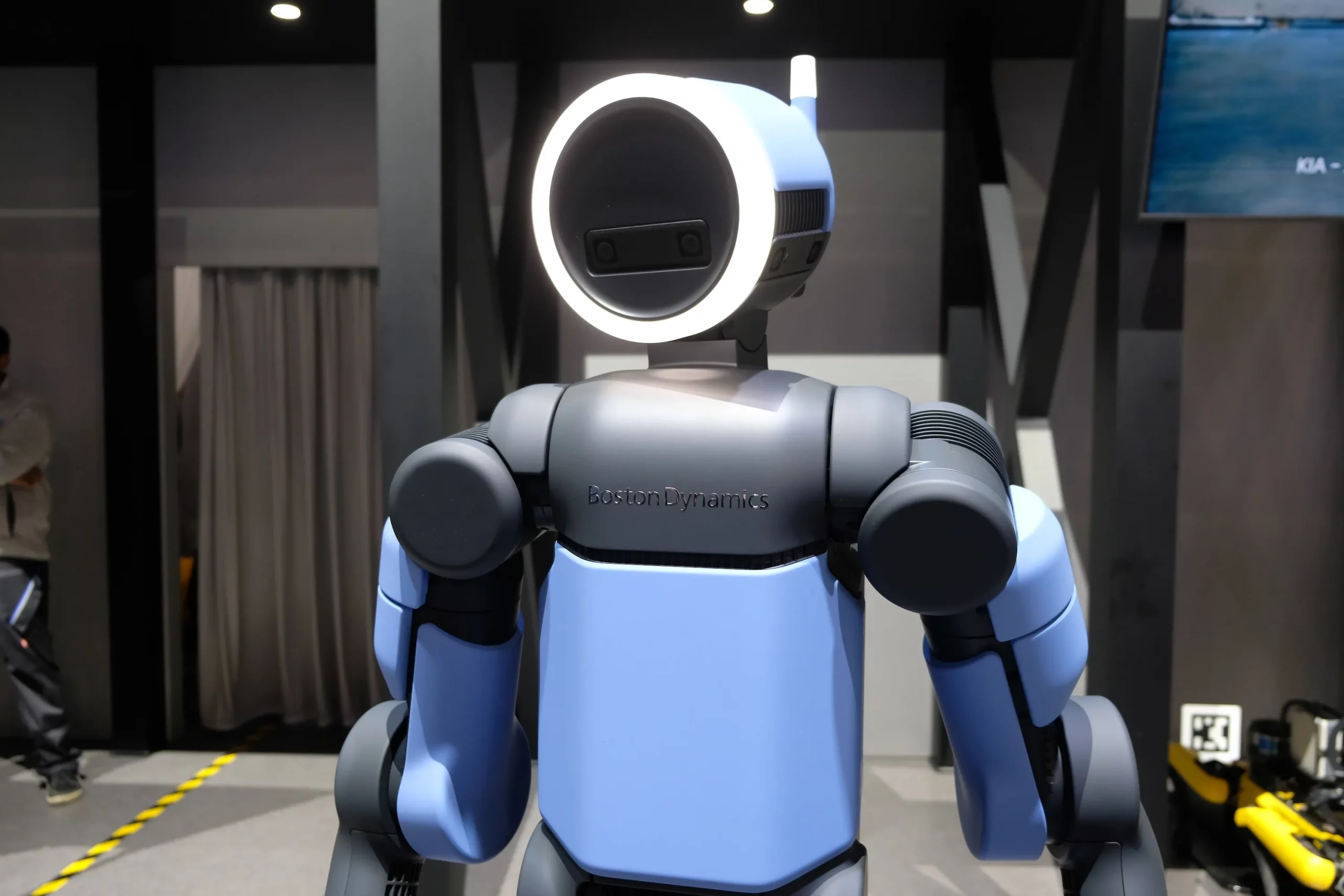
Legged robots like Boston Dynamics’ Spot and Atlas exemplify physical embodied intelligence:
- Integration of perception with locomotion control
- Real‑time balance maintenance
- Terrain adaptation through sensory feedback
These robots navigate stairs, uneven ground, and dynamic obstacles—tasks that demand embodied reasoning.
6.2 Dexterous Manipulators
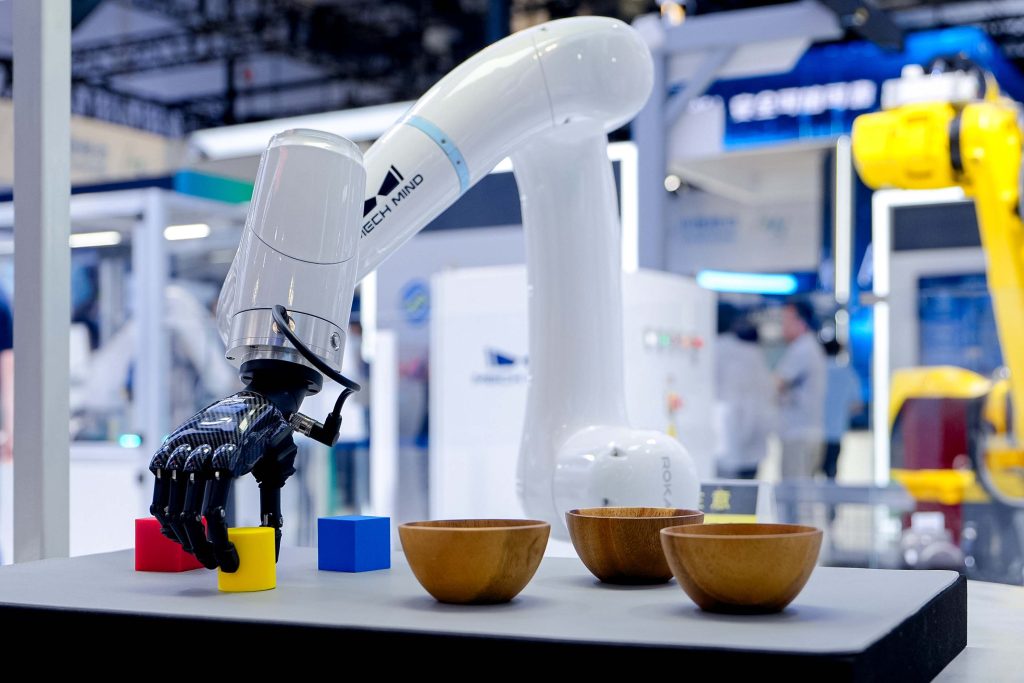
Robots like Shadow Robot Hand and OpenAI’s dexterous manipulation systems demonstrate precise, adaptive grasping. They integrate multimodal touch, force sensing, and vision to handle diverse objects.
6.3 Humanoid Assistants
Emerging humanoids combine navigation, manipulation, and interaction. They interpret high‑level instructions, reason about object relations, and execute tasks in human environments.
6.4 Autonomous Vehicles and Drones
While not traditionally “robots” in the humanoid sense, autonomous vehicles and drones embody dynamic interaction with the world: perceiving, planning, and acting in real time across varied domains.
7. Metrics and Evaluation
Evaluating embodied intelligence requires nuanced metrics:
7.1 Task Success and Efficiency
Metrics measuring task completion, time to completion, energy use, and error rates.
7.2 Adaptation and Generalization
Ability to handle novel environments, untrained tasks, and unexpected disturbances.
7.3 Robustness and Safety
Resilience to noise, sensor failure, and environmental uncertainty. Safety metrics gauge collision avoidance, safe fallback behaviors, and human interaction compliance.
7.4 Explainability and Interpretability
Understanding why a robot acted as it did aids debugging, trust, and regulatory compliance.
8. Industry and Cross‑Sector Applications
Physical embodied intelligence unlocks significant real‑world applications:
8.1 Manufacturing and Industry 4.0
Adaptive robots can handle variable parts, dynamic assembly, and human collaboration.
8.2 Healthcare and Assistance
Robots assist with rehabilitation, patient handling, and elder care through perceptionful, adaptive interaction.
8.3 Logistics and Warehousing
Dynamic path planning, grasping, and terrain adaptation enhance throughput and resiliency.
8.4 Service and Domestic Robots
Embodied intelligence enables complex domestic tasks, human interaction, and autonomous operation in unstructured environments.
9. Challenges and Open Questions
Despite progress, key challenges persist:
9.1 Sample Efficiency
Learning embodied skills often demands vast experience. Improving efficiency through better algorithms, transfer learning, and simulation augmentation remains critical.
9.2 Safety and Ethical Considerations
Adaptive robots operating near humans require rigorous safety guarantees. Ethical questions include autonomy boundaries and trust.
9.3 Scalability Across Platforms
Differing morphologies and hardware make generalizing embodied intelligence across robot types difficult.
9.4 Interpretability and Regulation
Understanding internal decision processes is vital for trust, certification, and compliance with regulatory frameworks.
10. Future Directions
The future of embodied intelligence is shaped by synergistic advances:
10.1 Integration with General AI Models
Foundation models that understand vision, language, and physics will further enhance autonomy and flexibility.
10.2 Lifelong and Continual Learning
Robots that learn throughout their operational lifetime will adapt to users and environments, closing the loop between experience and behavior.
10.3 Multi‑Agent and Social Embodiment
Collaborative embodied intelligence enables teams of robots and humans to coordinate complex tasks.
10.4 Neuromorphic and Bio‑Inspired Computing
Hardware inspired by biological brains may deliver energy‑efficient embodied inference and control.
Conclusion
Breakthrough physical embodied intelligence represents a paradigm shift in robotics and AI. It redefines intelligence not as abstract computation but as situated, sensorimotor competence grounded in dynamic interaction with the world. By integrating perception, action, learning, planning, and control in real time, embodied systems edge closer to human‑like adaptability and autonomy.
While challenges remain—such as safety, scalability, and data efficiency—the field’s momentum is unmistakable. With continued advances in multimodal perception, physics‑aware learning, simulation‑to‑real transfer, and general AI integration, embodied intelligence will power the next generation of autonomous systems—robots that can understand, adapt, collaborate, and flourish across domains.
In essence, the future of robotics is not just about smarter algorithms—it is about intelligence that lives in the world, perceives it, acts within it, and continues to evolve through experience.