









Introduction
Robotics technology has evolved rapidly, moving from simple, pre-programmed machines to systems capable of perceiving, understanding, and interacting with their environment in real time. Central to this evolution is the integration of perception and tactile sensing, often referred to as “perception + touch” technology.
- Perception involves visual, auditory, and environmental sensing, allowing robots to identify objects, estimate distances, recognize human gestures, and interpret contextual cues.
- Tactile sensing provides robots with a sense of touch, enabling them to detect force, texture, temperature, and pressure, much like human skin.
The combination of these capabilities allows robots to operate more autonomously, safely, and efficiently in complex, dynamic environments—ranging from industrial assembly lines to healthcare, service robotics, and exploratory missions. This article explores the current state, applications, technological mechanisms, challenges, and future directions of perception + tactile technologies in robotics.
1. Understanding Robot Perception Systems
1.1 Vision-Based Perception
- Cameras and Depth Sensors: RGB, stereo vision, and depth cameras allow robots to understand their surroundings. Depth sensing is essential for obstacle avoidance, object manipulation, and 3D mapping.
- LiDAR and Radar: Common in autonomous vehicles and mobile robots, these sensors generate precise spatial maps of the environment.
- Computer Vision Algorithms: AI-powered algorithms enable object recognition, motion tracking, and scene understanding, forming the visual perception backbone of autonomous systems.
1.2 Multimodal Perception Integration
- Modern robots often integrate multiple sensing modalities (vision, LiDAR, IMU, ultrasonic) to create redundant and reliable environmental models.
- Sensor fusion techniques allow robots to operate effectively even under partial occlusion or adverse lighting conditions.
1.3 Strategic Significance of Perception
- Autonomy: Enables decision-making without human intervention.
- Safety: Supports obstacle avoidance and human-robot interaction in shared spaces.
- Efficiency: Optimizes task execution through precise environmental awareness.
2. Tactile and Haptic Sensing in Robotics
2.1 Tactile Sensor Types
- Force/Torque Sensors: Measure applied force and torque at joints or end effectors.
- Pressure Sensors: Detect contact pressure, useful for delicate object handling.
- Temperature Sensors: Enable robots to respond safely to heat-sensitive objects.
- Vibration and Slip Sensors: Help robots maintain grip and prevent object slippage.
2.2 Haptic Feedback Systems
- Direct Feedback: Provides real-time tactile data to robot control systems, enabling adaptive grip and manipulation.
- Teleoperation and Remote Control: Haptic devices transmit force or motion sensations to human operators, improving precision in remote tasks such as surgery or hazardous material handling.
2.3 Benefits of Tactile Sensing
- Enhances dexterity, allowing robots to handle fragile or irregular objects.
- Supports adaptive manipulation, where robots adjust force and movement dynamically.
- Improves human-robot interaction by enabling robots to respond sensitively to touch and gestures.
3. Integration of Perception and Tactile Sensing
3.1 Multimodal Sensory Fusion
- Combining visual perception with tactile sensing creates a complementary system:
- Vision identifies object location, shape, and orientation.
- Tactile sensing provides real-time feedback on contact, grip, and force.
- Example: In robotic assembly, cameras locate components while tactile sensors ensure correct insertion without overforce.
3.2 Algorithms for Sensor Fusion
- Kalman Filters and Bayesian Estimation: Integrate noisy tactile and visual data for precise state estimation.
- Reinforcement Learning: Robots learn manipulation strategies through trial-and-error with real-time tactile feedback.
- Deep Learning Models: Predict object properties, slippage, or fragility by combining tactile patterns with visual features.
3.3 Advantages of Integrated Systems
- Increased Autonomy: Robots adapt to unseen objects and unpredictable environments.
- Error Reduction: Tactile feedback compensates for perception inaccuracies.
- Operational Versatility: Applicable in manufacturing, logistics, healthcare, and household robotics.
4. Industrial Applications
4.1 Manufacturing and Assembly
- Delicate Component Handling: Microelectronics assembly requires precise force and alignment.
- Adaptive Automation: Robots detect misaligned parts and correct positioning using tactile feedback.
- Collaborative Workstations: Cobots safely interact with humans, adjusting actions based on real-time contact.
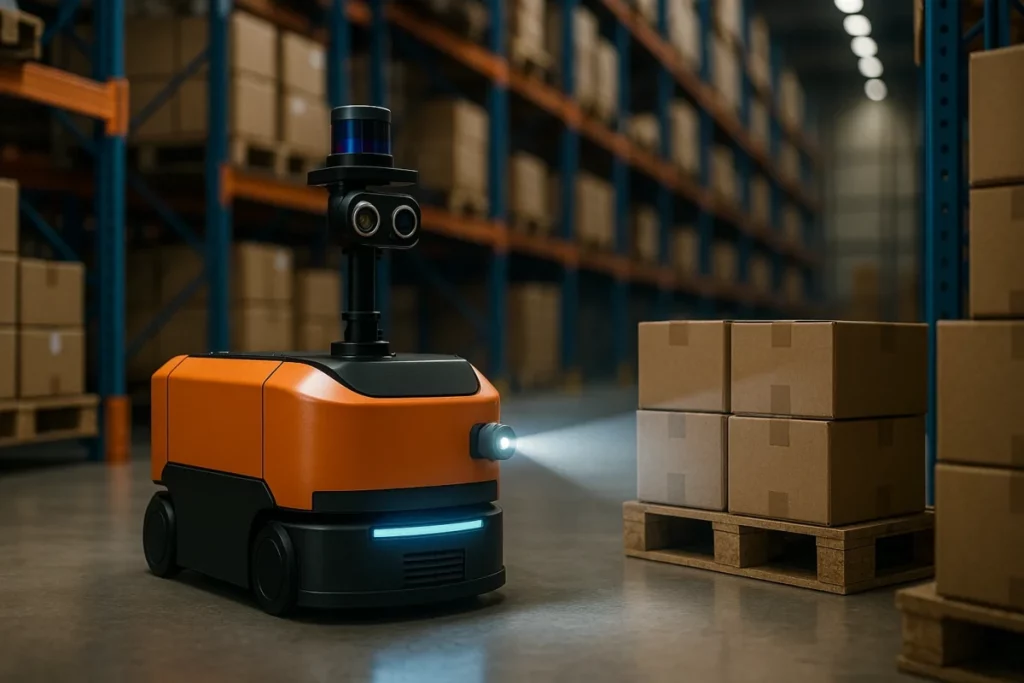
4.2 Logistics and Warehousing
- Grasping diverse packages with varying weight, shape, and texture.
- Detecting slippage to prevent damage during automated handling.
4.3 Healthcare and Service Robotics
- Surgical Robots: Tactile sensors provide force feedback to prevent tissue damage.
- Rehabilitation Robots: Measure patient resistance and adjust therapy intensity.
- Social Interaction: Touch-sensitive robots enhance engagement and human comfort.
4.4 Hazardous and Exploration Environments
- Space exploration, underwater robotics, and disaster response rely on tactile feedback when visual perception is limited.
5. Technical Challenges
5.1 Sensor Limitations
- Tactile sensors must balance sensitivity, robustness, and miniaturization.
- Visual sensors can fail under poor lighting, occlusion, or reflective surfaces.
5.2 Data Fusion Complexity
- Integrating high-frequency tactile data with vision requires advanced real-time processing.
- Synchronization delays can cause errors in dynamic manipulation tasks.
5.3 Algorithmic Challenges
- Developing models that learn from both tactile and visual cues is computationally intensive.
- Transfer learning between simulated and real-world environments remains difficult.
5.4 Cost and Scalability
- High-resolution tactile sensors are expensive.
- Mass deployment requires standardization and durability improvements.
6. Future Directions
6.1 Soft Robotics and Flexible Sensors
- Flexible tactile skins enhance coverage and sensitivity.
- Soft actuators reduce collision risk and improve human-robot interaction.
6.2 AI-Driven Perception + Tactile Systems
- Deep reinforcement learning enables robots to adapt manipulation strategies dynamically.
- Predictive tactile models anticipate object properties even before contact.
6.3 Human-Like Dexterity
- Integration of multi-fingered robotic hands with tactile sensing can rival human touch and dexterity.
- Enables sophisticated applications: delicate assembly, fine arts handling, or caregiving tasks.
6.4 Multimodal Simulation and Digital Twins
- Digital twins simulate both perception and tactile feedback for safe testing, training, and optimization.
- Accelerates deployment of robots in complex industrial or social environments.
7. Strategic Implications for Industry
- Enhanced Productivity: Reduced error rates, faster adaptation to new tasks, and minimal supervision.
- Safety and Compliance: Tactile feedback prevents accidents in human-robot collaborative settings.
- Market Differentiation: Companies leveraging perception + tactile systems gain competitive advantage in precision tasks.
- R&D Focus: Investment in sensor fusion, AI algorithms, and soft robotics is critical for next-generation robotics.
Conclusion
The integration of perception and tactile sensing represents a paradigm shift in robotics. By combining vision, environmental awareness, and haptic feedback, robots achieve higher autonomy, dexterity, and safety.
Applications span manufacturing, healthcare, logistics, exploration, and service robotics, while ongoing research in soft robotics, AI-driven sensor fusion, and digital twins promises even greater capabilities.
As industries increasingly demand robots that see, feel, and adapt, perception + tactile technology is poised to become a cornerstone of intelligent, human-compatible robotic systems, driving innovation and operational efficiency across sectors.