









Introduction
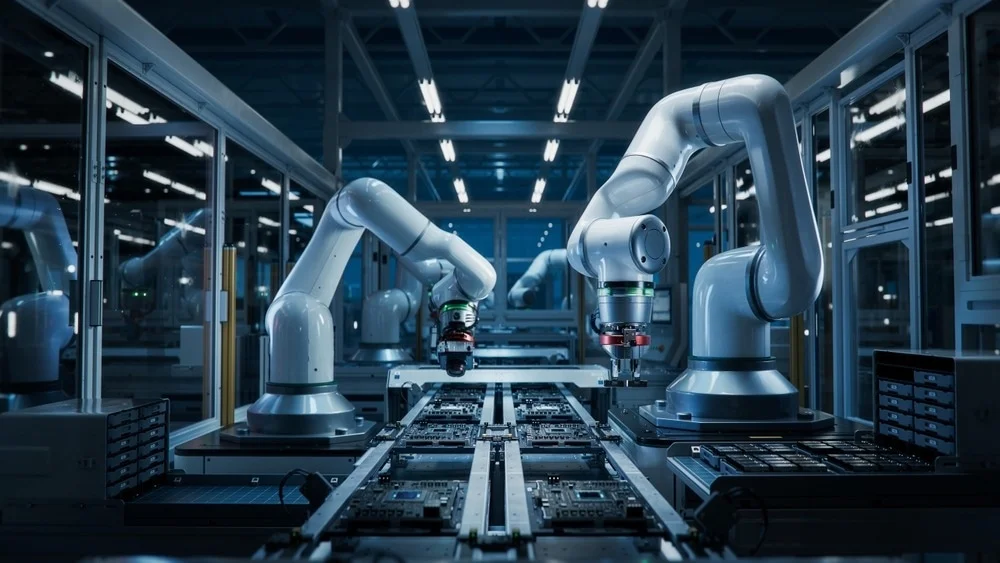
The convergence of Artificial Intelligence (AI) and robotics is no longer a futuristic concept confined to science fiction or experimental laboratories. It is rapidly becoming a defining force reshaping global industries, especially manufacturing. As AI technologies mature—encompassing machine learning, deep learning, computer vision, natural language processing, and reinforcement learning—their integration with robotic systems has dramatically accelerated. This fusion is now widely regarded as one of the most critical engines powering industrial automation and ushering in a new era of intelligent manufacturing.
Traditional industrial robots were designed primarily for repetitive, pre-programmed tasks in structured environments. While they revolutionized production efficiency in the late 20th century, they lacked adaptability, perception, and autonomous decision-making. AI changes this equation entirely. By embedding intelligence into machines, robots gain the ability to perceive their surroundings, learn from data, adapt to uncertainty, collaborate safely with humans, and optimize processes in real time.
This article explores in depth how the accelerated integration of AI and robotics is transforming industrial automation and redefining manufacturing paradigms. It examines the technological foundations, industrial applications, economic and social impacts, challenges, and future trajectories of this powerful synergy. Through a comprehensive and professional analysis, we aim to illuminate why AI-driven robotics stands at the heart of the new manufacturing revolution.
1. The Evolution from Traditional Automation to Intelligent Automation
1.1 Traditional Industrial Automation
Industrial automation began with mechanical systems, relay-based controls, and later programmable logic controllers (PLCs). These technologies enabled mass production, consistency, and cost reduction. However, they were fundamentally rule-based and deterministic. Any deviation from predefined conditions—such as changes in product design, unexpected defects, or environmental variability—required manual intervention or reprogramming.
Key limitations of traditional automation included:
- Low flexibility: Systems struggled with high-mix, low-volume production.
- Limited perception: Sensors provided basic feedback but lacked contextual understanding.
- High reconfiguration costs: Adjusting production lines was time-consuming and expensive.
- Human dependence: Skilled operators were needed to monitor, adjust, and troubleshoot systems.
1.2 The Emergence of Intelligent Automation
Intelligent automation integrates AI capabilities into automated systems, allowing them to move beyond rigid rule execution toward adaptive and autonomous behavior. When robots are equipped with AI models, they can:
- Interpret complex sensory data (vision, sound, force, and tactile inputs)
- Learn from historical and real-time data
- Make probabilistic decisions under uncertainty
- Continuously improve performance through feedback loops
This evolution marks a paradigm shift: automation is no longer about replacing human muscle but augmenting human intelligence and decision-making.
2. Core Technologies Enabling AI–Robot Integration
2.1 Machine Learning and Deep Learning
Machine learning (ML) allows robots to learn patterns from data rather than relying solely on explicit programming. Deep learning, a subset of ML, uses neural networks with multiple layers to process complex data such as images, videos, and sensor streams.
In manufacturing, deep learning enables:
- Visual inspection for defect detection
- Object recognition and classification
- Predictive maintenance based on equipment data
- Adaptive control of robotic motion
2.2 Computer Vision
Computer vision gives robots the ability to “see” and understand their environment. Advanced vision systems powered by AI can detect objects, estimate depth, recognize gestures, and track motion in real time.
Applications include:
- Bin picking in unstructured environments
- Automated quality control
- Precision assembly tasks
- Safe human–robot collaboration
2.3 Reinforcement Learning
Reinforcement learning (RL) enables robots to learn optimal behaviors through trial and error, guided by reward functions. This is particularly valuable for complex tasks where explicit modeling is difficult.
In industrial settings, RL supports:
- Motion planning and control optimization
- Adaptive grasping and manipulation
- Energy-efficient operation
- Autonomous process optimization
2.4 Edge Computing and Industrial IoT
The integration of AI and robotics is strengthened by edge computing and the Industrial Internet of Things (IIoT). Sensors, machines, and robots are connected through industrial networks, generating vast amounts of data. Edge AI allows real-time processing close to the source, reducing latency and enhancing reliability.
3. AI-Driven Robotics in Modern Manufacturing
3.1 Smart Factories and Industry 4.0
The concept of the smart factory lies at the heart of Industry 4.0. AI-powered robots act as intelligent agents within cyber-physical systems, interacting with digital twins, production management software, and human operators.
Characteristics of AI-enabled smart factories include:
- Self-optimizing production lines
- Real-time monitoring and analytics
- Predictive maintenance and fault prevention
- Seamless integration across the value chain
3.2 Flexible and Personalized Manufacturing
Consumer demand is shifting toward customization and shorter product life cycles. AI-driven robots enable flexible manufacturing systems capable of handling frequent changeovers and personalized products without sacrificing efficiency.
Robots can automatically adjust parameters, recognize different components, and reconfigure workflows based on digital instructions, making mass customization economically viable.
3.3 Human–Robot Collaboration (Cobots)
Collaborative robots, or cobots, are designed to work safely alongside humans. AI enhances cobots by enabling:
- Real-time perception of human presence and intent
- Adaptive force control for safe interaction
- Natural communication through voice or gestures
This collaboration combines human creativity and judgment with robotic precision and endurance, leading to higher productivity and improved workplace ergonomics.
4. Industrial Applications Across Sectors
4.1 Automotive Manufacturing
The automotive industry has long been a pioneer in robotics. AI now elevates robotic systems to handle more complex tasks such as autonomous welding adjustment, intelligent painting, and vision-based assembly.
AI-powered robots also support rapid model changes and electric vehicle production, which require new manufacturing processes and greater flexibility.
4.2 Electronics and Semiconductor Manufacturing
Electronics manufacturing demands extreme precision and cleanliness. AI-driven robotics enable:
- Micron-level assembly accuracy
- Automated inspection of complex circuit boards
- Adaptive handling of fragile components
In semiconductor fabs, AI optimizes robot scheduling, contamination control, and yield improvement.
4.3 Logistics and Intralogistics
Within factories and warehouses, autonomous mobile robots (AMRs) powered by AI handle material transport, inventory management, and order fulfillment. These robots dynamically navigate environments, avoid obstacles, and coordinate with other systems.
4.4 Heavy Industry and Hazardous Environments
AI-integrated robots operate in environments unsafe for humans, such as steel plants, chemical factories, and mining operations. Intelligent perception and decision-making allow robots to handle unpredictable conditions while improving safety and efficiency.
5. Economic and Strategic Impacts
5.1 Productivity and Cost Efficiency
AI–robot integration significantly boosts productivity by reducing downtime, minimizing defects, and optimizing resource usage. While initial investment costs can be high, long-term returns often justify the expense through improved throughput and quality.
5.2 Global Competitiveness
Nations and enterprises that lead in intelligent manufacturing gain strategic advantages. AI-driven automation reduces reliance on low-cost labor, reshaping global supply chains and enabling reshoring of manufacturing.
5.3 Workforce Transformation
Rather than simply replacing jobs, AI-driven robotics transforms the nature of work. Demand increases for roles such as:
- Robot technicians and engineers
- Data scientists and AI specialists
- System integrators and automation architects
At the same time, routine manual tasks decline, highlighting the importance of reskilling and lifelong learning.
6. Challenges and Limitations
6.1 Technical Complexity
Integrating AI with robotics requires expertise across multiple disciplines, including mechanical engineering, computer science, data analytics, and control systems. System reliability and robustness remain critical concerns.
6.2 Data Quality and Security
AI systems depend heavily on data. Poor data quality can lead to inaccurate models and unsafe behavior. Moreover, increased connectivity raises cybersecurity risks that must be addressed through robust industrial security strategies.
6.3 Ethical and Social Considerations
The widespread adoption of intelligent robots raises ethical questions related to job displacement, data privacy, and accountability. Transparent governance and responsible AI practices are essential to ensure societal trust.
6.4 Standardization and Interoperability
Lack of common standards can hinder seamless integration across platforms and vendors. Industry-wide collaboration is needed to establish interoperable frameworks.
7. The Role of Digital Twins and Simulation
Digital twins—virtual replicas of physical systems—play a crucial role in AI–robot integration. By simulating robots, production lines, and entire factories, manufacturers can:
- Train AI models safely and efficiently
- Test process changes before deployment
- Predict system behavior under various scenarios
This approach reduces risk, accelerates innovation, and shortens time to market.
8. Future Trends and Outlook
8.1 Autonomous Factories
The long-term vision is the autonomous factory, where AI-driven robots and systems coordinate end-to-end production with minimal human intervention. Humans will focus on strategic oversight, creativity, and innovation.
8.2 Integration with Generative AI
Generative AI will further enhance robotics by enabling natural language programming, automated process design, and intelligent troubleshooting.
8.3 Sustainable Manufacturing
AI-powered robots contribute to sustainability by optimizing energy usage, reducing waste, and enabling circular manufacturing models.
8.4 Global Collaboration and Ecosystems
The future of AI-driven robotics will be shaped by global ecosystems involving technology providers, manufacturers, research institutions, and policymakers working together to drive innovation responsibly.
Conclusion
The accelerated integration of AI and robotics represents a transformative force in industrial automation and the emergence of a new manufacturing era. By infusing intelligence into machines, industries move beyond rigid automation toward adaptive, resilient, and human-centric production systems.
This evolution is not merely a technological upgrade—it is a structural transformation of how value is created in manufacturing. AI-driven robots enhance productivity, enable flexibility, improve quality, and redefine the relationship between humans and machines. While challenges remain, the momentum is unmistakable.
As AI and robotics continue to converge, they will stand as a foundational engine driving industrial competitiveness, economic growth, and sustainable development. For manufacturers, policymakers, and society at large, embracing this intelligent automation revolution is not just an opportunity—it is a strategic imperative for the future.