









Introduction: The Rise of Humanoid Robot Competitions
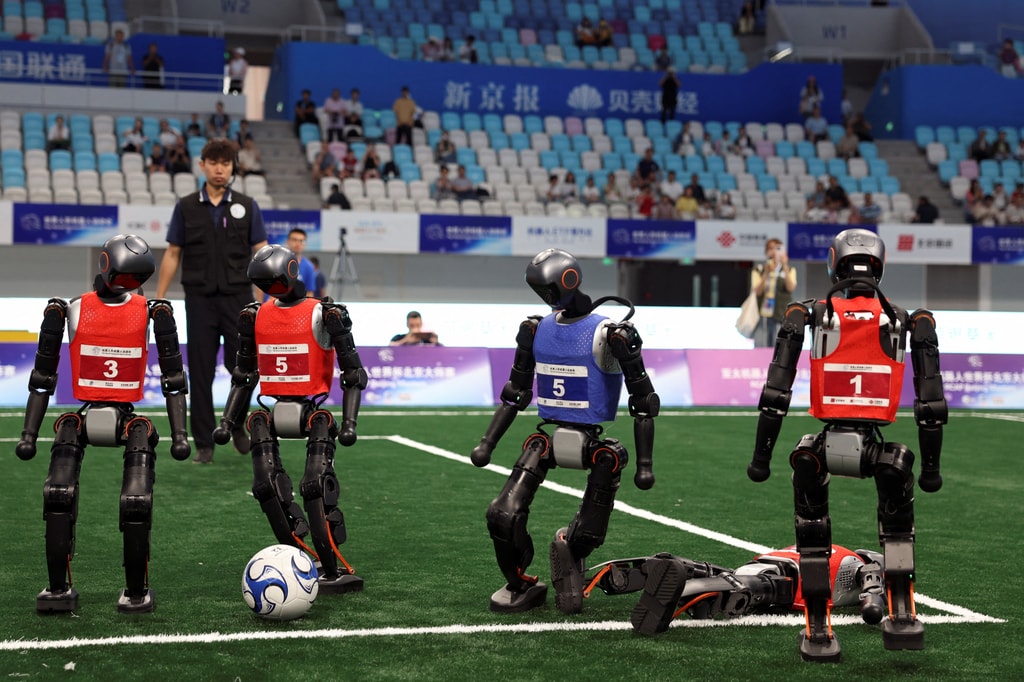
The Global Humanoid Robot Sports Games have emerged as one of the most exciting intersections of robotics, artificial intelligence, and entertainment. Unlike conventional robotics exhibitions, these competitions showcase advanced humanoid robots performing dynamic tasks under real-world constraints, from running and jumping to collaborative team challenges.
The rising momentum of these competitions reflects a broader trend: humanoid robots are transitioning from research prototypes to high-performance, interactive machines capable of complex physical and cognitive tasks. This development not only pushes the boundaries of robotic engineering but also drives innovation across AI, sensor integration, motion planning, and human-robot interaction.
This article explores the sustained excitement and significance of the Global Humanoid Robot Sports Games, addressing:
- Historical evolution of humanoid robot competitions
- Technical challenges and innovations demonstrated
- AI, control systems, and sensor technology in competitive robots
- Societal and industrial implications
- Case studies from recent competitions
- The future trajectory of humanoid robotics in sports and beyond
1. Historical Evolution of Humanoid Robot Competitions
1.1 Early Experiments
- Initial humanoid robots, developed in the late 20th century, were primarily research platforms, often limited to simple walking or object manipulation tasks.
- Competitions were largely demonstrative, emphasizing stability and basic locomotion.
1.2 Emergence of Sports-Oriented Challenges
- Events like the RoboCup Humanoid League transformed robotics competitions into dynamic, performance-based sports.
- Robots began engaging in tasks requiring balance, agility, and teamwork, including simulated soccer matches, obstacle courses, and dance performances.
1.3 The Global Expansion
- The Global Humanoid Robot Sports Games consolidate international efforts, attracting teams from universities, corporate R&D labs, and independent robotics enthusiasts.
- Participation has expanded from a few dozen robots in early editions to hundreds of entries across multiple disciplines, reflecting technological maturation and competitive appeal.
2. Technical Challenges in Competitive Humanoid Robotics
Humanoid robot competitions test a wide array of engineering disciplines:
2.1 Locomotion and Balance
- Bipedal robots must maintain stability while performing dynamic movements, such as sprinting, jumping, or maneuvering uneven terrain.
- Advanced inverse kinematics and control algorithms ensure precise joint actuation and energy-efficient motion.
2.2 Real-Time Perception
- Robots rely on multi-modal sensors, including cameras, LiDAR, IMUs, and force sensors, to perceive the environment.
- Perception systems detect obstacles, teammates, and targets in real time, enabling adaptive motion and strategy execution.
2.3 AI-Driven Decision-Making
- Competitive tasks require strategic planning, such as predicting opponent movements in robot soccer or coordinating complex maneuvers.
- Machine learning models process sensor data, environmental context, and historical performance to optimize behavior.
2.4 Energy Management
- Robots must balance high-performance actuation with limited battery capacity.
- Efficient energy management ensures sustained performance over multiple rounds or extended competitions.
3. Sensor and Control Systems
3.1 Vision Systems
- RGB and depth cameras allow real-time object detection, pose estimation, and environment mapping.
- Vision algorithms handle challenges like motion blur, changing lighting, and occlusions.
3.2 Tactile and Force Feedback
- Force-torque sensors in joints and limbs enable robots to interact safely with obstacles, surfaces, and other robots.
- Tactile feedback allows fine manipulation tasks under variable physical conditions.
3.3 Control Architectures
- Modern humanoid robots use hierarchical control systems:
- Low-level joint control ensures precise actuation.
- Mid-level trajectory planners optimize locomotion and manipulation.
- High-level decision modules coordinate tasks, strategy, and adaptive responses.
4. AI in Competitive Robotics
4.1 Reinforcement Learning
- Robots learn complex behaviors through trial-and-error simulations, optimizing movement and strategy.
- Reinforcement learning enables robust adaptation to unpredictable conditions during competitions.
4.2 Multi-Agent Coordination
- Team-based challenges, like robot soccer, require cooperative AI frameworks.
- Algorithms manage real-time role assignment, spatial positioning, and collaborative goal achievement.
4.3 Predictive Analytics
- AI models anticipate opponent actions, environmental changes, and energy consumption, enhancing decision-making efficiency.
5. Societal and Industrial Implications
5.1 Educational Value
- Competitions inspire students to pursue robotics, AI, and engineering careers.
- Teams gain hands-on experience in hardware design, software development, and systems integration.
5.2 Industry Advancements
- Competitive robotics drives innovation in actuators, sensors, AI algorithms, and materials.
- Companies translate learnings from competitions to industrial automation, service robots, and assistive technologies.
5.3 Public Engagement
- The sports-like format generates media attention and public interest, raising awareness of robotics capabilities.
- Demonstrates practical AI applications beyond laboratory settings.
6. Notable Events and Records
6.1 Speed and Agility Challenges
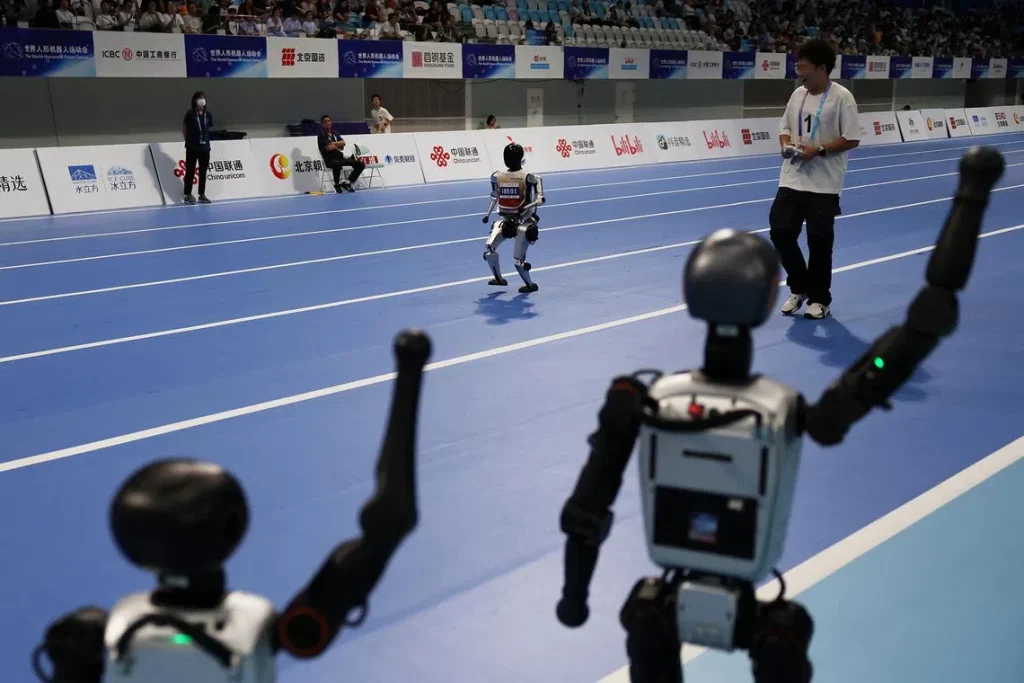
- Recent competitions feature robots achieving sprints exceeding 3 m/s and performing complex jumps or obstacle navigation.
- Innovations in lightweight materials and torque-optimized actuators contribute to these achievements.
6.2 Precision Tasks
- Fine manipulation events test object handling, stacking, and assembly.
- Robots exhibit millimeter-level accuracy, combining tactile feedback and vision-based guidance.
6.3 Team-Based Challenges
- Robot soccer and relay events require dynamic decision-making and teamwork, simulating real-world coordination challenges.
- Multi-agent AI algorithms demonstrate emergent cooperative behavior.
7. Global Participation and Trends
- Teams from Asia, Europe, and North America dominate technologically advanced entries, while emerging countries showcase innovative, cost-effective solutions.
- Competitions now include multi-category events, such as:
- Humanoid athletics
- Obstacle courses
- Collaborative robotics games
- Cognitive challenges like object recognition and problem-solving
- A clear trend is integration of AI learning capabilities, allowing robots to adapt to opponents, terrain, and environmental dynamics.
8. Challenges in Competitive Robotics
8.1 Hardware Reliability
- Extended competition duration tests joint endurance, actuator lifespan, and sensor robustness.
8.2 Software Complexity
- Integrating vision, motion planning, AI reasoning, and multi-agent coordination in real time remains a challenge.
8.3 Standardization
- Diverse robot designs make fair scoring, safety compliance, and rule enforcement critical.
- International collaboration aims to create unified protocols for evaluation and interoperability.
9. Case Study: 2025 Global Humanoid Robot Sports Games
- Hosted in Beijing, the event attracted over 500 humanoid robots from 200+ teams worldwide.
- Key highlights:
- Speed challenge: Fastest robot achieved a sprint of 3.5 m/s.
- Obstacle agility course: Robots navigated uneven terrain with dynamic balancing algorithms.
- Team-based robotics soccer: AI-enabled strategies allowed coordinated passing, defense, and goal-scoring.
- Judges highlighted AI adaptability, energy efficiency, and multi-task coordination as key differentiators among top performers.
10. The Future of Humanoid Robot Sports
10.1 Integration with AI Research
- Competitions will serve as testbeds for advanced AI, reinforcement learning, and cognitive architectures.
- Robots may learn from each competition, creating a global database of behaviors and strategies.
10.2 Real-World Applications
- Algorithms and hardware optimized for competitions can be applied to:
- Industrial robotics for logistics and assembly
- Healthcare assistance with mobility and task flexibility
- Search and rescue operations in dynamic or hazardous environments
10.3 International Collaboration
- Competitions foster cross-border collaboration and standardization, accelerating innovation and adoption.
- Open-source frameworks and shared learning platforms enhance global robotics capabilities.
10.4 Human-Robot Interaction in Sports
- Advanced humanoid competitions will explore cooperative sports with humans, testing safety, coordination, and real-time decision-making.
- This will push the envelope for social robotics and assistive applications.
11. Conclusion
The momentum of the Global Humanoid Robot Sports Games underscores a new era in robotics: one where robots are not merely laboratory curiosities, but dynamic, autonomous, and adaptive entities.