









Introduction
For decades, robotic systems have been designed around localized intelligence and isolated control loops. Robotic arms manipulated objects while remaining fixed in space; mobile robots navigated environments without sophisticated manipulation; humanoid robots often treated locomotion, perception, and manipulation as separate engineering problems. This modular approach enabled early successes but fundamentally constrained robots’ ability to operate in complex, dynamic, and unstructured real-world environments.
A new paradigm is now emerging: whole-body robot learning combined with advanced physical adaptation capabilities. Rather than controlling individual components in isolation, next-generation robots learn and act using their entire body as an integrated system. They coordinate perception, cognition, motion, balance, force, and interaction simultaneously, much like biological organisms do.
Whole-body learning allows robots to understand how their physical structure, sensory inputs, and motor actions interact with the environment. Physical adaptation enables robots to modify their behavior—and in some cases their morphology—in response to changes, uncertainty, and unexpected disturbances. Together, these capabilities form the foundation of embodied intelligence, marking a critical step toward truly autonomous, versatile, and resilient robotic systems.
This article explores the principles, technologies, applications, benefits, and challenges of whole-body robot learning and physical adaptation, and examines how this paradigm will shape the future of robotics.
1. From Component-Level Control to Whole-Body Intelligence
1.1 Limitations of Traditional Robotic Control
Traditional robotic systems rely on hierarchical and compartmentalized control structures:
- Locomotion, manipulation, and perception are designed separately
- Motion planning assumes fixed dynamics and known environments
- Adaptation is limited to parameter tuning or predefined modes
Such systems perform well in controlled settings but struggle when:
- The environment is unpredictable
- Tasks require coordination of multiple body parts
- Physical interaction is continuous and complex
Human and animal intelligence, by contrast, is inherently whole-body. Balance, movement, touch, and decision-making are deeply interconnected.
1.2 The Shift Toward Whole-Body Learning
Whole-body robot learning treats the robot as a single, integrated physical agent. Instead of prescribing how each joint or limb should behave, learning algorithms optimize behavior at the system level, allowing coordination to emerge naturally.
This shift enables robots to:
- Use their entire body to achieve goals
- Exploit physical dynamics rather than fighting them
- Adapt motion strategies to changing conditions
2. Defining Whole-Body Robot Learning
2.1 What Is Whole-Body Learning?
Whole-body robot learning refers to learning frameworks in which:
- The robot’s entire body is included in the learning loop
- Control policies span multiple joints, limbs, and sensors
- Learning objectives reflect global task performance rather than local metrics
This approach contrasts with isolated learning modules and encourages holistic optimization.
2.2 Embodiment and Intelligence
Embodied intelligence emphasizes that cognition emerges from the interaction between:
- A physical body
- Sensory perception
- Motor capabilities
- The surrounding environment
Whole-body learning embraces embodiment by allowing robots to discover how their physical form can be used effectively, rather than relying solely on abstract models.
3. Physical Adaptation in Robotics
3.1 Understanding Physical Adaptation
Physical adaptation refers to a robot’s ability to adjust its behavior in response to:
- Changes in terrain or environment
- External forces and disturbances
- Wear, damage, or degradation
- Variability in tasks and objects
Adaptation may occur at multiple timescales, from rapid reflex-like responses to long-term learning.
3.2 Types of Physical Adaptation
Robots may adapt through:
- Control adaptation: adjusting force, impedance, or motion strategies
- Behavioral adaptation: selecting alternative movement patterns
- Learning-based adaptation: updating policies through experience
- Morphological adaptation: reconfiguring physical structures (in advanced systems)
Together, these forms of adaptation enhance robustness and resilience.
4. Core Technologies Enabling Whole-Body Learning
4.1 Reinforcement Learning at Scale
Reinforcement learning (RL) plays a central role in whole-body robot learning. By optimizing reward functions that capture task success, stability, and efficiency, RL enables robots to:
- Learn coordinated whole-body behaviors
- Handle high-dimensional control spaces
- Discover novel movement strategies
Recent advances in scalable RL and simulation have made whole-body learning practical.
4.2 Simulation and Sim-to-Real Transfer
Training whole-body behaviors directly in the real world is costly and risky. High-fidelity simulation allows robots to:
- Explore millions of interactions safely
- Experience diverse physical conditions
- Learn robust control policies
Techniques such as domain randomization help transfer learned behaviors from simulation to physical robots.
4.3 Multimodal Sensing and State Estimation
Whole-body learning depends on rich sensory feedback, including:
- Vision and depth perception
- Force and torque sensing
- Proprioception and inertial measurements
- Tactile and contact sensing
Sensor fusion and state estimation integrate these signals into coherent representations of body and environment.
4.4 Model-Based and Hybrid Approaches
Purely data-driven learning can be inefficient. Hybrid approaches combine:
- Physical models of dynamics
- Learning-based adaptation and optimization
This combination improves sample efficiency and stability while preserving flexibility.
5. Whole-Body Control and Coordination
5.1 Balance and Locomotion
Whole-body learning enables robots to:
- Maintain balance under disturbances
- Adapt gait to uneven or changing terrain
- Coordinate upper and lower body motion
Humanoid robots, in particular, benefit from whole-body coordination to achieve stable and natural movement.
5.2 Manipulation with the Entire Body
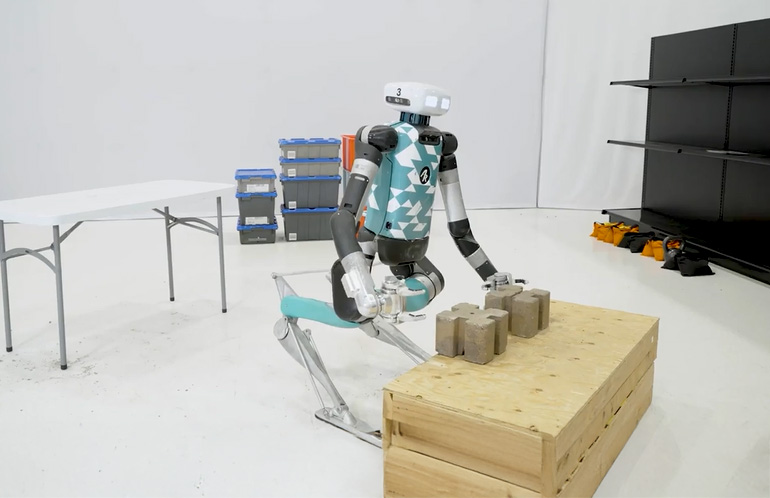
Humans often use their whole body to manipulate objects—leaning, bracing, pushing, or repositioning. Robots with whole-body learning can:
- Use legs, torso, and arms together
- Exploit contact with the environment
- Perform heavy or awkward manipulation tasks
This dramatically expands manipulation capabilities.
5.3 Contact-Rich Interaction
Whole-body control allows robots to manage multiple contact points simultaneously, a requirement for:
- Climbing
- Crawling
- Cooperative manipulation
- Operating in confined spaces
6. Applications Across Industries
6.1 Humanoid and General-Purpose Robots
Whole-body learning is essential for humanoid robots designed to:
- Navigate human environments
- Perform diverse tasks
- Interact naturally with objects and people
Such robots must coordinate locomotion, manipulation, and perception seamlessly.
6.2 Industrial and Warehouse Robotics
In industrial settings, whole-body adaptation enables robots to:
- Handle irregular or heavy objects
- Operate in flexible layouts
- Recover from collisions or disruptions
This increases safety and productivity.
6.3 Construction and Infrastructure
Robots working on construction sites must adapt to:
- Uneven terrain
- Dynamic environments
- Physical variability in materials
Whole-body learning supports stable operation in these challenging contexts.
6.4 Healthcare and Assistive Robotics
Assistive robots require:
- Safe physical interaction with humans
- Adaptive movement based on patient needs
- Whole-body balance and compliance
Physical adaptation is critical for trust and effectiveness.
6.5 Exploration and Disaster Response
In disaster zones or extraterrestrial environments, robots encounter unpredictable conditions. Whole-body adaptation enables:
- Traversal of debris and rough terrain
- Recovery from falls or damage
- Autonomous problem-solving under uncertainty
7. Advantages of Whole-Body Learning and Adaptation
7.1 Robustness and Resilience
Whole-body learning allows robots to maintain functionality despite disturbances, damage, or uncertainty.
7.2 Generalization Across Tasks
Rather than learning narrowly defined behaviors, robots acquire adaptable skills applicable to a wide range of tasks.
7.3 Efficiency and Natural Motion
By exploiting physical dynamics, robots move more efficiently and smoothly, reducing energy consumption and wear.
7.4 Reduced Engineering Complexity
Learning-based coordination reduces the need for manually designed controllers for every scenario.
8. Challenges and Open Problems
8.1 High-Dimensional Learning
Whole-body systems involve many degrees of freedom, making learning complex and computationally intensive.
8.2 Safety During Learning
Exploration can lead to unsafe behaviors. Ensuring safety while learning remains a critical concern.
8.3 Sim-to-Real Gaps
Despite advances, transferring learned behaviors from simulation to reality is still imperfect.
8.4 Interpretability and Control
Understanding and verifying learned whole-body behaviors is more difficult than analyzing traditional controllers.
9. Case Studies
9.1 Humanoid Locomotion Learning
Humanoid robots trained with whole-body reinforcement learning demonstrate robust walking, running, and recovery from pushes across varied terrain.
9.2 Adaptive Manipulation Systems
Robots using whole-body strategies can reposition themselves dynamically to manipulate large or awkward objects more effectively.
9.3 Quadruped Robots
Quadruped robots employ whole-body learning to adapt gaits and posture, enabling stable locomotion over rocks, stairs, and slopes.
10. The Future of Whole-Body Robot Intelligence
10.1 Toward Lifelong Learning
Future robots will continuously refine whole-body behaviors throughout their operational lifetime.
10.2 Integration with Cognitive Planning
Whole-body learning will integrate with high-level planning, enabling robots to reason about how to use their bodies to achieve goals.
10.3 Morphological Adaptation
Advances in soft robotics and modular design may allow robots to physically reconfigure themselves in response to tasks.
10.4 Ethical and Societal Implications
As robots become more capable and autonomous, questions of safety, responsibility, and human–robot coexistence become increasingly important.
Conclusion
Whole-body robot learning and physical adaptation capabilities represent a transformative step in the evolution of robotics. By treating the robot as an integrated, embodied system rather than a collection of independent components, this paradigm enables machines to move, interact, and adapt in ways that more closely resemble biological organisms.
Through advances in learning algorithms, sensing, simulation, and control, robots are gaining the ability to exploit their physical structure, respond intelligently to uncertainty, and operate robustly in real-world environments. While significant challenges remain, the trajectory is clear: the future of robotics lies in embodied, adaptive, whole-body intelligence.
As these capabilities mature, robots will transition from specialized tools to versatile, resilient partners capable of working alongside humans in complex and dynamic settings. Whole-body learning is not merely an incremental improvement—it is a foundational shift that redefines what robots can be.