









Introduction: Why Robots Need a New Kind of Brain
As robotics enters a new era defined by autonomy, embodiment, and intelligence, the concept of a robot “brain” has shifted dramatically. Early robots relied on deterministic control logic and isolated controllers. Modern robots, by contrast, must see, understand, decide, and act in complex, dynamic, and human-centered environments. They must process massive volumes of sensor data, run sophisticated AI models in real time, and coordinate perception, planning, and control with millisecond-level precision—all while operating under strict power and thermal constraints.
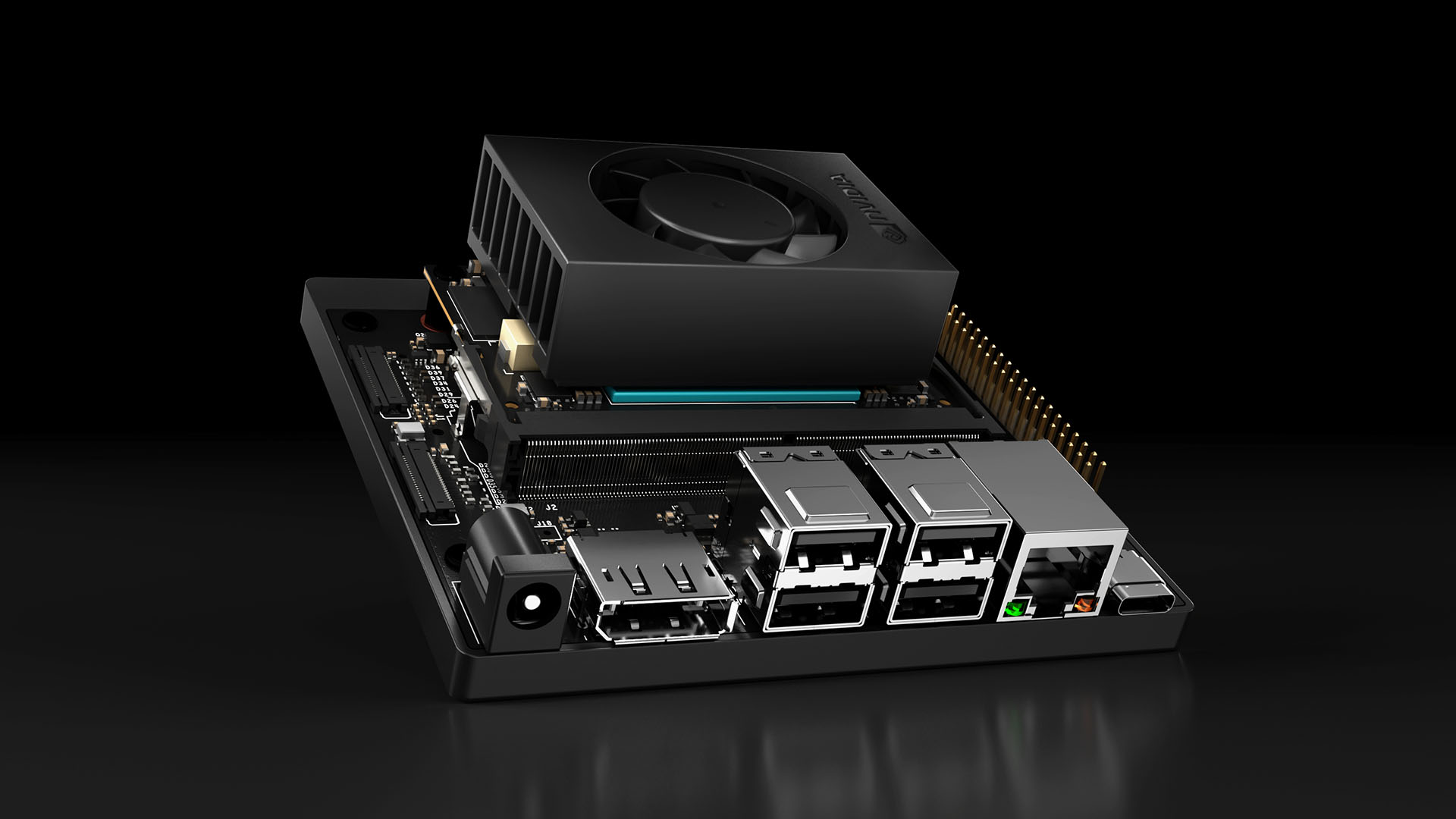
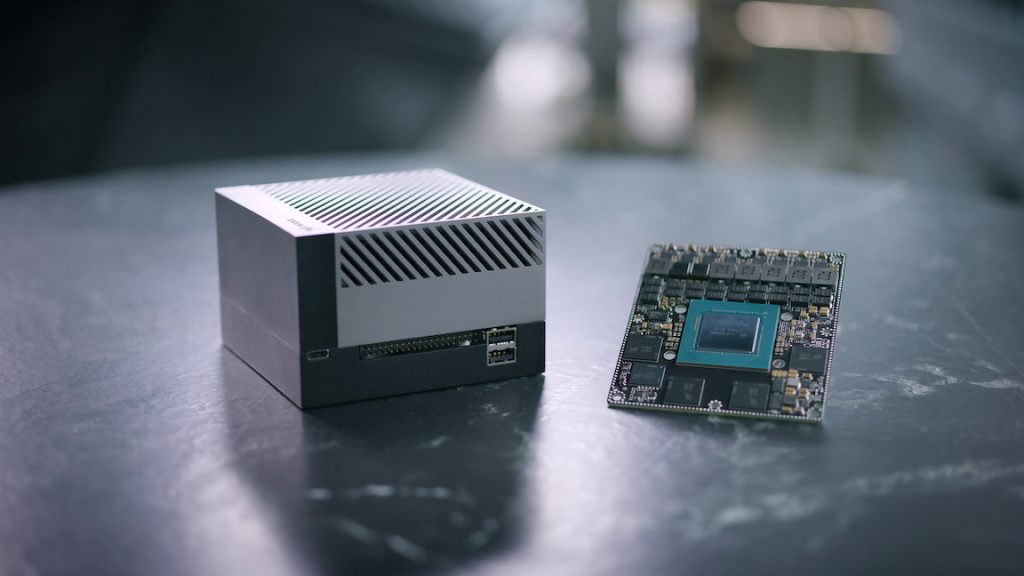
In this context, the Nvidia Jetson Thor series represents a pivotal technological development. Designed as a high-end edge AI computing platform specifically for advanced robotics, Jetson Thor is widely regarded as a next-generation robotic “brain.” It brings together unprecedented AI performance, real-time processing capability, and a mature software ecosystem in a compact, energy-efficient form factor suitable for humanoid robots, autonomous mobile robots, and intelligent industrial systems.
This article provides an in-depth, professional, and structured exploration of the Jetson Thor series. It examines its technological foundations, architectural philosophy, software ecosystem, application domains, and broader significance for the future of robotics. Rather than focusing solely on specifications, the discussion emphasizes system-level impact, positioning Jetson Thor as a cornerstone of embodied artificial intelligence.
1. From Controllers to Cognition: The Evolution of Robotic Computing
1.1 Traditional Robotic “Brains”
For much of industrial history, robotic intelligence was narrowly defined. Industrial robots operated using:
- Programmable logic controllers (PLCs)
- Fixed motion trajectories
- Predefined rule-based logic
These systems were extremely reliable but fundamentally limited. They lacked perception, adaptation, and learning. Any deviation from expected conditions required human intervention or reprogramming.
1.2 The Shift Toward Intelligent, Autonomous Robots
With advances in artificial intelligence and sensing, robots began to move beyond rigid automation. Capabilities such as:
- Computer vision
- Sensor fusion
- Machine learning
- Probabilistic planning
transformed robots into systems capable of operating in partially unstructured environments. This shift, however, created a massive computational burden that traditional embedded controllers could not handle.
1.3 Why Edge AI Is Essential
Robots operate in the physical world, where latency, reliability, and safety are critical. Cloud-based intelligence alone is insufficient due to:
- Network latency and instability
- Bandwidth limitations
- Privacy and security concerns
As a result, robots require local, high-performance AI computing at the edge. Jetson Thor is designed precisely to meet this requirement, enabling robots to think and react in real time without dependence on remote infrastructure.
2. Positioning the Jetson Thor Series
2.1 Nvidia’s Vision for Robotic Intelligence
The Jetson Thor series reflects Nvidia’s broader vision of robotics as embodied AI systems—machines that integrate perception, cognition, and action. Rather than treating AI as an add-on, Nvidia positions Jetson Thor as the central nervous system of the robot.
This platform is aimed at high-end use cases where performance, flexibility, and scalability are essential, including:
- Humanoid robots
- Autonomous mobile robots (AMRs)
- Advanced collaborative robots
- Research platforms for embodied intelligence
2.2 A Platform-Level Approach
Jetson Thor is not merely a processor. It is a platform, combining:
- A powerful system-on-chip architecture
- High-bandwidth memory and I/O
- A comprehensive AI and robotics software stack
- Deep integration with simulation and development tools
This approach reduces fragmentation and allows robotics developers to focus on behavior, intelligence, and application logic rather than low-level integration challenges.
3. Architectural Foundations of Jetson Thor
3.1 CPU Complex: Deterministic Control Meets High Performance
The CPU subsystem in Jetson Thor is designed to handle:
- Real-time operating system tasks
- Control loops for motion and manipulation
- Coordination between AI inference and actuation
It balances general-purpose performance with predictability, ensuring that time-critical tasks are executed reliably—an essential requirement for safety-critical robotic applications.
3.2 GPU and AI Accelerators: The Heart of Perception and Reasoning
The defining strength of Jetson Thor lies in its AI computing capabilities. Built on Nvidia’s advanced GPU architecture and dedicated AI accelerators, the platform delivers massive parallel processing for:
- Deep neural network inference
- Vision and perception pipelines
- Transformer-based and multimodal models
This computational power allows robots to process high-resolution visual data, 3D point clouds, and multimodal sensor inputs in real time, forming a rich and continuously updated understanding of their environment.
3.3 Memory Architecture: Feeding Large-Scale Models
Modern robotic AI models are data-hungry. Jetson Thor addresses this through:
- High-bandwidth memory systems
- Low-latency data paths between compute units
- Support for large model footprints
This ensures that performance scales with model complexity, enabling more sophisticated perception and reasoning without bottlenecks.
3.4 I/O and Sensor Connectivity
A robot’s intelligence is only as good as its sensors. Jetson Thor supports extensive connectivity for:
- Multiple high-resolution cameras
- LiDAR and radar sensors
- IMUs and force-torque sensors
- Motor controllers and industrial fieldbuses
This makes Jetson Thor suitable as a centralized computing hub, capable of integrating and synchronizing diverse data streams.
4. Software Ecosystem: Turning Hardware into Intelligence
4.1 JetPack SDK and Linux Foundation
Jetson Thor is supported by Nvidia JetPack, a robust software development kit built on Linux. JetPack includes:
- Optimized drivers and firmware
- CUDA for parallel computing
- TensorRT for high-performance AI inference
- Multimedia, vision, and sensor libraries
This software foundation ensures consistency, performance, and long-term support.
4.2 AI Model Optimization and Deployment
Jetson Thor is designed to run state-of-the-art AI models efficiently at the edge. Through optimization tools, developers can:
- Convert trained models into optimized inference engines
- Balance accuracy, latency, and power consumption
- Deploy models with predictable real-time performance
This capability is crucial for robots operating in safety-critical environments.
4.3 Robotics Middleware and ROS Integration
Modern robotics development relies heavily on middleware such as ROS and ROS 2. Jetson Thor integrates seamlessly with these frameworks, enabling:
- Modular and scalable software architectures
- Distributed processing across robot subsystems
- Rapid prototyping and experimentation
This compatibility accelerates development and lowers the barrier to entry for advanced robotics.
5. Jetson Thor as a Robotic “Brain”
5.1 Perception: Understanding the Physical World
Perception is the foundation of robotic intelligence. Jetson Thor enables robots to:
- Detect and classify objects and humans
- Track motion and predict trajectories
- Build 3D maps and semantic representations
By processing sensory data locally, robots achieve low-latency responses essential for interaction and safety.
5.2 Planning and Decision-Making
Beyond perception, robots must decide how to act. Jetson Thor supports advanced planning algorithms, including:
- Motion planning in dynamic environments
- Task-level reasoning and sequencing
- Human-aware navigation and interaction
This computational headroom allows robots to consider multiple hypotheses and adapt behavior in real time.
5.3 Control and Embodied Intelligence
High-level intelligence must translate into precise physical action. Jetson Thor coordinates with control systems to ensure:
- Smooth, stable locomotion
- Accurate manipulation
- Rapid response to disturbances
This tight integration between AI and control is particularly important for humanoid robots, where balance and coordination are critical.
6. Application Domains
6.1 Humanoid Robots
Humanoid robots represent one of the most demanding use cases in robotics. They require:
- Full-body coordination
- Multimodal perception
- Real-time balance and locomotion
Jetson Thor’s performance and integration capabilities make it a natural choice as the central brain for humanoid platforms.
6.2 Autonomous Mobile Robots
In logistics, warehousing, and service applications, AMRs depend on robust autonomy. Jetson Thor supports:
- SLAM and localization
- Obstacle detection and avoidance
- Multi-robot coordination
Its energy efficiency enables long operational lifetimes on battery-powered systems.
6.3 Industrial and Collaborative Robots
In advanced manufacturing, robots must adapt to changing tasks and collaborate safely with humans. Jetson Thor enables:
- Vision-guided manipulation
- Adaptive quality inspection
- Real-time safety monitoring
This flexibility is key to the next generation of smart factories.
6.4 Research and Embodied AI Development
For research institutions, Jetson Thor provides a powerful platform for studying:
- Reinforcement learning in the physical world
- Human–robot interaction
- General-purpose embodied intelligence
Its compatibility with simulation tools facilitates rapid iteration from virtual to real environments.
7. Power Efficiency, Thermal Design, and Reliability
7.1 Performance per Watt
Robots operate under strict power constraints. Jetson Thor emphasizes:
- High performance per watt
- Dynamic power scaling
- Workload-specific acceleration
This balance enables sophisticated AI without compromising mobility or endurance.
7.2 Thermal Management in Compact Robots
High-end computing generates heat. Jetson Thor supports:
- Configurable thermal profiles
- Passive and active cooling solutions
- Stable operation across temperature ranges
These features enhance reliability in real-world deployments.
8. Strategic Importance in Nvidia’s Robotics Ecosystem
8.1 Integration with Simulation and Digital Twins
Jetson Thor is part of a broader ecosystem that includes simulation and digital twin technologies. This integration enables:
- Training AI models in virtual environments
- Validating behaviors before deployment
- Continuous improvement through data feedback
Such workflows significantly reduce development risk and cost.
8.2 The AI Computing Continuum
Jetson Thor fits into a unified AI computing continuum that spans:
- Cloud-based training
- Data center inference
- Edge deployment
This continuity simplifies lifecycle management of robotic intelligence, from development to deployment.
9. Challenges and Considerations
9.1 Cost and Complexity
As a high-end platform, Jetson Thor represents a significant investment. However, its ability to consolidate multiple computing functions into a single system can reduce overall system complexity and cost.
9.2 Skills and Ecosystem Dependency
Leveraging Jetson Thor effectively requires expertise in AI, systems engineering, and robotics software. Continued investment in developer education and tooling is essential to unlock its full potential.
10. The Future of Robotic Brains
10.1 Toward General-Purpose Robots
Jetson Thor points toward a future where robots are no longer task-specific machines, but adaptable systems capable of learning new skills and operating across domains.
10.2 Collective Intelligence and Robot Fleets
As robots become networked, Jetson Thor-enabled systems can share knowledge, enabling fleet-level intelligence and continuous improvement.
Conclusion: Jetson Thor as the Cognitive Core of Advanced Robotics
The Nvidia Jetson Thor series represents a defining step in the evolution of robotic intelligence. By delivering exceptional AI performance, robust real-time capabilities, and a comprehensive software ecosystem in an embedded platform, Jetson Thor truly functions as the “brain” of high-end robots.
More than a technological achievement, Jetson Thor embodies a shift in how robots are conceived—no longer as rigid machines, but as intelligent, adaptive agents embedded in the physical world. As robotics continues to reshape industry, research, and society, platforms like Jetson Thor will play a central role in determining what robots can perceive, understand, and ultimately become.