








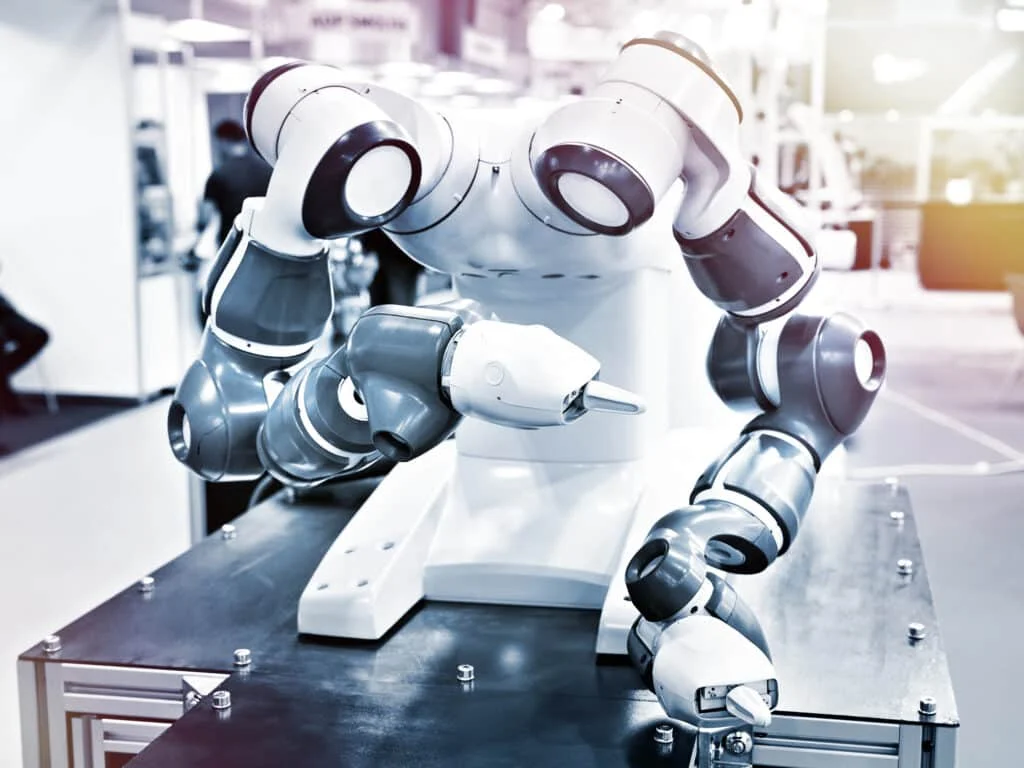

Introduction: The Rise of Edge AI in Robotics
Robotics has entered a transformative era where artificial intelligence is no longer confined to the cloud. Traditionally, robots relied on remote servers for heavy computation, from perception and motion planning to decision-making. While effective in controlled environments, cloud-based AI faces limitations: latency, bandwidth constraints, network reliability, and privacy concerns.
The advent of edge AI inference has shifted this paradigm. By embedding powerful AI processors directly into robots, these machines can run complex neural networks locally, enabling real-time perception, decision-making, and autonomous behavior. Edge AI empowers robots to operate efficiently in dynamic environments, collaborate safely with humans, and adapt to unforeseen scenarios without dependence on constant cloud connectivity.
This article explores the technological foundations, architectural innovations, practical applications, and future potential of edge AI in robotics. It details how edge AI inference transforms capabilities across perception, motion planning, multi-robot coordination, and autonomous decision-making.
1. Edge AI: Definition and Importance
1.1 What Is Edge AI?
Edge AI refers to the deployment of artificial intelligence models directly on local devices—in this case, robotic platforms—rather than relying on cloud servers. Key characteristics include:
- Low latency: Immediate response to environmental stimuli
- Reduced bandwidth usage: Minimizes continuous data transmission
- Enhanced privacy and security: Sensitive data remains on-device
- Operational independence: Robots can function even with intermittent connectivity
1.2 Why Edge AI Matters for Robotics
Robots often operate in dynamic, unpredictable environments. Cloud-based processing introduces delays that may compromise safety and performance. Edge AI addresses these challenges by enabling:
- Real-time motion adaptation
- On-board perception and scene understanding
- Autonomous navigation in unstructured or remote areas
- Continuous learning and adaptation without cloud dependency
2. Hardware Foundations of Edge AI in Robotics
2.1 AI Accelerators
Modern edge AI relies on specialized hardware for high-performance neural network inference:
- GPU-based platforms: Nvidia Jetson series, AMD Radeon embedded solutions
- AI ASICs and NPUs: Dedicated chips optimized for neural network operations
- FPGA solutions: Configurable hardware for low-latency AI computation
These accelerators allow robots to process large models for perception, planning, and control in real time.
2.2 Memory and Bandwidth Considerations
Edge AI inference requires efficient memory hierarchies:
- High-bandwidth, low-latency memory for intermediate neural network data
- Local storage for pre-trained models and learned policies
- Techniques like model quantization and pruning to reduce memory footprint
Optimizing memory access ensures robots can run deep convolutional, transformer, and recurrent models without performance degradation.
2.3 Power Efficiency
Robots, especially mobile platforms, face power constraints. Edge AI designs incorporate:
- Energy-efficient processing cores
- Dynamic voltage and frequency scaling
- Hardware accelerators optimized for low-power AI inference
These innovations extend operational runtime while supporting complex models.
3. Software and Architectural Innovations
3.1 Model Optimization for Edge Inference
Running complex AI models on robots requires optimization techniques, including:
- Quantization: Reducing precision of weights and activations to decrease computation
- Pruning: Removing redundant network connections to reduce model size
- Knowledge Distillation: Training smaller models to replicate larger models’ performance
Such techniques enable robots to run state-of-the-art neural networks for perception, motion planning, and decision-making.
3.2 Middleware for Edge AI Robotics
Robotics middleware such as ROS 2, integrated with edge AI frameworks, supports:
- Real-time communication between sensors, actuators, and AI modules
- Efficient scheduling of inference tasks alongside control loops
- Seamless integration of multi-modal sensor data for perception and planning
This software layer ensures edge AI capabilities are fully utilized in robotic applications.
3.3 Real-Time Inference Pipelines
Edge AI enables low-latency inference pipelines, including:
- Vision: Object detection, tracking, semantic segmentation
- Auditory processing: Speech recognition, environmental sound detection
- Multimodal fusion: Combining visual, tactile, and proprioceptive data for robust decision-making
These pipelines are critical for autonomous operation and human-robot collaboration.
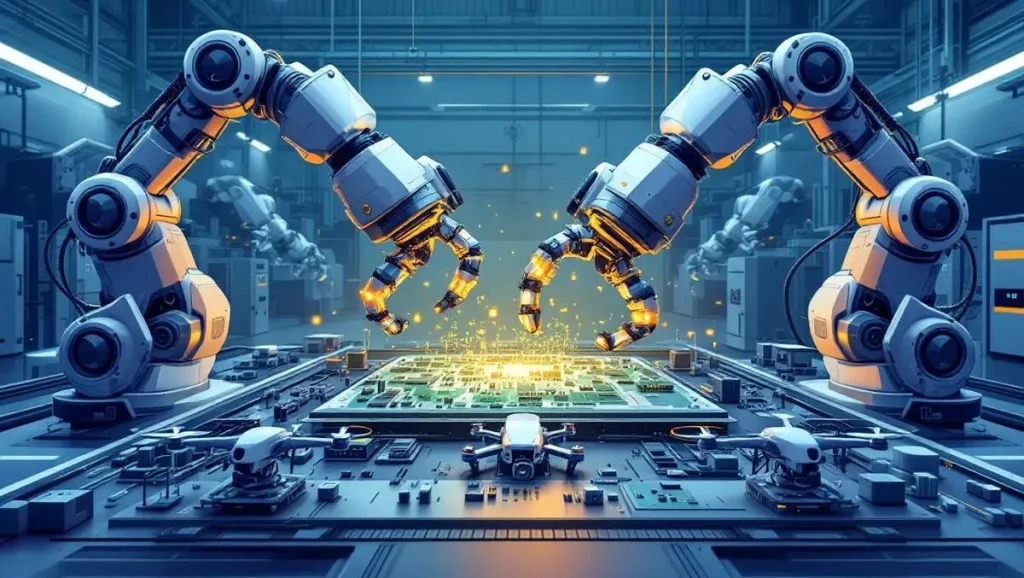
4. Applications of Edge AI in Robotics
4.1 Autonomous Navigation
Edge AI allows robots to:
- Perceive dynamic obstacles and humans in real time
- Generate collision-free trajectories without cloud dependency
- Adapt to environmental changes instantly
Autonomous delivery robots, warehouse automation platforms, and field robots benefit from edge-based path planning and obstacle avoidance.
4.2 Dexterous Manipulation
Robots performing complex manipulation rely on:
- Vision-guided grasping using real-time object recognition
- Tactile feedback interpretation for adaptive grip
- Reinforcement learning models running locally for task adaptation
Edge AI enables human-like dexterity and adaptive manipulation in industrial and service contexts.
4.3 Human-Robot Collaboration
Robots working alongside humans require:
- Real-time tracking of human motion
- Prediction of human intent using AI models
- Adaptive response to avoid collisions and optimize workflows
Edge inference ensures instantaneous reaction to human movements, enhancing safety and productivity.
4.4 Multi-Robot Coordination
- Local AI allows each robot to compute paths and task allocation independently
- Peer-to-peer communication shares insights without central cloud dependency
- Real-time coordination enables swarm robotics and collaborative operations
Edge AI reduces communication bottlenecks and ensures robust multi-agent cooperation.
5. Advantages of Edge AI Over Cloud-Centric AI
| Aspect | Edge AI | Cloud AI |
|---|---|---|
| Latency | Milliseconds | Tens to hundreds of milliseconds |
| Bandwidth | Minimal | High |
| Reliability | Autonomous operation | Network-dependent |
| Privacy | On-device data | Sensitive data transmitted |
| Real-time adaptation | Immediate | Limited by network |
These advantages make edge AI indispensable for real-world robotics, especially in safety-critical and latency-sensitive applications.
6. Technical Challenges
6.1 Computational Load
- Running complex models locally requires high-performance processors
- Trade-offs between model complexity and power consumption must be balanced
6.2 Model Deployment and Updates
- Updating models in distributed robots presents challenges in consistency and synchronization
- Incremental learning and federated learning approaches address these issues
6.3 Hardware-Software Co-Design
- Edge AI requires tight integration of hardware, software, and algorithms
- Poor co-design can lead to latency spikes, overheating, or suboptimal inference
6.4 Safety and Reliability
- On-board AI must operate reliably under diverse conditions
- Fail-safes, redundancy, and watchdog systems are critical for safe autonomous operation
7. Case Studies
7.1 Industrial Automation
- Robotic arms running deep CNNs for visual inspection and quality control
- On-device inference allows real-time defect detection without cloud delays
7.2 Autonomous Delivery Robots
- Edge AI enables dynamic route planning and human detection in crowded urban environments
- Local inference ensures timely reaction to unpredictable obstacles
7.3 Service Robotics
- Hotel or retail robots use edge AI for speech recognition, object tracking, and human interaction
- Immediate response improves user experience and operational safety
7.4 Field Robotics
- Agricultural robots analyze plant health using real-time visual AI models
- Edge inference reduces data transmission needs in remote areas without reliable network coverage
8. Future Directions
8.1 Integration with 5G and Edge-Cloud Hybrid Systems
- Edge AI can be complemented by cloud resources for model training and global coordination
- 5G connectivity allows low-latency offloading when needed while maintaining autonomous edge operation
8.2 Advanced Model Architectures
- Lightweight transformers and graph neural networks optimized for on-device inference
- AI models capable of lifelong learning and adaptation in real-world environments
8.3 Energy-Efficient Edge AI
- Neuromorphic computing and specialized AI accelerators reduce energy consumption
- Power-efficient designs support extended operation of mobile robots
8.4 Safety-Aware AI Inference
- Real-time risk assessment and motion planning integrated with edge AI
- Ensures human-robot collaboration is safe and compliant with industrial standards
9. Strategic Implications
9.1 Market Growth
- Edge AI expands opportunities for autonomous industrial, service, and field robots
- Encourages investment in hardware accelerators, AI software platforms, and sensor technologies
9.2 Competitive Advantage
- Companies deploying edge AI robots gain real-time autonomy, adaptability, and efficiency
- Edge AI differentiates solutions from slower, cloud-reliant alternatives
9.3 Innovation Ecosystem
- Development of edge AI stimulates hardware-software co-design, sensor fusion techniques, and autonomous algorithms
- Drives collaboration between robotics firms, AI developers, and industrial partners
10. Conclusion
Powerful edge AI inference is revolutionizing robotics. By enabling on-device processing of complex models, robots can perceive, reason, and act autonomously in dynamic environments. The benefits include:
- Low-latency decision-making
- Enhanced autonomy and reliability
- Safe and adaptive human-robot collaboration
- Efficient operation in remote or constrained environments
Edge AI bridges the gap between high-performance artificial intelligence and real-world robotic capabilities, marking a pivotal shift from cloud dependency to truly autonomous, intelligent machines. As hardware, software, and algorithmic innovations continue to advance, robots equipped with edge AI will become smarter, faster, and more capable than ever before, redefining what it means to operate autonomously in complex physical spaces.