








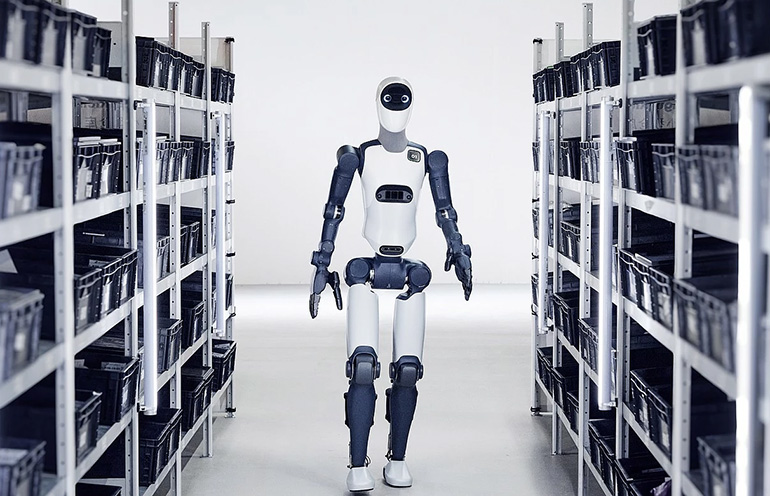

Introduction: The Rise of Humanoid Robotics
Humanoid robots—machines designed with a bipedal or human-like form—are transitioning from research prototypes and demonstration platforms into practical industrial, logistics, and service applications. Unlike traditional robotic arms or wheeled mobile robots, humanoid robots combine mobility, dexterity, perception, and cognitive capabilities, enabling them to navigate complex, unstructured environments designed for humans.
The increasing capabilities of humanoid robots are driven by advances in actuation, sensors, artificial intelligence, and human-robot collaboration frameworks. As industries and service sectors seek flexibility, efficiency, and adaptability, humanoid robots are positioned to fill roles that previously required human labor—particularly in environments unsuitable for conventional automation.
This article explores the technological foundations, application scenarios, operational advantages, challenges, and future potential of humanoid robots in industrial, warehousing, and service settings. It provides a detailed analysis of how humanoid robotics is reshaping operational efficiency, workforce collaboration, and customer experience.
1. Technological Foundations of Humanoid Robotics
1.1 Actuation and Mobility
Humanoid robots require sophisticated actuation systems to replicate human-like movement:
- Bipedal locomotion: Enables navigation in environments with stairs, ramps, and uneven surfaces
- Joint and tendon mechanisms: Provide dexterity for grasping and manipulation
- Balance and stabilization: Gyroscopes, IMUs, and force sensors allow robots to maintain stability during dynamic tasks
1.2 Perception Systems
To operate safely and efficiently in human environments, humanoid robots rely on advanced perception technologies:
- Visual perception: RGB, depth, and stereo cameras for object recognition and environment mapping
- LiDAR and sonar: Precise distance measurement for obstacle avoidance and navigation
- Tactile and force sensors: Enable fine manipulation and human-safe interaction
- Auditory perception: Speech recognition and sound localization for human communication
1.3 Artificial Intelligence Integration
AI is central to humanoid functionality:
- Computer vision and scene understanding: Identify objects, humans, and spatial constraints
- Motion planning and control: Compute dynamic trajectories for locomotion and manipulation
- Decision-making and task scheduling: Optimize workflows and adapt to changing environments
- Learning algorithms: Enable skill acquisition and continual improvement over time
2. Industrial Applications
2.1 Flexible Assembly
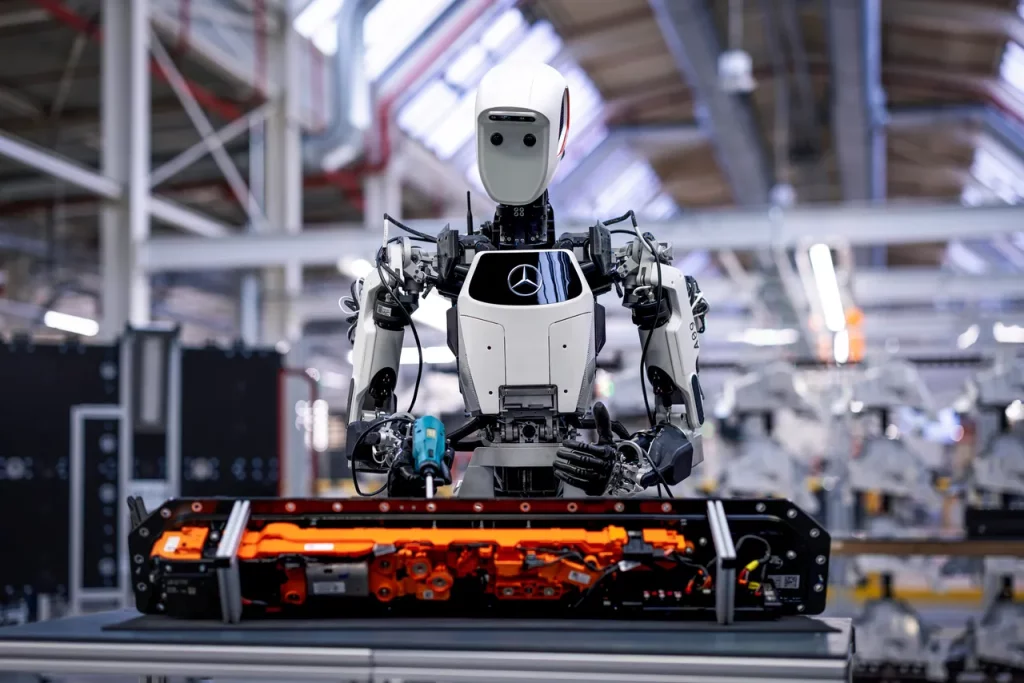
- Humanoid robots can handle assembly tasks requiring dexterity, such as screwing, welding, or inserting components in non-standard orientations
- Unlike robotic arms, humanoids can navigate cluttered spaces, adjust to human workflows, and operate alongside humans without extensive reprogramming
2.2 Quality Inspection
- Equipped with cameras and AI, humanoid robots can perform visual inspection, detecting defects in manufactured goods
- Their human-like height and reach allow inspection at multiple levels on assembly lines or in warehouses
2.3 Safety and Hazardous Tasks
- Humanoids can operate in hazardous or ergonomically challenging environments, such as chemical plants or high-temperature zones
- By performing high-risk tasks, robots reduce workplace injuries and allow human workers to focus on higher-level decision-making
3. Warehousing and Logistics Applications
3.1 Picking and Packing
- Humanoid robots with dexterous hands can pick and sort products from shelves designed for human access
- AI-driven perception allows recognition of irregularly shaped items and adaptation to varying package orientations
3.2 Navigation in Dynamic Environments
- Unlike wheeled robots restricted to flat paths, humanoids navigate stairs, ramps, narrow aisles, and cluttered spaces
- This flexibility enables deployment in legacy warehouses without extensive infrastructure modification
3.3 Collaborative Fleet Operations
- Humanoids can work alongside automated guided vehicles (AGVs) and other robotic fleets, performing complementary tasks
- Edge AI and multi-robot coordination frameworks ensure efficient workflow optimization
4. Service Applications
4.1 Customer Interaction
- Humanoid robots can greet, guide, and assist customers in retail, hospitality, and public service environments
- Speech recognition, natural language processing, and facial recognition allow personalized, context-aware interactions
4.2 Delivery and Assistance
- Robots can transport goods, meals, or supplies within hospitals, hotels, or offices
- Human-like mobility allows them to traverse stairs, elevators, and congested hallways safely
4.3 Education and Entertainment
- Humanoids serve as educational assistants, teaching STEM concepts or providing interactive learning experiences
- In entertainment, they can perform choreography, storytelling, or live interaction in theme parks and public spaces
5. Advantages of Humanoid Robots
| Advantage | Description |
|---|---|
| Flexibility | Operate in spaces designed for humans without structural modification |
| Dexterity | Grasp and manipulate diverse objects with human-like hands |
| Collaboration | Work safely alongside humans with adaptive motion control |
| Mobility | Traverse stairs, ramps, and uneven surfaces |
| Perception | Integrate multimodal sensors for robust environmental understanding |
These advantages allow humanoids to bridge the gap between traditional automation and full human-robot symbiosis, making them ideal for multi-purpose tasks across industries.
6. Technical Challenges
6.1 Locomotion and Balance
- Maintaining stable bipedal movement on uneven surfaces or during dynamic interactions remains computationally intensive
- Algorithms must adapt in real time to disturbances, payload variations, and environmental unpredictability
6.2 Manipulation in Unstructured Environments
- Dexterous manipulation requires fine motor control, tactile feedback, and AI-driven perception
- Tasks involving irregular or delicate objects challenge both control and sensing systems
6.3 Human-Robot Interaction
- Ensuring safe collaboration with humans involves predicting human motion, avoiding collisions, and respecting personal space
- Natural communication through gestures, speech, and eye contact is computationally demanding
6.4 Energy Efficiency
- Bipedal locomotion and dexterous manipulation consume significant power
- Battery technology and energy-efficient actuators are critical to extending operational time
7. Enabling Technologies for Expanded Roles
7.1 Edge AI and On-Board Processing
- On-device AI enables real-time decision-making and perception, critical for dynamic industrial and service environments
- Reduces latency and dependency on cloud connectivity, enhancing reliability
7.2 Advanced Actuation Systems
- Series elastic actuators, tendon-driven mechanisms, and soft robotics technologies improve movement fidelity and safety
- Allow precise force control for delicate tasks and human-safe interactions
7.3 Multi-Modal Sensor Fusion
- Combining vision, LiDAR, tactile, and auditory data enhances environmental understanding and task adaptability
- Enables robots to navigate dynamic spaces and adapt to unstructured human environments
7.4 Collaborative Control Frameworks
- Human-in-the-loop systems allow operators to supervise, correct, or guide robot behavior
- Reinforcement learning and imitation learning enable skill acquisition from human demonstration
8. Case Studies
8.1 Industrial Assembly Humanoids
- A Japanese electronics manufacturer deployed humanoids to assist in assembly tasks alongside human workers, reducing repetitive strain and improving efficiency
- The robots handle parts manipulation, tool operation, and visual inspection, while humans supervise and perform strategic tasks
8.2 Warehouse Deployment
- Humanoids in e-commerce warehouses pick, sort, and transport products
- Their mobility allows operation in spaces with stairs and narrow shelves, complementing wheeled AGVs and drones
8.3 Service and Hospitality Robots
- Hotels in Asia have deployed humanoids for check-in, room service delivery, and guest interaction
- AI-powered perception and speech recognition enable adaptive and personalized service experiences
9. Future Prospects
9.1 Enhanced Autonomy
- Humanoids will leverage edge AI and cloud-edge hybrid systems to perform more autonomous, complex tasks
- Advanced planning and perception allow operation in entirely unstructured environments
9.2 Expanded Industry Applications
- Healthcare: Patient care, rehabilitation assistance
- Retail: Personalized guidance, stock management
- Construction: Inspection, material transport, and safety monitoring
9.3 Human-Robot Collaboration
- Integration of humanoids as team members rather than tools
- Shared learning and adaptive behavior will enable fluid, human-centric workflows
9.4 Social Integration
- Humanoids may serve as companions, educators, and assistants, bridging social and operational roles
- Ethical design, safety standards, and human-robot interaction protocols will be critical
10. Conclusion
Humanoid robots are transitioning from novelty and research platforms to practical operational tools across industrial, warehousing, and service sectors. By combining mobility, dexterity, perception, and intelligence, they offer unique advantages over traditional automation:
- Flexibility to operate in human-oriented spaces
- Ability to manipulate diverse objects and tools
- Safe and collaborative integration with human teams
Challenges remain in energy efficiency, locomotion, manipulation, and human-robot interaction, but advances in AI, edge computing, sensor fusion, and actuation continue to accelerate progress.
As humanoid robots become more capable, industries and societies will increasingly rely on them for complex, unstructured, and dynamic tasks, driving productivity, safety, and innovation in ways previously unimaginable.
The era of humanoid robotics is not a distant vision—it is emerging today, poised to reshape the industrial, warehousing, and service landscapes of the near future.