








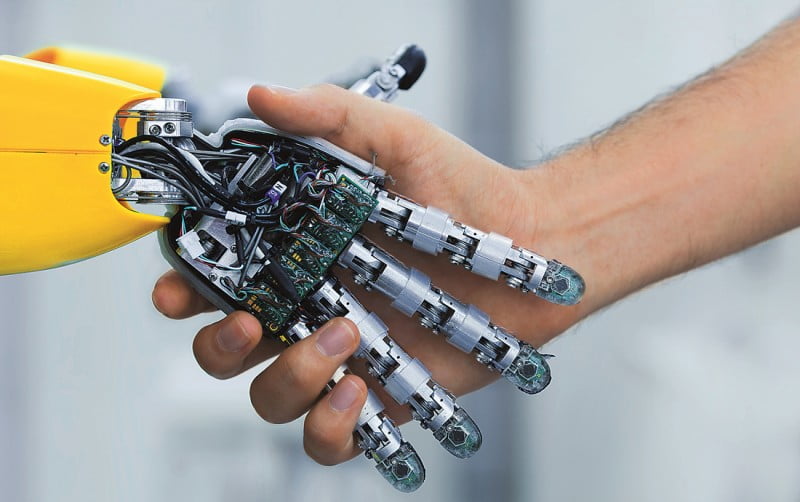

Introduction: The Rise of Collaborative Robotics
Collaborative robots, commonly known as cobots, are redefining industrial, logistics, and service environments by working alongside humans rather than in isolation. Unlike traditional industrial robots that operate in cages for safety, cobots are designed to interact directly with human operators, enabling higher flexibility, efficiency, and adaptive automation.
This shift introduces unique challenges and opportunities in human-robot coexistence. Ensuring safety without sacrificing productivity requires the integration of advanced sensing, control, and AI-based decision-making, combined with industry standards and ergonomic considerations.
This article explores the technical, regulatory, and practical aspects of human-robot safety coexistence in collaborative robotics, drawing on case studies, best practices, and emerging trends.
1. Fundamentals of Human-Robot Collaboration
1.1 Definition of Collaborative Robotics
- Cobots are robots specifically designed to work safely alongside humans, enabling:
- Shared workspaces
- Flexible task handovers
- Augmented human capabilities in repetitive or physically demanding tasks
1.2 Distinction from Traditional Industrial Robots
| Feature | Traditional Robots | Collaborative Robots |
|---|---|---|
| Workspace | Isolated, caged | Shared with humans |
| Interaction | Minimal | Direct physical or task-level collaboration |
| Safety Measures | Emergency stops, physical barriers | Force limitation, sensors, AI-based monitoring |
| Flexibility | Low | High adaptability to changing tasks |
2. Core Safety Principles
2.1 Risk Assessment and Standards
- ISO 10218 (Industrial Robots) and ISO/TS 15066 (Collaborative Robots) provide guidelines for:
- Force and speed limits in shared workspaces
- Safety-rated monitored stops
- Human injury thresholds
- Risk assessment involves:
- Task analysis
- Workspace evaluation
- Probabilistic hazard assessment
2.2 Safety Measures
- Physical Safety
- Rounded edges, padded surfaces, and lightweight actuators reduce injury risks.
- Speed and Force Limitation
- Cobots limit maximum joint torque and end-effector speed based on human biomechanical tolerance.
- Protective Stops
- Emergency stop buttons and monitored stop routines halt robot motion instantly when unsafe conditions are detected.
- Workspace Segmentation
- Combining shared and restricted zones ensures safe task allocation between humans and robots.

3. Sensor Technologies for Safety
3.1 Vision-Based Monitoring
- Cameras and depth sensors detect human presence, posture, and motion trajectories.
- Applications include:
- Predictive collision avoidance
- Task handoff detection
- Workspace monitoring for compliance
3.2 Force-Torque Sensing
- Detects abnormal contact forces between robot and human or object.
- Enables compliant behavior, where the robot yields when encountering resistance.
3.3 Proximity and LIDAR Sensors
- Provide 360-degree awareness in shared workspaces.
- Allow real-time adjustment of robot speed or path to maintain safety distances.
3.4 Multi-Sensor Fusion
- Combines IMU, vision, LIDAR, and tactile data for robust safety monitoring.
- Improves accuracy in dynamic environments where human motion is unpredictable.
4. Control Strategies for Safe Interaction
4.1 Impedance and Admittance Control
- Impedance control modulates robot force response to external interaction, e.g., when a human pushes a manipulator.
- Admittance control maps applied forces to motion, allowing smooth, compliant operation.
4.2 Predictive and AI-Based Motion Planning
- Real-time motion prediction algorithms anticipate human trajectories to prevent collisions.
- AI decision-making ensures:
- Dynamic speed adjustment
- Collision avoidance
- Task sequencing with minimal human interference
4.3 Reinforcement Learning for Adaptive Safety
- Cobots can learn optimal interaction policies through simulations or controlled environments.
- RL allows robots to adapt to new human operators and workflows while maintaining safety margins.
5. Collaborative Applications
5.1 Industrial Manufacturing
- Cobots assist humans in:
- Assembly operations
- Material handling
- Quality inspection
- Benefits include:
- Reduced ergonomic strain
- Increased production flexibility
- Faster integration of new products
5.2 Logistics and Warehousing
- Collaborative mobile robots work alongside human operators to:
- Transport goods
- Pick and place items
- Optimize inventory workflows
- Safety is ensured through geofencing, proximity sensors, and AI collision prediction.
5.3 Healthcare and Service Industries
- Cobots assist in patient handling, disinfection, or medication delivery.
- Interaction safety is critical due to human vulnerability and regulatory constraints.
6. Standards and Regulatory Framework
6.1 ISO/TS 15066
- Establishes:
- Maximum allowable force thresholds for human contact
- Guidelines for robot speed, power, and workspace allocation
- Introduces four modes of collaborative operation:
- Safety-rated monitored stop
- Hand guiding
- Speed and separation monitoring
- Power and force limiting
6.2 National and Regional Guidelines
- OSHA (USA), EU Machinery Directive, and China’s GB/T 37961 provide complementary rules.
- Compliance is mandatory for industrial deployment and insurance purposes.
7. Human Factors and Ergonomics
7.1 Cognitive Load and Trust
- Cobots must minimize cognitive strain on operators.
- Transparent robot behavior and predictable motion increase trust and efficiency.
7.2 Training and Simulation
- Operators benefit from VR/AR simulations for task rehearsal.
- Training ensures correct interaction with cobots, reducing incidents.
7.3 Workplace Integration
- Shared workspaces require dynamic task allocation to prevent bottlenecks or collisions.
- Ergonomic positioning of cobots improves both safety and productivity.
8. Case Studies
8.1 Universal Robots in Automotive Assembly
- Collaborative arms work alongside assembly line operators.
- Force-limited joints and vision sensors prevent collisions.
- Increased production flexibility and reduced repetitive strain injuries.
8.2 KUKA LBR iiwa in Electronics Manufacturing
- Lightweight, 7-DoF arms perform delicate assembly tasks.
- Compliant control ensures safe human interaction during frequent handovers.
8.3 Mobile Cobots in E-Commerce Logistics
- AMRs (Autonomous Mobile Robots) navigate crowded warehouses.
- AI-based motion planning and LIDAR safety sensors prevent collisions with staff.
9. Challenges and Future Directions
9.1 Balancing Productivity and Safety
- Higher safety often reduces speed or payload capacity.
- Ongoing research focuses on adaptive risk assessment to dynamically optimize productivity without compromising safety.
9.2 Multi-Human Environments
- Coexistence with multiple humans increases complexity of motion prediction and collision avoidance.
- Advanced AI models and sensor fusion are required for crowded collaborative workspaces.
9.3 Standards Evolution
- Rapid adoption of cobots necessitates continuous updates to safety regulations.
- Predictive metrics and data-driven certification may supplement traditional static thresholds.
9.4 AI-Augmented Safety
- Real-time AI models anticipate human behavior and optimize robot response.
- Edge AI allows onboard processing of sensor data, reducing latency and improving safety.
10. Conclusion
Collaborative robots represent a paradigm shift in industrial and service automation, enabling human-robot coexistence without physical separation. Key takeaways:
- Safety is multi-layered: combining standards, sensors, control strategies, and human factors.
- Advanced perception and AI enhance predictive safety and adaptability.
- Ergonomics and trust are critical to successful integration in human-centric environments.
- Hybrid approaches, combining compliance, predictive control, and AI learning, offer the best balance of safety and productivity.
By adhering to established standards, leveraging cutting-edge sensor and control technologies, and prioritizing human-centric design, collaborative robots can safely and effectively coexist with humans, unlocking new levels of operational efficiency and workplace innovation.