








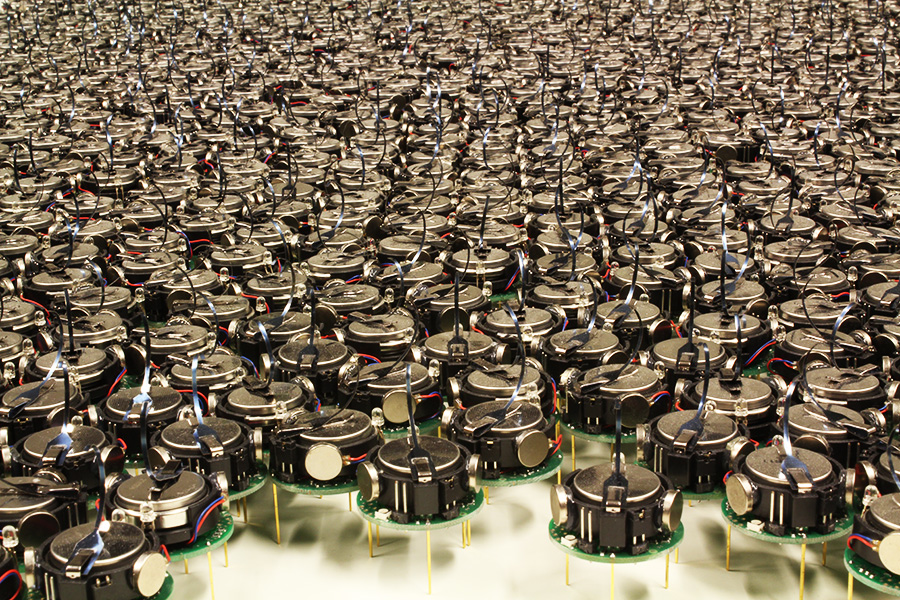

Introduction: From Individual Intelligence to Collective Power
For decades, robotics research and industrial development focused on building increasingly complex, highly capable individual robots. These systems were designed to sense more accurately, reason more deeply, and act more dexterously—often at significant cost and engineering complexity. However, a parallel and increasingly influential paradigm has emerged: large numbers of simple robots collaborating to complete tasks that exceed the capability of any single robot.
This concept—often referred to as swarm robotics, collective robotics, or distributed robotic systems—draws inspiration from nature. Ant colonies, bee swarms, bird flocks, and fish schools demonstrate how simple agents, governed by local rules and limited intelligence, can collectively exhibit sophisticated, adaptive, and robust behavior. Translating this principle into robotics has profound implications for scalability, resilience, cost-efficiency, and real-world deployment.
This article provides an in-depth, knowledge-driven analysis of how many simple robots can collaboratively accomplish complex tasks, examining the theoretical foundations, coordination algorithms, system architectures, communication mechanisms, and real-world applications, as well as the challenges and future directions of this paradigm.
1. Conceptual Foundations of Collective Robotics
1.1 Defining “Simple Robots”
In this context, a simple robot typically exhibits:
- Limited sensing capabilities (e.g., proximity sensors, low-resolution cameras)
- Modest computational power
- Restricted actuation (e.g., basic locomotion, simple grippers)
- Minimal or no global knowledge of the environment
Individually, such robots are incapable of complex reasoning or sophisticated manipulation. Their power emerges not from individual intelligence, but from coordination, redundancy, and scale.
1.2 What Makes a Task “Complex”?
A complex task is characterized by:
- Large spatial or temporal scale
- Dynamic and uncertain environments
- Multiple subtasks requiring coordination
- Nonlinear dependencies between actions
Examples include large-area exploration, warehouse fulfillment, environmental monitoring, disaster response, and collective construction.
1.3 Emergence as a Core Principle
At the heart of collective robotics lies emergent behavior—global patterns and capabilities that arise from local interactions between robots and their environment.
Key properties of emergence:
- No central controller
- Local decision-making
- Simple interaction rules
- Global order arising spontaneously
This principle fundamentally differentiates swarm systems from traditional centralized robotic control.
2. Biological Inspiration and Theoretical Models
2.1 Lessons from Natural Swarms
Biological systems offer rich analogies:
- Ant colonies: Distributed foraging, path optimization via pheromones
- Bees: Task allocation and decision-making through quorum sensing
- Bird flocks: Collision avoidance and coordinated movement using local alignment rules
These systems demonstrate how robustness, adaptability, and scalability can be achieved without centralized intelligence.
2.2 Mathematical and Computational Models
Several models underpin collective robotic behavior:
- Boids Model: Governs flocking behavior using separation, alignment, and cohesion rules
- Cellular Automata: Discrete local interactions leading to global patterns
- Graph Theory: Robots as nodes, communication links as edges
- Dynamical Systems: Stability and convergence of collective motion
These models provide formal tools to analyze convergence, stability, and performance bounds of multi-robot systems.
3. System Architecture of Multi-Robot Collaboration
3.1 Centralized vs. Decentralized Architectures
Centralized Systems:
- A global controller assigns tasks and trajectories
- Easier to optimize globally
- Poor scalability and single-point failure risk
Decentralized Systems:
- Each robot operates autonomously using local information
- High robustness and scalability
- Requires sophisticated coordination algorithms
Most swarm systems favor decentralized or hybrid architectures to balance performance and resilience.
3.2 Local Sensing and Perception
Instead of global maps, simple robots rely on:
- Proximity sensing
- Local vision or depth estimation
- Neighbor detection
- Environmental cues
Collectively, these local perceptions form a distributed understanding of the environment.
3.3 Communication Mechanisms
Communication ranges from implicit to explicit:
- Implicit communication: Environmental modification (e.g., virtual pheromones, stigmergy)
- Explicit communication: Short-range wireless messages, broadcast signals
Designing communication protocols requires balancing bandwidth, latency, energy consumption, and fault tolerance.
4. Coordination Algorithms and Mechanisms
4.1 Task Allocation
Efficient division of labor is essential. Common approaches include:
- Market-based algorithms: Robots bid for tasks based on cost or availability
- Behavior-based allocation: Task selection driven by local stimuli and internal states
- Threshold models: Robots activate tasks when environmental signals exceed thresholds
These methods allow dynamic and adaptive task distribution without centralized control.
4.2 Collective Motion and Formation Control
Maintaining coordinated movement requires:
- Local collision avoidance
- Velocity alignment with neighbors
- Formation maintenance (lines, grids, clusters)
Algorithms such as consensus protocols, virtual force fields, and distributed control laws enable stable group motion.
4.3 Consensus and Decision-Making
Swarm systems often need to agree on shared decisions, such as route selection or target prioritization.
Techniques include:
- Majority voting
- Distributed averaging
- Quorum-based decision rules
These mechanisms ensure global coherence from local interactions.
4.4 Learning in Multi-Robot Systems
Learning enhances adaptability:
- Reinforcement learning: Robots adapt policies based on local rewards
- Multi-agent learning: Agents learn cooperative strategies
- Federated learning: Models updated collectively without centralized data pooling
Learning enables swarms to improve performance over time in changing environments.
5. Achieving Complex Tasks Through Collective Behavior
5.1 Exploration and Mapping
Large robot swarms can explore unknown environments efficiently:
- Parallel coverage reduces exploration time
- Redundancy increases robustness to failures
- Local mapping merged into global representations
Applications include planetary exploration, search-and-rescue, and environmental monitoring.
5.2 Collective Transport and Manipulation
Simple robots can cooperatively move large or heavy objects:
- Distributed force application
- Adaptive role assignment (push, pull, stabilize)
- Real-time adjustment to object dynamics
This enables capabilities far beyond individual robot strength.
5.3 Construction and Assembly
Swarm construction relies on:
- Local placement rules
- Environmental cues guiding structure growth
- Error tolerance through redundancy
Examples include modular structure assembly and self-organizing architectures.
5.4 Logistics and Fulfillment
In warehouses, large fleets of simple robots:
- Retrieve and transport goods
- Optimize traffic flow through local rules
- Dynamically reassign tasks based on demand
Collectively, they achieve high throughput and fault-tolerant operation.
6. Performance, Cost, and Scalability Advantages
6.1 Cost Efficiency
- Simple robots are cheaper to manufacture and maintain
- System cost scales linearly rather than exponentially
- Failures are tolerated without catastrophic system loss
6.2 Scalability
- Adding robots increases capacity without redesign
- Decentralized control avoids bottlenecks
- Suitable for large-scale deployments
6.3 Robustness and Fault Tolerance
- No single point of failure
- Redundant agents compensate for losses
- Graceful degradation under adverse conditions
These properties make swarm systems ideal for harsh, dynamic, or uncertain environments.
7. Engineering Challenges and Constraints
7.1 Coordination Complexity
- Emergent behavior is difficult to predict and verify
- Ensuring convergence and stability is non-trivial
7.2 Communication Limitations
- Bandwidth constraints increase with swarm size
- Latency and packet loss affect coordination
7.3 Debugging and Verification
- Failures emerge at system level, not individual robot level
- Traditional debugging tools are insufficient
7.4 Safety and Human Interaction
- Large robot groups must ensure collision-free interaction with humans
- Requires reliable local sensing and conservative safety policies
8. Real-World Case Studies
8.1 Warehouse Robot Fleets
E-commerce warehouses deploy thousands of simple mobile robots:
- Each robot performs basic navigation and lifting
- Central planning is minimal; local rules dominate
- Overall system achieves high efficiency and resilience
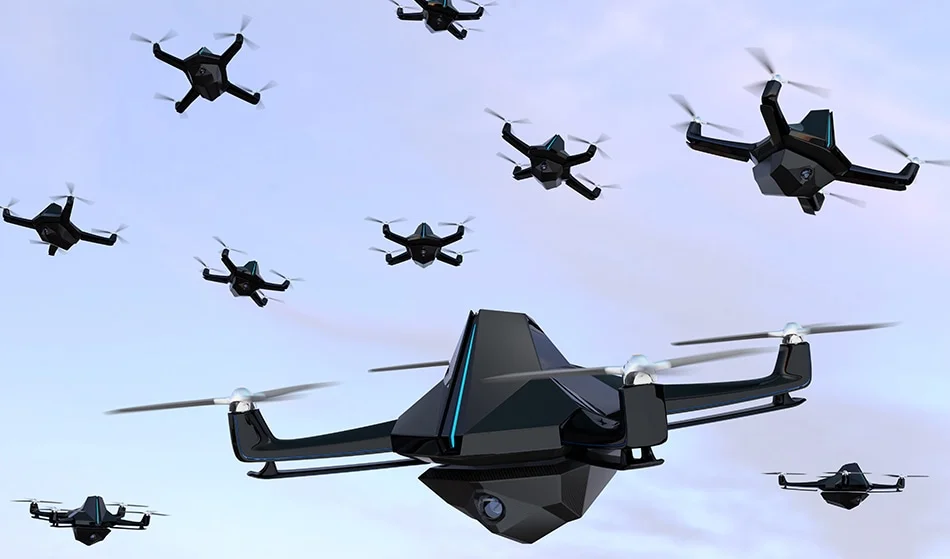
8.2 Drone Swarms
Drone swarms demonstrate:
- Coordinated flight and formation control
- Distributed sensing and surveillance
- Rapid coverage of large areas
These systems are used in agriculture, disaster response, and infrastructure inspection.
8.3 Environmental Monitoring
Swarm robots monitor:
- Oceans and rivers
- Forests and wildlife habitats
- Agricultural fields
Large numbers of inexpensive robots provide dense, continuous data collection.
9. Future Directions of Collective Robotics
9.1 Increased Autonomy Through Edge AI
Embedding edge AI in simple robots allows:
- More sophisticated local decision-making
- Reduced communication dependence
- Enhanced adaptability
9.2 Hybrid Centralized–Decentralized Systems
Combining:
- Global objectives from cloud systems
- Local autonomy at robot level
This hybrid approach balances efficiency and robustness.
9.3 Human-Swarm Collaboration
Future systems will allow humans to:
- Guide swarm behavior at high level
- Intervene safely when needed
- Collaborate intuitively with large robot groups
9.4 Standardization and Interoperability
Open standards will enable:
- Heterogeneous swarms
- Plug-and-play robot integration
- Cross-vendor collaboration
10. Conclusion
As robotics continues to move into real-world, open-ended environments, collective intelligence and swarm-based approaches will become increasingly central, redefining how complex tasks are achieved—not by one powerful robot, but by many simple ones working together.