









Abstract
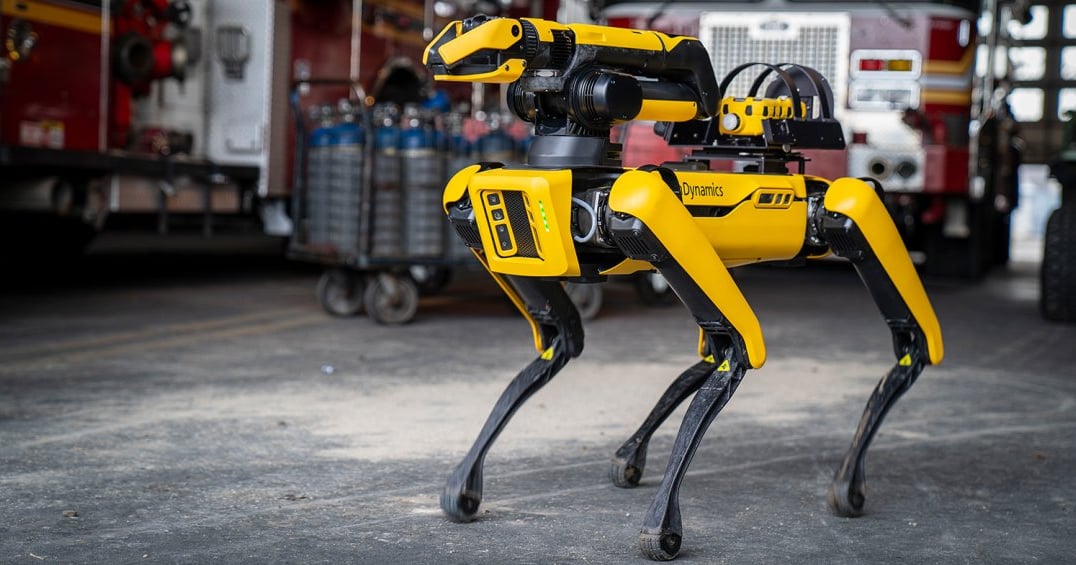
Robots are increasingly expected to operate beyond controlled laboratory or factory settings and enter complex, dynamic, and uncertain real-world environments. These environments—characterized by moving obstacles, unpredictable human behavior, changing terrain, incomplete information, and evolving task goals—pose significant challenges to robotic perception, decision-making, and control. As a result, robot adaptability has emerged as a core research focus in modern robotics.
This article provides an in-depth and professional examination of research case studies focused on robot adaptability in complex dynamic scenarios. It analyzes representative examples from industrial, service, mobile, and humanoid robotics, highlighting how advances in perception, learning, planning, and control enable robots to cope with uncertainty and change. By synthesizing theoretical foundations, system architectures, and real-world deployment experiences, this article offers a comprehensive perspective on how adaptability is being achieved, evaluated, and scaled in contemporary robotic systems.
1. Introduction
Robotic systems were historically designed for environments that were structured, predictable, and static. Early industrial robots performed pre-programmed motions in fenced workcells, isolated from human activity and environmental variability. While this paradigm enabled remarkable gains in productivity, it limited robots’ applicability to a narrow range of tasks.
In contrast, modern deployment scenarios increasingly demand robots that can function in complex dynamic environments. These environments are defined by:
- Continuous changes in spatial configuration
- Interaction with humans and other agents
- Uncertainty in perception and action outcomes
- Non-deterministic task requirements
Examples include autonomous vehicles navigating urban streets, service robots operating in crowded public spaces, mobile manipulators in warehouses, and humanoid robots working alongside humans.
The ability of robots to adapt—to sense changes, interpret them correctly, and modify behavior accordingly—is therefore a decisive factor in their real-world viability. Research on adaptability bridges robotics, artificial intelligence, control theory, and cognitive science, making it one of the most interdisciplinary areas of the field.
2. Defining Adaptability in Complex Dynamic Scenarios
2.1 What Is Robot Adaptability?
Robot adaptability refers to the capacity of a robotic system to modify its perception, decision-making, and actions in response to changes in the environment, task, or internal state. Adaptability includes:
- Reactive adaptation: immediate responses to unexpected events
- Contextual adaptation: adjusting behavior based on situational understanding
- Learning-based adaptation: improving performance over time through experience
In dynamic environments, adaptability is not optional—it is a prerequisite for safety, robustness, and effectiveness.
2.2 Characteristics of Complex Dynamic Environments
Complex dynamic environments exhibit several defining features:
- Partial observability and sensor noise
- Multiple interacting agents with independent intentions
- Time-varying constraints and objectives
- High-dimensional state and action spaces
These characteristics make classical rule-based or static control approaches insufficient.
3. Core Technologies Enabling Adaptability
3.1 Multimodal Perception Systems
Adaptability begins with perception. Robots operating in dynamic environments rely on:
- Vision systems for object and motion recognition
- LiDAR and depth sensors for spatial mapping
- Tactile and force sensors for contact awareness
Sensor fusion combines these inputs to produce robust, real-time environmental representations.
3.2 Real-Time State Estimation
Dynamic environments demand accurate and timely state estimation. Research emphasizes probabilistic methods that account for uncertainty, enabling robots to make informed decisions even with incomplete data.
3.3 Adaptive Planning and Control
Adaptable robots integrate planning and control tightly, allowing plans to be updated continuously as conditions change. This blurs the traditional separation between deliberation and execution.
3.4 Learning-Based Adaptation
Machine learning—particularly reinforcement learning and imitation learning—plays a crucial role in enabling robots to acquire adaptive behaviors that are difficult to hand-code.
4. Case Study Category I: Mobile Robots in Dynamic Navigation Environments
4.1 Autonomous Navigation in Crowded Spaces
One prominent research area focuses on mobile robots navigating among humans in crowded environments such as airports, shopping malls, and hospitals. These scenarios require robots to:
- Predict human motion
- Avoid collisions while maintaining efficiency
- Respect social norms and personal space
Research systems integrate perception, trajectory prediction, and adaptive motion planning to respond dynamically to human behavior.
4.2 Adaptive Obstacle Avoidance
Traditional obstacle avoidance treats obstacles as static. In dynamic environments, obstacles move unpredictably. Research case studies demonstrate robots using real-time sensing and predictive models to adjust speed and direction seamlessly.
4.3 Learning Socially Aware Navigation
Some research projects employ learning-based approaches to model human preferences and social conventions, enabling robots to adapt navigation behavior to different cultural or situational contexts.
5. Case Study Category II: Industrial Robots in Dynamic Production Settings
5.1 Adaptive Assembly in Variable Conditions
Modern manufacturing increasingly involves small batch sizes and product variation. Research case studies show industrial robots equipped with vision and force sensing adapting assembly strategies to variations in part position, orientation, and tolerance.
5.2 Human–Robot Collaboration on the Factory Floor
In collaborative workcells, robots must adapt to human motion and intent in real time. Research demonstrates adaptive safety strategies, where robots modulate speed, force, and trajectory based on human proximity and behavior.
5.3 Dynamic Task Replanning
When disruptions occur—such as missing parts or tool changes—adaptive robots can replan tasks autonomously, reducing downtime and increasing system resilience.
6. Case Study Category III: Service Robots in Unstructured Public Environments
6.1 Cleaning and Maintenance Robots
Service robots deployed in large facilities must adapt to changing layouts, moving people, and variable cleanliness conditions. Research highlights adaptive coverage planning and environment mapping as key enablers.
6.2 Delivery Robots in Indoor and Outdoor Settings
Autonomous delivery robots encounter dynamic obstacles, weather changes, and navigation uncertainties. Adaptive control and perception allow them to reroute, pause, or request assistance when necessary.
6.3 Interaction-Driven Adaptation
Service robots must adjust interaction strategies based on user behavior, language, and responsiveness. Research shows how adaptive dialogue systems and behavior selection improve user acceptance.
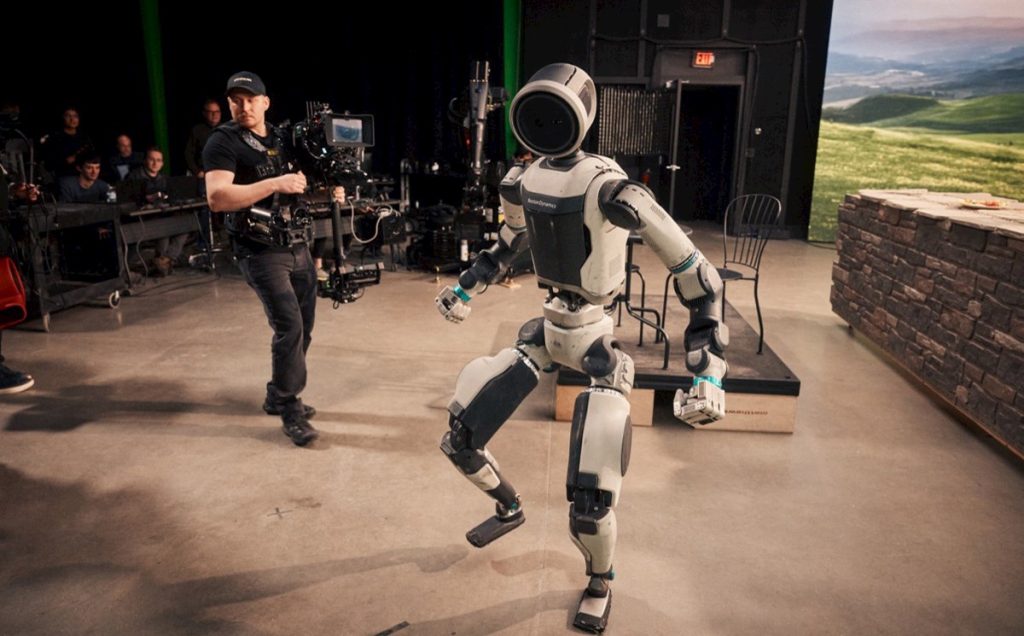
7. Case Study Category IV: Humanoid Robots in Dynamic Human-Centered Environments
7.1 Balance and Locomotion Adaptation
Humanoid robots represent some of the most challenging dynamic systems. Research case studies demonstrate adaptive balance control enabling robots to recover from pushes, uneven terrain, and unexpected loads.
7.2 Whole-Body Adaptation During Manipulation
Humanoid robots performing tasks such as carrying objects or opening doors must adapt whole-body posture and force distribution dynamically to maintain stability.
7.3 Learning Dynamic Skills
Learning-based approaches allow humanoid robots to acquire adaptive locomotion and manipulation skills through simulation and real-world experience.
8. Case Study Category V: Autonomous Vehicles and Field Robots
8.1 Urban Autonomous Systems
Autonomous vehicles operate in highly dynamic environments with traffic participants, road conditions, and regulatory constraints. Research emphasizes adaptive perception and decision-making to handle rare and unexpected scenarios.
8.2 Agricultural and Field Robots
Field robots must adapt to unstructured terrain, weather, and biological variability. Research case studies show adaptive sensing and control enabling robots to operate across seasons and crop conditions.
9. Adaptive Learning Frameworks in Dynamic Scenarios
9.1 Reinforcement Learning Under Uncertainty
Reinforcement learning enables robots to discover adaptive strategies through interaction. Research focuses on improving sample efficiency and safety in dynamic environments.
9.2 Online and Lifelong Learning
Rather than training once and deploying, adaptive robots continue learning during operation, refining models and behaviors over time.
9.3 Hybrid Model-Based and Learning-Based Approaches
Combining physical models with learning enhances robustness and interpretability, making adaptation more reliable.
10. Evaluation of Adaptability in Research Case Studies
10.1 Performance Metrics
Adaptability is evaluated using metrics such as:
- Task success rate under varying conditions
- Recovery time after disturbances
- Robustness to sensor noise and uncertainty
10.2 Generalization and Transfer
A key research goal is enabling robots to generalize adaptive behaviors across tasks and environments without extensive retraining.
10.3 Real-World Validation
Case studies emphasize the importance of real-world testing, as simulation alone cannot capture all aspects of dynamic complexity.
11. Challenges Highlighted by Case Studies
Despite progress, research case studies reveal persistent challenges:
- Limited robustness to rare or extreme events
- High computational demands for real-time adaptation
- Difficulty in ensuring safety during learning
- Gaps between simulated and real environments
Addressing these challenges remains a central focus of ongoing research.
12. Ethical and Social Considerations
Adaptability raises ethical questions, particularly when robots operate around humans. Transparency, predictability, and accountability are essential to maintaining trust in adaptive robotic systems.
13. Implications for Real-World Deployment
Research case studies provide valuable insights for deployment:
- Adaptability significantly improves resilience and usability
- Domain-specific adaptation strategies are often necessary
- Human-centered design enhances acceptance and effectiveness
Adaptability research directly influences the feasibility of deploying robots in real-world dynamic scenarios.
14. Future Directions in Adaptability Research
14.1 Toward General-Purpose Adaptive Robots
Future research aims to develop robots capable of adapting across a wide range of tasks and environments with minimal retraining.
14.2 Collective and Cloud-Based Adaptation
Sharing experience across robot fleets can accelerate learning and improve adaptability at scale.
14.3 Integration of Cognitive Models
Incorporating higher-level reasoning and intent understanding may enable deeper forms of adaptation.
15. Conclusion
Research on robot adaptability in complex dynamic environments represents one of the most critical and challenging frontiers in robotics. Through diverse case studies—from mobile navigation and industrial collaboration to service robotics and humanoid systems—researchers have demonstrated that adaptability is achievable through the integration of perception, learning, planning, and control.
While current systems remain far from human-level adaptability, the trajectory is clear. Robots are becoming increasingly capable of operating in uncertain, dynamic, and human-centered environments. Continued research, grounded in real-world case studies, will be essential for transforming adaptable robotic systems from experimental prototypes into reliable partners in everyday life and work.
In this sense, adaptability is not merely a technical feature—it is the defining characteristic that will determine the future role of robots in complex dynamic worlds.