








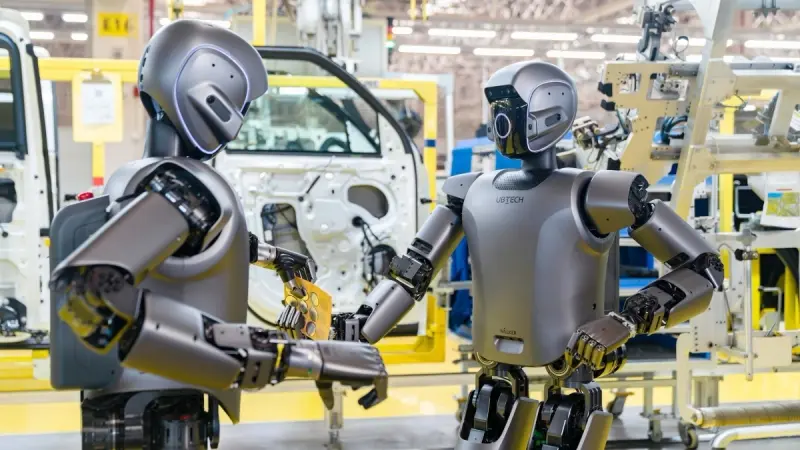

Introduction: When Humanoid Robots Enter the World’s Most Demanding Factories
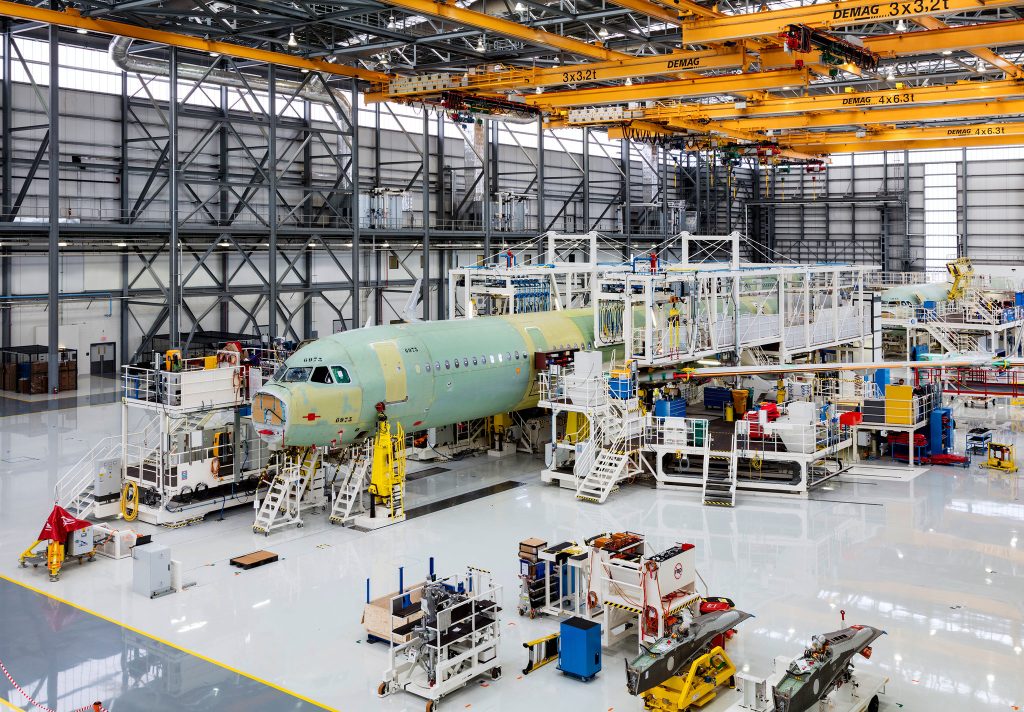
Aerospace manufacturing is widely regarded as one of the most complex, precision-driven, and safety-critical industrial environments in the world. Every component, from fuselage panels to wiring harnesses and cabin interiors, must meet exacting standards. Traditionally, this domain has relied heavily on skilled human labor, supported by highly specialized industrial robots designed for fixed, repetitive tasks.
The collaboration between UBTech Robotics and Airbus marks a significant shift in this paradigm. Rather than deploying traditional industrial robotic arms or automated cells alone, Airbus is exploring humanoid and general-purpose robots capable of operating within human-centric production environments. This partnership signals a new chapter in aerospace manufacturing—one where intelligent, flexible robots work alongside humans, adapting to complex tasks and evolving production needs.
This article provides an in-depth analysis of the UBTech × Airbus collaboration, examining its technological foundations, industrial significance, strategic motivations, challenges, and long-term implications for global manufacturing. More broadly, it situates this partnership within the emerging wave of physical AI, embodied intelligence, and next-generation industrial robotics.
1. Background: Two Industry Leaders from Different Worlds
1.1 Airbus: A Pioneer Under Pressure to Transform
Airbus is one of the world’s largest aerospace manufacturers, producing commercial aircraft, helicopters, defense systems, and space technologies. With global production lines spread across Europe, Asia, and the Americas, Airbus faces mounting pressures:
- Increasing aircraft demand and production ramp-ups
- Severe shortages of skilled manufacturing labor
- Growing customization requirements
- Rising costs and sustainability targets
- The need for higher flexibility across mixed-model assembly lines
While Airbus has long invested in automation, many aerospace tasks remain difficult to robotize due to variability, confined spaces, and the need for dexterous manipulation. These challenges have pushed Airbus to explore more adaptive robotic solutions beyond traditional automation.
1.2 UBTech: From Consumer Robots to Industrial Humanoids
UBTech Robotics, founded in China, is best known internationally for its humanoid robot platforms. Over the past decade, UBTech has evolved from educational and consumer robots toward industrial-grade humanoid systems, integrating:
- Advanced perception (vision, depth sensing, force feedback)
- AI-driven motion planning
- Bipedal locomotion and dexterous manipulation
- ROS-based and proprietary control architectures
UBTech’s strategy centers on general-purpose humanoid robots capable of operating in environments designed for humans—factories, warehouses, laboratories, and service settings—without requiring massive infrastructure changes.
The collaboration with Airbus represents UBTech’s most high-profile industrial deployment to date and a critical test of humanoid robots in one of the world’s toughest manufacturing contexts.
2. Why Aerospace Manufacturing Is a Perfect Stress Test for Humanoid Robots
2.1 Complexity and Variability
Unlike automotive manufacturing, which benefits from highly standardized processes and volumes, aerospace manufacturing involves:
- Low to medium production volumes
- Frequent design variations
- Large, irregularly shaped components
- Tight tolerances and manual fitting
These characteristics make rigid automation expensive and difficult to scale. Humanoid robots, in contrast, promise task flexibility and environmental adaptability.
2.2 Human-Centric Workspaces
Aircraft assembly lines are designed around human ergonomics:
- Ladders, platforms, and narrow fuselage interiors
- Tools sized and positioned for human hands
- Visual inspection tasks requiring contextual judgment
Rather than redesigning factories for robots, Airbus sees value in robots that can fit into existing human workflows, an area where humanoid robots have theoretical advantages.
2.3 Labor and Demographic Pressures
The aerospace industry faces an aging workforce and difficulty attracting new skilled technicians. Robots capable of assisting or augmenting human workers can:
- Reduce physical strain
- Handle repetitive or ergonomically challenging tasks
- Preserve institutional knowledge through AI-based learning
3. The Core of the UBTech × Airbus Collaboration
3.1 Scope of the Partnership
The partnership focuses on testing and deploying humanoid robots in real Airbus production environments, rather than laboratory simulations. Key objectives include:
- Validating humanoid robots for industrial use
- Identifying tasks suitable for early deployment
- Integrating robots into existing digital manufacturing systems
- Evaluating safety, reliability, and economic feasibility
Initial deployments emphasize assistance roles, not full autonomy, reflecting a pragmatic approach to industrial adoption.
3.2 Targeted Use Cases
While Airbus has not publicly disclosed every task under evaluation, likely application areas include:
- Material handling and logistics within assembly halls
- Tool fetching and transport
- Inspection support using vision systems
- Assisting with fastening, cabling, and interior installation
- Working in confined or ergonomically challenging spaces
These tasks prioritize mobility, perception, and human-robot collaboration over raw speed.
4. Technology Foundations: What Makes This Collaboration Possible
4.1 Embodied Intelligence and Physical AI
At the heart of UBTech’s humanoid robots is the concept of embodied intelligence—the idea that intelligence emerges from the interaction between perception, cognition, and physical action.
Key components include:
- Vision-language-action (VLA) models
- Multi-modal sensor fusion
- Learning-based motion control
- Real-time feedback loops
This approach enables robots to understand not just commands, but context, a crucial requirement in aerospace manufacturing.
4.2 Human-Like Locomotion and Manipulation
UBTech’s bipedal locomotion allows robots to:
- Navigate stairs, platforms, and uneven surfaces
- Access elevated or constrained workspaces
- Share physical pathways with humans
Dexterous end-effectors and force-controlled arms enable safe interaction with delicate aircraft components.
4.3 Digital Twins and Simulation
Airbus brings advanced digital twin infrastructure, allowing robot behaviors to be:
- Simulated in virtual factories
- Tested against multiple scenarios
- Optimized before physical deployment
This reduces risk and accelerates iteration cycles.
5. Human-Robot Collaboration: A New Workforce Model
5.1 From Replacement to Augmentation
Contrary to popular fears, the Airbus–UBTech initiative is not about replacing human workers. Instead, it emphasizes:
- Collaborative workflows
- Shared tasks between humans and robots
- Robots acting as intelligent assistants
This model reflects a broader industry shift from automation as substitution to automation as augmentation.
5.2 Safety as a First-Class Requirement
In aerospace manufacturing, safety is non-negotiable. Collaborative humanoid robots must meet strict criteria:
- Real-time collision detection
- Force and torque limiting
- Redundant sensing systems
- Predictable, transparent behavior
Airbus’s involvement ensures industrial-grade safety validation, setting benchmarks for future deployments.
6. Strategic Significance for the Global Robotics Industry
6.1 A Validation Moment for Humanoid Robots
For years, humanoid robots were viewed as impressive demonstrations with unclear commercial value. Airbus’s decision to test humanoids in production environments sends a powerful signal:
- Humanoid robots are no longer confined to labs
- Real industries see potential economic value
- General-purpose robots may complement specialized automation
This collaboration could influence adoption decisions across multiple industries.
6.2 Redefining Industrial Automation Architectures
If successful, humanoid robots could reshape factory design:
- Less reliance on fixed automation cells
- Greater emphasis on software-defined capabilities
- Faster reconfiguration of production lines
This flexibility is particularly valuable in industries facing frequent product changes.
7. Challenges and Limitations: A Realistic Perspective
7.1 Performance and Efficiency Gaps
Current humanoid robots are still:
- Slower than skilled human workers
- Less energy-efficient
- Limited in fine motor precision for certain tasks
Bridging these gaps requires advances in hardware, control algorithms, and learning systems.
7.2 Cost and ROI Considerations
Humanoid robots remain expensive to build, deploy, and maintain. Airbus and UBTech must demonstrate:
- Clear productivity gains
- Reduced downtime or injury rates
- Long-term cost competitiveness
Without measurable ROI, large-scale deployment will remain limited.
7.3 Integration Complexity
Integrating humanoid robots into existing factories involves:
- IT/OT system alignment
- Workforce training
- Cultural acceptance
These non-technical factors often determine the success or failure of automation projects.
8. Broader Implications Beyond Aerospace
8.1 A Blueprint for Other Industries
Lessons from the UBTech × Airbus collaboration are directly applicable to:
- Automotive final assembly
- Shipbuilding
- Energy infrastructure maintenance
- Warehousing and logistics
- Large-scale equipment manufacturing
Any industry with complex, human-centric environments stands to benefit.
8.2 Accelerating the Rise of General-Purpose Robots
This partnership contributes to a broader trend toward robots that can learn, adapt, and generalize across tasks, blurring the line between industrial and service robotics.
9. Long-Term Vision: Toward the Factory of the Future
9.1 Software-Defined Manufacturing
In the long term, factories may evolve into environments where:
- Robots are reprogrammed via high-level instructions
- AI models continuously learn from operations
- Physical capabilities are upgraded modularly
Humanoid robots fit naturally into this vision due to their generality.
9.2 Humans as Supervisors and Collaborators
As robots take on more physical tasks, human roles will shift toward:
- Supervision and decision-making
- Quality assurance
- System optimization and innovation
This transformation requires investment in reskilling and organizational change.
Conclusion: A Turning Point for Industrial Robotics
The UBTech × Airbus collaboration is more than a pilot project—it is a strategic experiment at the intersection of AI, robotics, and advanced manufacturing. By bringing humanoid robots into aerospace production environments, the partnership challenges long-held assumptions about what robots can do, where they belong, and how they should work with humans.
While significant technical and economic challenges remain, the importance of this collaboration lies in its directional impact. It signals a future where robots are not confined to cages or repetitive motions, but instead become adaptive, intelligent participants in human-designed systems.
If successful, this initiative could redefine industrial automation, accelerate the adoption of humanoid robots, and help shape the next era of global manufacturing—one where flexibility, intelligence, and collaboration matter as much as speed and scale.
In that sense, UBTech and Airbus are not merely deploying robots; they are helping to reimagine the factory of the future.