










Introduction: Why Arm’s Move into Robotics Matters
In the global technology landscape, few companies have shaped modern computing as profoundly as Arm. From smartphones and tablets to embedded systems and cloud infrastructure, Arm’s processor architectures power billions of devices worldwide. Yet for much of its history, Arm remained largely invisible to end users, operating behind the scenes as a foundational technology provider.
Today, Arm is stepping into a far more visible and strategically critical arena: artificial intelligence and robotics. As robots evolve from isolated machines into intelligent, autonomous systems operating in the physical world, the importance of computing architecture—how intelligence is executed at the edge, how power efficiency is managed, and how software and hardware co-design is achieved—has never been greater.
Arm’s expansion into AI and robotics is not a minor business adjustment. It represents a strategic realignment toward what many consider the next major computing platform: physical AI systems that perceive, reason, and act in real environments. This article provides an in-depth exploration of why Arm is investing heavily in AI and robotics, how its architecture underpins next-generation robotic systems, what technologies and ecosystems are emerging around it, and how this move could reshape the future of intelligent machines.
1. Arm’s Historical Role: The Architecture Behind the Digital World
1.1 A Licensing Model That Changed Computing
Unlike traditional chip manufacturers, Arm does not primarily fabricate processors. Instead, it designs instruction set architectures (ISAs) and reference microarchitectures, licensing them to partners such as Apple, Qualcomm, Samsung, MediaTek, NVIDIA, and countless others.
This model allowed Arm to achieve:
- Massive scalability across industries
- Rapid innovation driven by ecosystem partners
- Unparalleled energy efficiency
Arm-based chips became synonymous with low power consumption, making them ideal for mobile and embedded applications.
1.2 From Mobile to Everywhere
Over time, Arm expanded far beyond smartphones:
- Automotive systems and autonomous driving
- Networking and telecommunications infrastructure
- IoT and industrial controllers
- Cloud and data center processors
This ubiquity positioned Arm as a natural foundation for robotics, which demands high performance under strict power and thermal constraints.
2. Why Robotics Needs a New Computing Paradigm
2.1 Robotics Is Not Just Another AI Workload
While AI in the cloud focuses on large-scale data processing, robotics introduces unique requirements:
- Real-time decision-making
- Tight control loops between perception and action
- Deterministic latency
- High reliability and safety constraints
A robot cannot wait hundreds of milliseconds for cloud inference when navigating a factory floor or interacting with humans.
2.2 The Shift Toward Edge AI
As robots operate in dynamic physical environments, intelligence must move closer to the sensors and actuators. This shift toward edge AI emphasizes:
- Energy-efficient inference
- On-device learning and adaptation
- Reduced reliance on connectivity
- Enhanced privacy and safety
Arm’s architecture is inherently aligned with these requirements.
3. Arm’s Strategic Expansion into AI and Robotics
3.1 Recognizing Robotics as the Next Computing Platform
Arm increasingly views robotics not as a niche application, but as a platform shift, similar in magnitude to mobile computing or cloud infrastructure. Robots combine:
- CPUs for control and orchestration
- GPUs and NPUs for perception and learning
- Specialized accelerators for vision, motion, and safety
Arm’s strategy is to become the default architectural backbone for this heterogeneous computing stack.
3.2 From IP Provider to Ecosystem Enabler
In robotics, Arm is moving beyond core CPU licensing to offer:
- AI-optimized architectures
- Reference platforms for robotics workloads
- Software tools and frameworks
- Partnerships with robotics OEMs and AI developers
This deeper involvement allows Arm to influence how robots are designed from silicon to software.
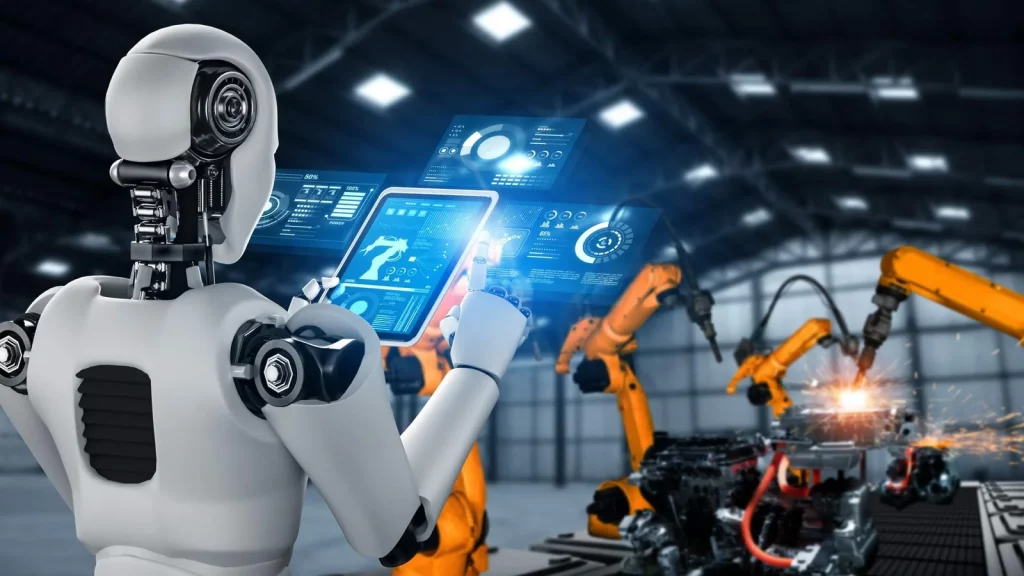
4. The Role of Arm Architecture in Robotic Systems
4.1 CPUs as the Control Brain
In robots, CPUs handle:
- Real-time operating systems (RTOS)
- Task scheduling and orchestration
- Safety monitoring and redundancy management
- Communication between subsystems
Arm’s Cortex-A and Cortex-R families are widely used for these roles due to their balance of performance and determinism.
4.2 Heterogeneous Computing and AI Acceleration
Modern robots rely on heterogeneous architectures:
- CPUs for logic and control
- GPUs for parallel processing
- NPUs for AI inference
Arm designs CPUs that integrate seamlessly with accelerators, enabling efficient system-on-chip (SoC) designs tailored for robotics.
4.3 Power Efficiency as a Competitive Advantage
Robots are often battery-powered or thermally constrained. Arm’s emphasis on performance per watt enables:
- Longer operational time
- Smaller form factors
- Reduced cooling requirements
These advantages are critical for mobile robots, drones, and humanoid platforms.
5. Physical AI: Arm’s Vision for Intelligent Machines
5.1 Defining Physical AI
Physical AI refers to AI systems that:
- Perceive the physical world through sensors
- Understand spatial and temporal context
- Act through motors and manipulators
- Learn from real-world interaction
Robotics is the most direct embodiment of physical AI.
5.2 Arm’s Contribution to Physical AI
Arm supports physical AI by enabling:
- Real-time perception pipelines
- Low-latency inference at the edge
- Tight coupling between sensing, computation, and actuation
This allows robots to respond intelligently and safely in dynamic environments.
6. Software Ecosystem: Making Robotics Development Scalable
6.1 Compatibility with ROS and ROS 2
The Robot Operating System (ROS) has become a standard framework for robotics development. Arm-based platforms are widely supported by ROS, enabling:
- Hardware abstraction
- Modular software development
- Rapid prototyping and deployment
Arm’s growing involvement includes optimizing ROS performance on Arm architectures.
6.2 AI Frameworks and Toolchains
Arm works closely with major AI frameworks, including:
- TensorFlow Lite
- PyTorch
- ONNX
By optimizing inference on Arm CPUs and accelerators, developers can deploy AI models efficiently on robotic hardware.
7. Industry Applications Driving Arm’s Robotics Push
7.1 Industrial and Manufacturing Robots
Factories are transitioning toward:
- Collaborative robots working alongside humans
- Flexible automation for small-batch production
- Mobile manipulation systems
Arm-based systems enable scalable, energy-efficient computing for these applications.
7.2 Autonomous Mobile Robots and Logistics
Warehouses and distribution centers rely on fleets of robots that must:
- Navigate dynamic environments
- Coordinate with each other
- Operate continuously with minimal downtime
Arm’s architecture supports fleet-level intelligence while keeping per-unit costs low.
7.3 Humanoid and Service Robots
Humanoid robots demand:
- High compute density
- Efficient AI processing
- Complex sensor fusion
Arm’s designs are increasingly used as the control and coordination layer in these advanced platforms.
8. Competitive Landscape: Arm vs. Other Computing Paradigms
8.1 Arm and x86
While x86 dominates traditional PCs and servers, it often struggles with:
- Power efficiency
- Embedded and real-time constraints
In robotics, Arm’s efficiency and flexibility provide a clear advantage.
8.2 Arm and Specialized AI Chips
Dedicated AI accelerators offer high performance but lack generality. Arm positions itself as:
- The orchestration layer
- The glue connecting specialized accelerators
- The platform ensuring software portability
This complementary role strengthens Arm’s relevance.
9. Safety, Reliability, and Regulation
9.1 Functional Safety in Robotics
Robots operating near humans must meet strict safety standards. Arm supports this through:
- Safety-certified cores
- Redundant architectures
- Deterministic real-time processing
These features are critical for industrial and medical robots.
9.2 Long-Term Support and Stability
Industrial robotics requires long product lifecycles. Arm’s commitment to long-term architecture stability ensures:
- Software compatibility over many years
- Reduced maintenance costs
- Regulatory compliance
10. Challenges Arm Faces in Expanding Robotics
10.1 Fragmentation of the Robotics Market
Robotics spans many industries with diverse requirements. Arm must balance:
- Standardization vs. customization
- Broad ecosystem support vs. targeted optimization
10.2 Software Complexity
Hardware alone does not solve robotics challenges. Arm must continue investing in:
- Developer tools
- Middleware and libraries
- AI optimization workflows
11. Long-Term Vision: Arm and the Future of Robotics
11.1 Robots as Ubiquitous Computing Devices
Arm envisions a future where robots are as ubiquitous as smartphones, embedded in:
- Factories
- Cities
- Homes
- Infrastructure
In this world, Arm-based processors quietly power the intelligence behind physical automation.
11.2 Continuous Learning at the Edge
Future robots will:
- Learn from experience
- Share updates across fleets
- Improve performance over time
Arm’s edge-centric architecture is well-suited to this vision.
Conclusion: A Strategic Bet on the Physical World
Arm’s expansion into artificial intelligence and robotics reflects a deep understanding of where computing is headed. As intelligence moves out of data centers and into the physical world, the need for efficient, flexible, and scalable architectures becomes paramount.
By positioning itself at the heart of robotic computing—powering control systems, enabling AI inference, and supporting complex software ecosystems—Arm is not merely following industry trends. It is helping to define the technological foundation of next-generation intelligent machines.
In the coming decade, as robots become integral to manufacturing, logistics, healthcare, and daily life, Arm’s role may prove as influential in robotics as it once was in mobile computing. What began as a quiet architecture company is now shaping the future of physical AI, one processor at a time.