









Introduction: Pioneering Physical AI for the Next Era of Robotics
In the rapidly evolving landscape of robotics and autonomous machines, NVIDIA has emerged as a central architect of “Physical AI” — a paradigm where artificial intelligence is no longer confined to cloud servers or simulated environments, but embedded directly into the physical world through edge hardware and tight integration with robotics platforms.
At the heart of this transformation is NVIDIA’s strategic vision to create an end‑to‑end hardware and software ecosystem that empowers robots to perceive, reason, and act autonomously in real‑world environments — spanning humanoids, mobile manipulators, autonomous vehicles, industrial robots, and service machines. This article provides a deep, professional, and richly detailed examination of NVIDIA’s physical AI ecosystem: its core hardware platforms, software frameworks, partnerships, foundation models, developer tools, and the broader implications for the robotics industry.
1. Understanding Physical AI: The Shift from Data to Action
Physical AI represents a new phase in robotics: machines that do more than compute; they sense, interpret, decide, and act in the physical world. Unlike traditional AI focused on data center workloads — classification, prediction, and analytics — physical AI tightens the loop between perception and real‑time action:
- Perception: Real‑time multimodal sensing (vision, depth, proprioception)
- Reasoning: Contextual understanding via AI models
- Action: Low‑latency motion planning and control integrated with embedded compute
This requires a new class of hardware capable of delivering server‑level intelligence at the edge — where robots operate — without reliance on cloud processing.
NVIDIA’s ecosystem is designed precisely for this blend of high‑performance AI reasoning and physical interaction, which differentiates physical AI from other edge AI disciplines.
2. The Core Hardware: NVIDIA Jetson Thor and Physical Compute Platforms
2.1 Jetson Thor: The Robotic “Supercomputer” at the Edge
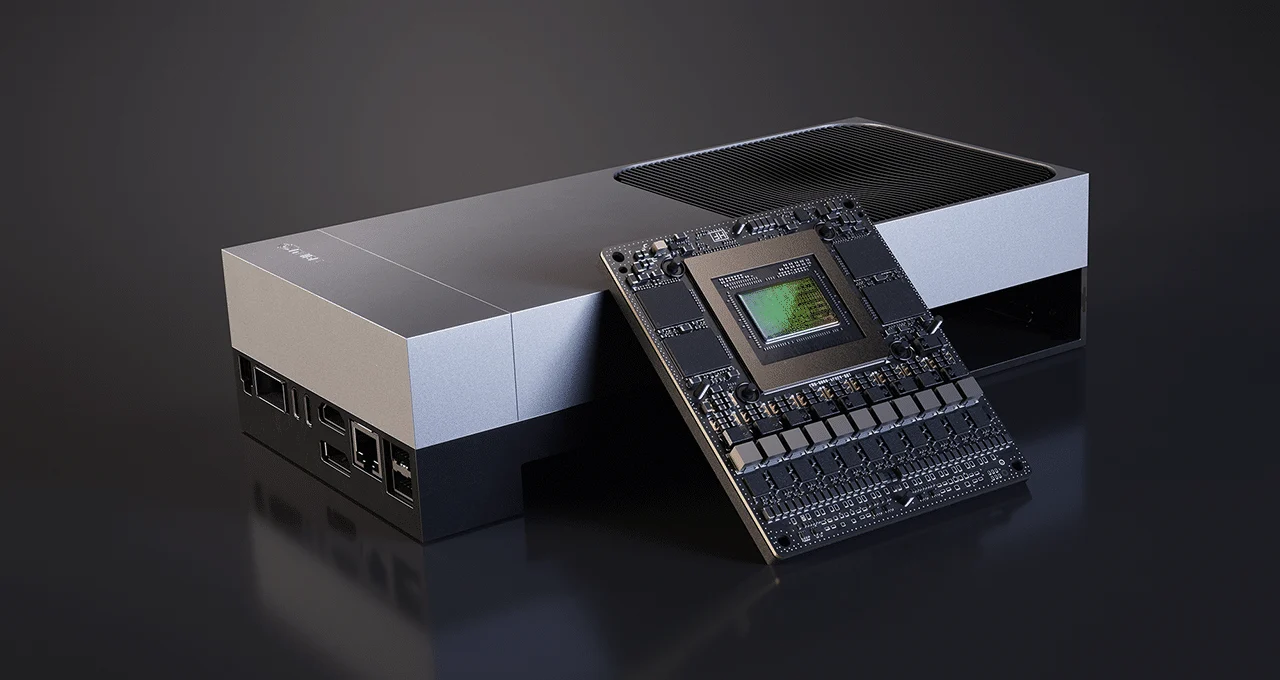
The linchpin of NVIDIA’s physical AI hardware stack is the Jetson Thor series — a family of high‑performance embedded compute modules built specifically for robotics and AI workloads. Jetson Thor delivers unprecedented compute density in an embedded form factor, enabling robots to run multiple AI models concurrently with low latency.
Key capabilities include:
- Blackwell GPU architecture: Up to 2,070 FP4 teraflops of AI compute — roughly 7.5× the AI performance of NVIDIA’s prior Orin architecture.
- Large memory footprint: Up to 128 GB of LPDDR5X for running large AI models locally.
- Multi‑Sensor Processing: Support for high‑speed sensor fusion and real‑time inference, including high‑resolution video and LiDAR pipelines.
- Edge‑to‑Cloud Integration: Designed to integrate seamlessly with cloud services while maintaining real‑time autonomy at the robot level.
This performance enables robotics developers to run vision‑language‑action (VLA) models, large language models (LLMs), and transformer‑based reasoning models directly on the edge compute platform. The result is an “AI brain” capable of generating context‑aware actions without reliance on remote servers.
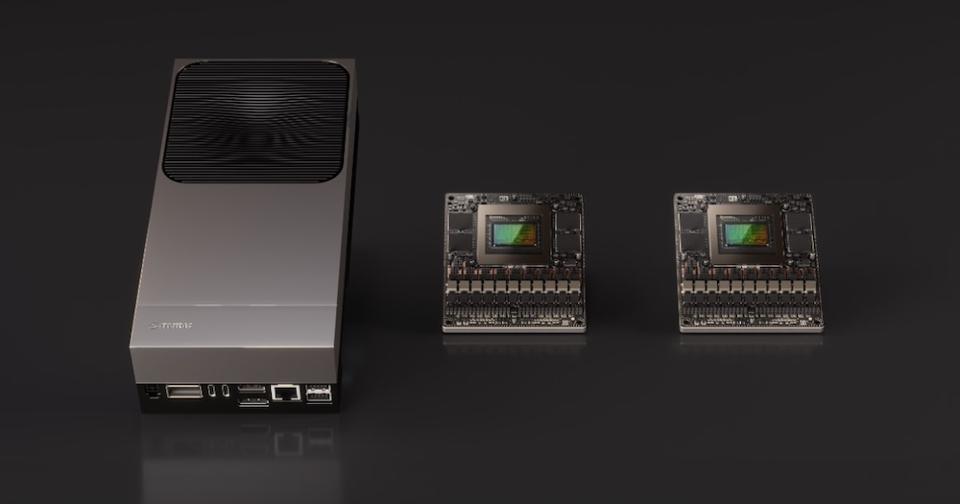
Jetson Thor is available in both a developer kit (Jetson AGX Thor) and production modules such as Jetson T5000 and T4000, offering a range of performance and power envelopes suited to different robot classes.
2.2 The Role of Jetson T4000 and Scalable Compute Tiers
Beyond the flagship Thor AGX, NVIDIA also introduced Jetson T4000, which brings much of the Blackwell architecture performance into a more energy‑efficient, cost‑effective form. The T4000 delivers about 1,200 TFLOPS of AI performance within a configurable 70 W envelope, making it ideal for resource‑constrained mobile robots and industrial automation settings without sacrificing the ability to run modern AI models.
This scaling of physical AI hardware — from high‑end AGX platforms to more accessible T‑series modules — broadens the physical AI ecosystem, enabling a greater diversity of developers and products to adopt advanced robotics compute.
3. Software and Models: Turning Compute into Reasoning and Action
3.1 NVIDIA Isaac and Physical AI Foundation Models
Hardware performance is only one pillar of the ecosystem. Equally important are the AI models and software frameworks that enable perception, reasoning, and task execution:
- Isaac Lab‑Arena: A robotics evaluation environment that accelerates robot model testing and validation.
- Cosmos Transfer, Predict, and Reason: A suite of open world models for synthetic data generation, world modeling, and reasoning — essential for training physical AI systems.
- GR00T N1.6: A vision‑language‑action model purpose‑built for humanoid and generalist robots, enabling rich contextual understanding and complex task planning.
These models are integrated into the LeRobot open‑source robotics framework via collaboration with Hugging Face, allowing developers to fine‑tune and deploy models easily across diverse robotic platforms.
3.2 Unified Ecosystem: Software, Simulation, and Simulation Tools
NVIDIA’s physical AI stack also includes robust software tools:
- Omniverse: A scalable simulation and digital twin environment where robotics developers can simulate real‑world physics, sensors, and movement before deploying on physical hardware.
- Holoscan: A sensor processing acceleration framework that streamlines the flow of sensor data into AI inference pipelines.
Together, these tools create a continuous development lifecycle — from simulation and digital twin modeling, through AI training, to edge deployment.
4. Industry Adoption: Robots Powered by Physical AI
The ecosystem is not theoretical — it is being actively adopted across industries and robot classes:
4.1 Humanoid Robotics and State‑of‑the‑Art Platforms
At CES 2026 and other industry events, a wide range of humanoid robots demonstrated real‑time reasoning and task planning enabled by NVIDIA Jetson Thor:
- NEURA Robotics unveiled a Gen 3 humanoid designed for industrial tasks, optimized for dexterous control.
- Boston Dynamics, Humanoid, and RLWRLD integrated Jetson Thor into their existing platforms to enhance navigation and manipulation.
- AGIBOT and other developers introduced new humanoids for both consumer and industrial segments.
- LG Electronics showcased home robots capable of a wide range of indoor tasks driven by physical AI computing.
These examples underscore the breadth of application — from industrial labor to personal assistance — enabled by real‑time onboard AI.
4.2 Broader Physical AI in Autonomous Systems
Physical AI hardware also extends beyond humanoids:
- Mobile Manipulators: Robots in warehouses, logistics, and manufacturing are adopting Jetson Thor to improve autonomy, perception, and task execution.
- Edge Industrial Robots: The performance and efficiency of Thor and T4000 platforms make them suitable for energy‑constrained industrial environments where autonomous decision‑making improves throughput and reliability.
- Simulated and Hybrid Workflows: Robotics developers can iterate simulation (Omniverse) and hardware deployment without rewriting core AI logic, shortening time‑to‑market.
5. Ecosystem and Developer Support
5.1 A Massive Developer Community
NVIDIA’s robotics ecosystem is supported by a vast developer base, including:
- 2 million robotics developers within the Jetson ecosystem
- 13 million AI builders in the combined NVIDIA + Hugging Face community
This community drives innovation by building models, sharing datasets, and developing custom robotics applications across sectors.
5.2 Partner Networks and Interoperability
The ecosystem extends to hardware partners, sensor vendors, and software integrators. Integration with open standards like ROS Quantum Robotics Operating System (ROS2) — through NVIDIA Isaac ROS — ensures interoperability across hardware platforms and reduces fragmentation in development.
6. Strategic Vision: Toward Generalist Physical AI
NVIDIA’s roadmap signals a strategic shift from specialized robotics solutions toward generalist physical AI — systems capable of learning multiple tasks, reasoning about contexts, and adapting to new environments without exhaustive hand‑coding:
- Foundation models like Cosmos Reason and GR00T N1.6 enable generalizable reasoning across tasks.
- Edge hardware like Jetson Thor supports running these models locally, enabling real‑time responsiveness and safety.
- Open frameworks reduce barriers to entry for smaller developers while nurturing innovation.
According to NVIDIA leadership, this represents a moment akin to the “ChatGPT moment for robotics,” where general intelligence begins complementing physical interaction in real world systems.
7. Challenges and Future Opportunities
Despite impressive progress, several challenges remain:
7.1 Power Efficiency vs Compute Performance
Physical AI demand pushes the boundaries of energy‑efficient AI computing. While Jetson Thor delivers unprecedented performance, optimizing power consumption for battery‑dependent robots — such as humanoids or outdoor mobile units — remains an engineering priority.
7.2 Standards and Safety
As robots make more autonomous decisions, safety certification, functional safety standards, and predictability become critical — especially in industrial and human‑collaborative environments.
7.3 Model Generalization and Continual Learning
Developing physical AI models that handle real‑world unpredictability — from sensor noise to dynamic objects — requires ongoing research in model robustness and on‑device continual learning.
These areas represent opportunities for collaboration between ecosystem partners, academic institutions, and industry leaders.
Conclusion: NVIDIA’s Ecosystem as the Engine of Physical AI
NVIDIA’s physical AI hardware ecosystem represents one of the most comprehensive and forward‑looking stacks in the robotics industry today. By combining edge‑optimized AI computing platforms like Jetson Thor, open foundation models like Cosmos and GR00T, robust simulation environments, and a thriving developer community, NVIDIA has laid a foundation for robots that can see, reason, plan, and act autonomously in the physical world.
What once required supercomputers and centralized servers can now be executed locally on embedded platforms — a transformation that promises to unlock smarter manufacturing, autonomous logistics, home robotics, healthcare automation, and beyond. As physical AI continues to mature, NVIDIA’s ecosystem will likely remain at the nexus of innovation in the next wave of autonomous machines and intelligent robotics.