









Introduction
Humanoid robots have long occupied a unique space at the intersection of science fiction, engineering ambition, and societal imagination. For decades, they were largely confined to research laboratories, tech demonstrations, and speculative narratives—impressive yet impractical, fascinating yet far from mass adoption. Today, however, humanoid robots are increasingly being viewed as a critical inflection point: a transition from experimental products to scalable commercial systems with real economic and social value.
This shift is not accidental. It is driven by converging breakthroughs in artificial intelligence, advanced sensing, high-performance actuators, materials science, and large-scale manufacturing. At the same time, structural global challenges—aging populations, labor shortages, rising costs, and the demand for flexible automation—are creating fertile ground for humanoid robots to move beyond experimentation and into deployment at scale.
This article explores why humanoid robots are now seen as a key milestone in commercialization, examining the technological foundations, economic logic, industrial ecosystems, application scenarios, and societal implications that underpin this transformation. By situating humanoid robotics within the broader evolution of automation and AI, we can better understand why this moment represents not just incremental progress, but a fundamental turning point.
1. From Conceptual Curiosity to Engineering Reality
1.1 Early Visions and Limitations
The concept of humanoid robots dates back centuries, from mechanical automata of the Renaissance to early cybernetic theories in the 20th century. In modern robotics, humanoid design emerged from a simple idea: if robots are meant to operate in human environments, they should share human-like form factors.
Yet for much of their history, humanoid robots were constrained by:
- Insufficient computing power for real-time perception and control
- Limited battery density, restricting autonomy
- Rigid and inefficient actuators
- Fragmented software architectures
- High costs with low reliability
As a result, early humanoids served primarily as research platforms rather than commercially viable products.
1.2 The Turning Point: System-Level Maturity
What differentiates today’s humanoid robots from their predecessors is not a single breakthrough, but system-level maturity. Modern humanoids integrate perception, cognition, motion, and interaction into coherent, learning-enabled systems. They are no longer isolated experiments but modular, upgradable platforms designed with scalability in mind.
This evolution mirrors earlier transitions in other industries, such as:
- Mainframes to personal computers
- Feature phones to smartphones
- Industrial robots to collaborative robots (cobots)
Each transition marked a moment when technology crossed the threshold from niche utility to mass relevance. Humanoid robots are now approaching that same threshold.
2. Technological Foundations Enabling Commercialization
2.1 Artificial Intelligence as the Cognitive Core
At the heart of humanoid commercialization lies modern AI, particularly:
- Deep learning for perception (vision, audio, tactile sensing)
- Reinforcement learning for motor control
- Large models for planning, reasoning, and language interaction
Unlike traditional rule-based robotics, AI-driven humanoids can generalize across tasks, adapt to new environments, and learn from experience. This flexibility is essential for commercial viability, as it reduces the need for costly, task-specific programming.
2.2 Advances in Embodied Intelligence
Embodied intelligence emphasizes that cognition emerges through interaction between body, environment, and control systems. Humanoid robots benefit greatly from this paradigm:
- Human-like kinematics enable intuitive task mapping
- Multimodal sensory feedback improves robustness
- Physical embodiment allows learning through trial and error
This shift moves humanoids away from scripted automation toward adaptive physical agents.
2.3 Hardware Innovations: Actuators, Sensors, and Materials
Key hardware advances include:
- High-torque, lightweight actuators with better efficiency
- Series elastic actuators for safe human-robot interaction
- Advanced proprioceptive and tactile sensors
- Improved energy storage and thermal management
These developments reduce cost, improve durability, and make humanoids safer and more reliable—critical requirements for commercial deployment.
3. Economic Logic: Why Humanoid Robots Make Sense Now
3.1 Labor Market Pressures
Globally, industries face:
- Aging workforces
- Declining birth rates
- Rising labor costs
- Shortages in physically demanding or repetitive jobs
Humanoid robots offer a compelling solution: general-purpose labor automation that can be redeployed across tasks without redesigning infrastructure.
3.2 Cost Curves and Economies of Scale
Historically, humanoid robots were prohibitively expensive. Today, costs are declining due to:
- Standardized components
- AI software reuse
- Cloud-based training and simulation
- Scalable manufacturing techniques
As production volumes increase, cost curves resemble those seen in consumer electronics rather than bespoke machinery.
3.3 Return on Investment (ROI) Considerations
From a commercial perspective, humanoid robots are increasingly evaluated not as novelty machines but as capital assets:
- 24/7 operation potential
- Reduced training costs
- Lower long-term labor expenses
- Improved consistency and safety
This reframing is crucial for enterprise adoption.
4. Application Scenarios Driving Commercial Adoption
4.1 Manufacturing and Industrial Operations
In factories, humanoid robots can:
- Operate in spaces designed for humans
- Handle flexible assembly tasks
- Perform inspection, logistics, and maintenance
Unlike traditional industrial robots, humanoids reduce the need for costly reconfiguration of production lines.
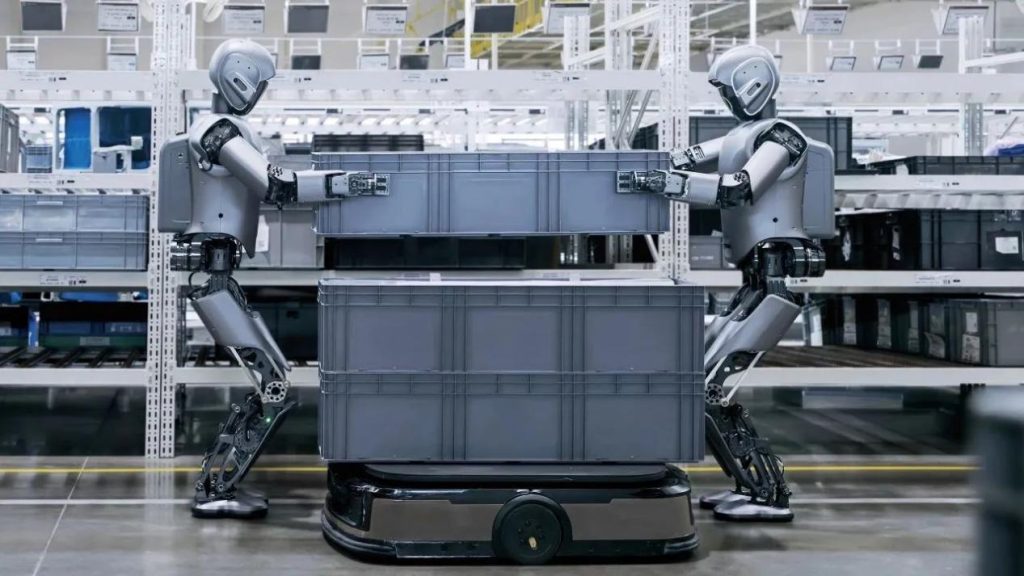
4.2 Logistics and Warehousing
Humanoid robots are well-suited for:
- Picking and sorting
- Loading and unloading
- Navigating complex, dynamic environments
Their bipedal or hybrid mobility allows them to function in facilities not optimized for wheeled automation.
4.3 Healthcare and Elderly Care
In aging societies, humanoid robots can:
- Assist with mobility and daily activities
- Support medical staff with routine tasks
- Provide companionship and monitoring
While ethical and regulatory considerations are significant, the demand is undeniable.
4.4 Service and Hospitality Industries
From hotels to retail environments, humanoid robots can:
- Provide customer assistance
- Handle repetitive service tasks
- Enhance brand differentiation through innovation
Here, human-like interaction becomes a commercial advantage rather than a liability.
5. Ecosystem Evolution: From Single Products to Platforms
5.1 Software Platforms and Developer Communities
Commercial humanoids are increasingly positioned as platforms, not finished products. Open APIs, simulation environments, and developer toolkits enable:
- Rapid application development
- Third-party innovation
- Continuous capability expansion
This mirrors the success of smartphone and cloud ecosystems.
5.2 Data as a Strategic Asset
Humanoid robots generate massive amounts of data:
- Motion trajectories
- Environmental interactions
- Human behavior patterns
This data fuels continuous learning, improving performance over time and creating competitive moats for early leaders.
5.3 Supply Chains and Industrial Collaboration
Scaling humanoid production requires:
- Robust component supply chains
- Cross-industry partnerships
- Standardization of interfaces and safety protocols
As ecosystems mature, barriers to entry will rise, further accelerating consolidation and commercialization.
6. Safety, Ethics, and Regulation
6.1 Physical Safety and Trust
Commercial humanoid robots must meet stringent safety standards:
- Collision avoidance
- Force control
- Fail-safe mechanisms
Trust is foundational; without it, adoption will stall regardless of technical capability.
6.2 Ethical Considerations
Key ethical issues include:
- Job displacement
- Human dependency
- Data privacy
- Emotional attachment to machines
Addressing these concerns transparently is essential for sustainable commercialization.
6.3 Regulatory Frameworks
Governments and international bodies are beginning to:
- Define safety and liability standards
- Regulate AI decision-making
- Establish certification processes
Clear regulation reduces uncertainty and encourages investment.
7. Competitive Landscape and Strategic Implications
7.1 Technology Companies vs. Traditional Robotics Firms
Humanoid commercialization blurs industry boundaries:
- AI-first companies bring software dominance
- Robotics firms contribute mechanical expertise
- New entrants leverage vertical integration
Success increasingly depends on system integration, not isolated excellence.
7.2 National Strategies and Geopolitical Dimensions
Humanoid robotics is becoming a strategic technology:
- Linked to industrial competitiveness
- Relevant to defense and resilience
- Central to future labor productivity
Nations investing early may gain long-term advantages.
8. Societal Impact and Human-Robot Coexistence
8.1 Redefining Work
Rather than simply replacing workers, humanoid robots are likely to:
- Augment human capabilities
- Take over hazardous or undesirable tasks
- Shift labor toward creative and supervisory roles
This transition will require reskilling and social adaptation.
8.2 Cultural Acceptance
Human-like form factors evoke strong emotional responses. Successful commercialization depends on:
- Thoughtful design
- Cultural sensitivity
- Clear communication of purpose
Acceptance is as much psychological as technological.
9. Why This Moment Is a Critical Milestone
Humanoid robots are now widely regarded as the bridge between narrow automation and general-purpose physical intelligence. This moment is pivotal because:
- Core technologies have reached sufficient maturity
- Economic incentives are aligned
- Ecosystems are forming around scalable platforms
- Societal needs are becoming more urgent
What was once an experimental ambition is evolving into a practical, scalable solution.
Conclusion
Humanoid robots being viewed as a key milestone from experimental products to large-scale commercialization reflects a profound shift in both technology and mindset. They are no longer symbols of distant futures but embodiments of present capability and near-term opportunity.
As AI, hardware, and industrial ecosystems continue to converge, humanoid robots will increasingly integrate into factories, hospitals, warehouses, and public spaces. Their commercialization will not be instantaneous, nor without challenges—but the trajectory is clear.
In this sense, humanoid robots represent more than a new category of machines. They signify a new phase in the relationship between humans and technology—one where intelligent, embodied systems operate alongside us, reshaping work, productivity, and society itself.
The milestone has been reached. The journey toward scale has begun.