









Introduction
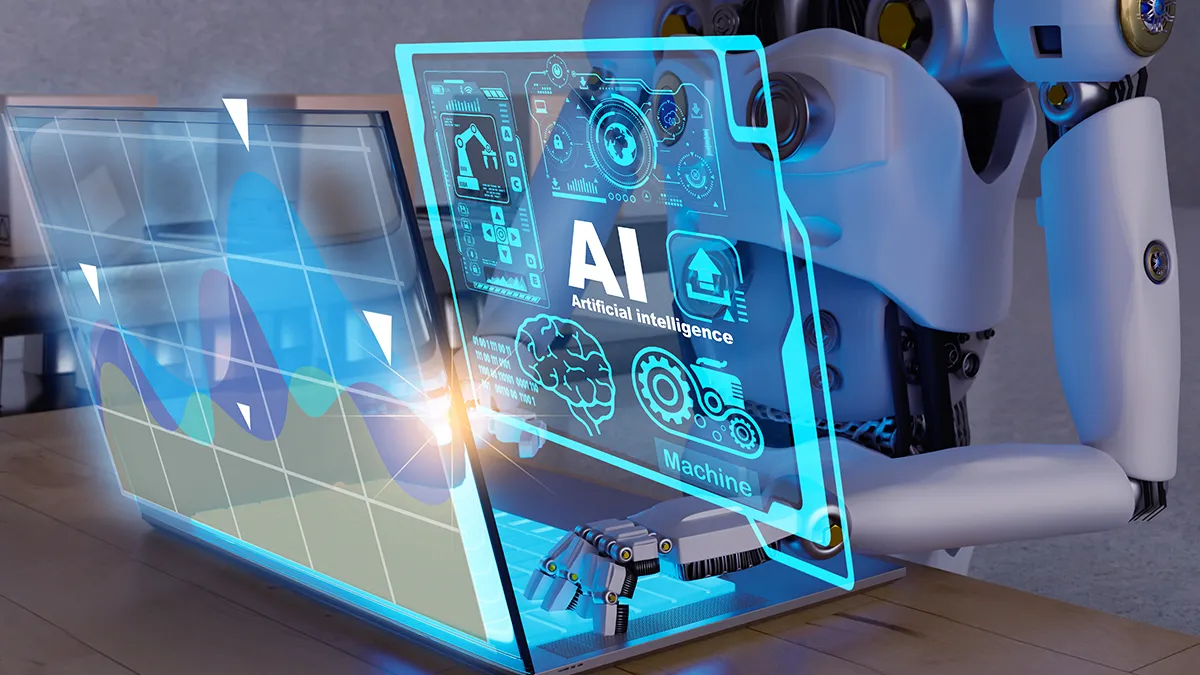
The fusion of robotics and artificial intelligence (AI) is reshaping the boundaries of technology, society, and human potential. Historically, robotics and AI evolved as separate domains—robotics focusing on mechanical and physical automation, and AI emphasizing cognition, perception, and decision-making. Today, their convergence is catalyzing a new era where robots are no longer just programmable machines but intelligent, autonomous agents capable of perceiving, learning, and adapting in real-world environments.
The integration of robotics and AI holds profound implications for industrial productivity, healthcare, human-robot collaboration, social interaction, and ethical governance. This article explores the technological foundations, practical applications, societal impact, and future trajectories of AI-powered robotics, highlighting why this convergence represents one of the most transformative innovations of the 21st century.
1. Historical Context: The Separate Evolution of Robotics and AI
1.1 Early Robotics
Robotics originated as a field centered on mechanical manipulation and automation. Early industrial robots, such as the Unimate arm, were designed to perform repetitive tasks in structured factory environments. These systems excelled in precision and reliability but lacked adaptability, learning, and cognitive capabilities. Their operations were strictly deterministic, limited to pre-programmed instructions.
Key characteristics of early robotics:
- Fixed motion sequences for repetitive tasks.
- Minimal environmental perception, often limited to simple contact sensors.
- High precision but low flexibility, restricting applications to controlled industrial environments.
1.2 Evolution of Artificial Intelligence
Artificial intelligence, by contrast, emerged as a field devoted to cognitive tasks: problem-solving, pattern recognition, and decision-making. AI systems in the mid-20th century were largely symbolic, relying on predefined rules to simulate reasoning processes. With the advent of machine learning and, later, deep learning, AI began to acquire the ability to perceive, generalize, and adapt, creating a new paradigm in computational intelligence.
Despite these advances, AI historically lacked embodiment. It existed primarily in software systems, separated from the physical capabilities of robots. Only with recent integration efforts has AI been coupled with robotics to create intelligent, autonomous agents capable of physical action informed by cognitive reasoning.
2. Technological Drivers of AI-Robotics Integration
The fusion of robotics and AI is enabled by several technological advances that bridge perception, cognition, and action.
2.1 Advanced Perception Systems
Robots equipped with AI leverage sophisticated sensors to interpret the world:
- Computer vision systems: AI-driven cameras detect objects, faces, gestures, and environmental changes.
- LiDAR and radar sensors: Provide spatial awareness and obstacle avoidance for autonomous navigation.
- Tactile and force sensors: Enable delicate manipulation of fragile objects, critical in healthcare and logistics.
- Multimodal perception: Integration of vision, audio, and haptic sensing enables robots to understand complex environments and human behavior.
2.2 AI-Powered Decision Making
AI provides robots with the capacity to reason, plan, and adapt:
- Machine learning allows robots to optimize tasks based on data-driven insights.
- Reinforcement learning enables adaptive behavior in dynamic environments, such as warehouse logistics or autonomous driving.
- Natural language processing (NLP) allows robots to understand and respond to human communication, enhancing collaboration.
This cognitive layer transforms robots from reactive machines into proactive agents capable of anticipating needs and making autonomous decisions.
2.3 Robotics Advancements Facilitating AI Integration
Modern robotics has evolved to provide the physical capabilities necessary for AI applications:
- Flexible actuators and soft robotics: Enhance safety in human-robot interaction.
- Mobile platforms: Allow AI-powered robots to navigate real-world environments.
- Collaborative robots (cobots): Operate safely alongside humans, leveraging AI to understand human intent and adjust behavior.
2.4 Cloud Computing and IoT Connectivity
The integration of cloud computing and the Internet of Things (IoT) amplifies the potential of AI-powered robotics:
- Real-time data sharing and processing allow robots to operate as intelligent nodes in a networked ecosystem.
- Cloud-based AI enables continuous learning from distributed datasets, accelerating adaptation and performance.
- IoT integration allows robots to interact seamlessly with smart infrastructure, enhancing industrial, urban, and domestic applications.
3. Transformative Applications of AI-Powered Robotics
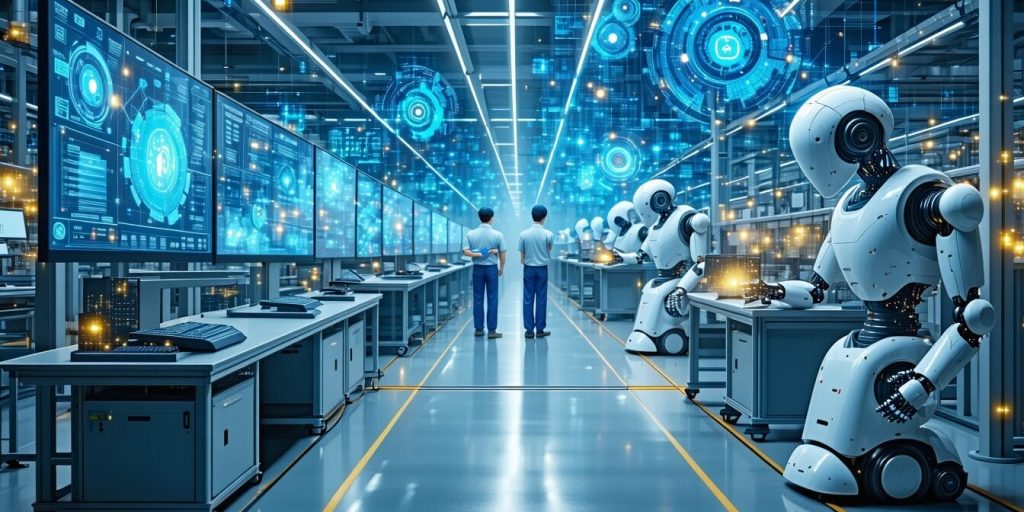
The integration of AI and robotics is revolutionizing multiple domains.
3.1 Industrial Automation and Smart Manufacturing
AI-powered robots enhance manufacturing efficiency and flexibility:
- Predictive maintenance: AI algorithms analyze sensor data to prevent downtime.
- Adaptive assembly lines: Robots adjust their actions in real-time to accommodate variability in parts or workflows.
- Collaborative production: Cobots work alongside human operators, optimizing labor and safety.
This synergy increases productivity, reduces operational costs, and introduces flexibility previously unattainable in traditional automation.
3.2 Healthcare and Medical Robotics
AI-robotics integration has significant impact in medicine:
- Surgical robots: AI assists in planning and executing minimally invasive procedures with high precision.
- Rehabilitation robotics: Adaptive therapy robots monitor patient progress and adjust exercises dynamically.
- Elderly care and companion robots: Provide social interaction, cognitive stimulation, and physical assistance.
AI enhances the robot’s ability to personalize treatment, predict patient needs, and safely interact in sensitive healthcare environments.
3.3 Service and Domestic Applications
Service robots leverage AI to perform tasks in homes, offices, and public spaces:
- Robotic cleaners and assistants: Navigate unstructured environments, learn user habits, and optimize task efficiency.
- Customer service robots: Use AI for dialogue, understanding context, and emotional interaction.
- Delivery and logistics robots: Plan routes dynamically, avoid obstacles, and interact safely with humans.
These applications illustrate how AI transforms robots from tools into intelligent companions capable of complex interactions.
3.4 Autonomous Vehicles and Drones
Autonomous vehicles exemplify the integration of perception, cognition, and action:
- Self-driving cars: AI interprets sensor data, predicts human behavior, and makes real-time driving decisions.
- Delivery and surveillance drones: Navigate complex urban or industrial environments, optimizing flight paths and task execution autonomously.
These systems demonstrate the potential of AI-powered robotics to operate safely and efficiently in highly dynamic environments.
3.5 Research, Exploration, and Hazardous Environments
AI-powered robots are increasingly deployed in domains hazardous to humans:
- Space exploration: Robots like NASA’s Perseverance rover use AI to navigate unpredictable terrains.
- Disaster response: AI-guided robots perform search and rescue, damage assessment, and hazardous material handling.
- Environmental monitoring: Robots equipped with AI can track wildlife, monitor pollution, and analyze ecosystems autonomously.
Such applications highlight the ability of AI-enabled robots to extend human reach and capability in extreme environments.
4. Societal and Ethical Implications
The integration of robotics and AI carries profound societal and ethical consequences:
4.1 Workforce Transformation
AI-powered robots are reshaping labor markets:
- Automation of repetitive and hazardous tasks improves efficiency and safety.
- Cognitive robots may complement human workers in decision-intensive roles.
- Upskilling and retraining are necessary to mitigate displacement and leverage human-robot collaboration.
4.2 Human-Robot Interaction and Social Dynamics
As robots enter human spaces, social and ethical design becomes critical:
- AI enables robots to recognize emotions, gestures, and social cues, promoting intuitive interaction.
- Privacy, consent, and data security are key concerns, particularly for companion and surveillance robots.
- Ethical frameworks are needed to guide acceptable behavior and decision-making in autonomous systems.
4.3 Governance and Accountability
AI-powered robots raise questions of responsibility:
- Who is accountable for autonomous decisions, errors, or accidents?
- How should ethical dilemmas, such as prioritizing safety in unavoidable collisions, be resolved?
- Regulatory frameworks must balance innovation with public safety and trust.
4.4 Equity and Accessibility
The societal impact of AI-powered robotics will vary across regions and demographics:
- Ensuring equitable access to these technologies is crucial to avoid widening digital divides.
- Inclusive design principles are necessary to ensure that robots serve diverse populations.
5. Future Directions
The future of AI-powered robotics is poised for transformative impact:
5.1 Swarm and Collective Robotics
AI enables coordination among multiple robots, creating swarm intelligence:
- Applications include logistics, environmental monitoring, and disaster response.
- Distributed decision-making allows adaptive and resilient operations at scale.
5.2 Cognitive and Emotional Robotics
Future robots may combine AI with emotional intelligence:
- Understanding human emotions and social context will improve collaboration and care provision.
- Cognitive robots may participate in decision-making and problem-solving alongside humans.
5.3 Integration with Quantum Computing and Edge AI
Advances in quantum computing and edge AI could accelerate robotic cognition:
- Quantum algorithms may enable faster optimization and complex problem-solving.
- Edge AI allows robots to process data locally, enhancing responsiveness and autonomy.
5.4 Ethical AI and Human-Centered Design
As AI-robotics integration deepens, ethical and human-centered design principles will be central:
- Transparent and explainable AI ensures trust and accountability.
- Standards for safety, privacy, and social impact will guide responsible adoption.
Conclusion
The fusion of robotics and AI represents a profound technological and societal milestone. By combining the physical capabilities of robots with the cognitive power of AI, we are witnessing the emergence of intelligent autonomous agents capable of perceiving, learning, adapting, and interacting in complex, real-world environments.
This integration enhances industrial productivity, healthcare outcomes, human-robot collaboration, and exploration of extreme environments, while also raising critical questions regarding ethics, governance, and social equity. The ongoing convergence of AI and robotics is not merely a technological evolution—it is a transformative force redefining human potential, societal structures, and the future of work, care, and interaction.
As AI-powered robots become increasingly capable and autonomous, their profound significance lies not only in what they do but in how they redefine the boundaries of human capability, cooperation, and imagination.