










Introduction: From Automation Tools to Intelligent Partners
Over the past two decades, industrial automation has transformed global manufacturing. Traditional industrial robots—powerful, precise, and fast—reshaped production lines, particularly in automotive, electronics, and heavy industry. Yet these systems were typically isolated from human workers, operating behind safety cages and performing narrowly defined, repetitive tasks.
Today, a new paradigm is emerging. Collaborative robots (cobots)—designed to work safely alongside humans—are rapidly integrating with artificial intelligence (AI) technologies. This convergence is redefining what robots can do, how they are deployed, and why they matter strategically. No longer limited to simple assistance, AI-powered cobots are becoming adaptive, perceptive, and increasingly autonomous, capable of learning from their environments and collaborating with humans in complex, dynamic settings.
As a result, collaborative robotics integrated with AI is evolving into a core competitive advantage for companies across manufacturing, logistics, healthcare, and beyond. This article provides an in-depth, professional exploration of this transformation: the technologies behind it, the economic and strategic drivers, real-world applications, challenges, and its long-term implications for industry and work.
1. The Evolution of Collaborative Robots
1.1 What Makes a Robot “Collaborative”?
Collaborative robots differ fundamentally from traditional industrial robots. Their defining characteristics include:
- Designed-in safety features such as force and torque limiting
- Lightweight structures and rounded edges
- Ability to operate without physical barriers
- Ease of programming and redeployment
These features enable cobots to share workspaces with humans, making automation accessible to small and medium-sized enterprises (SMEs) as well as large manufacturers.
1.2 From Simple Assistance to Intelligent Collaboration
Early cobots were primarily used for tasks such as pick-and-place, screwdriving, and simple assembly. Their intelligence was limited, relying on pre-programmed motions and structured environments.
The integration of AI has fundamentally changed this picture. Modern cobots can now:
- Recognize objects and gestures
- Adapt to variable parts and workflows
- Optimize motion based on context
- Learn new tasks with minimal programming
This evolution marks the transition from passive automation to active collaboration.
2. Why AI Integration Is Transformational
2.1 Beyond Deterministic Programming
Traditional robot programming is deterministic: every motion is explicitly defined. While precise, this approach struggles with variability. AI enables cobots to operate under uncertainty by introducing:
- Perception through computer vision
- Decision-making through machine learning
- Adaptation through reinforcement learning
As a result, robots can respond to changes in their environment rather than failing when conditions deviate from expectations.
2.2 From Tools to Cognitive Systems
AI transforms cobots from mechanical tools into cognitive systems. They can perceive, reason, and act—key components of what is increasingly referred to as physical AI. This cognitive capability is essential for operating in human-centric environments where unpredictability is the norm.
3. Core Technologies Driving AI-Cobot Integration
3.1 Computer Vision and Perception
Vision systems powered by deep learning allow cobots to:
- Identify objects regardless of orientation
- Detect defects and variations
- Track human movement for safe collaboration
This eliminates the need for rigid fixturing and highly controlled setups.
3.2 Machine Learning and Adaptive Control
Machine learning enables robots to improve performance over time by:
- Optimizing trajectories for efficiency
- Adjusting grip force based on object properties
- Learning from human demonstrations
Such adaptability significantly reduces setup time and increases flexibility.
3.3 Natural Human-Robot Interaction
AI-powered interfaces allow humans to interact with cobots using:
- Voice commands
- Gestures
- Visual cues
This lowers the barrier to adoption and empowers non-experts to work effectively with robots.
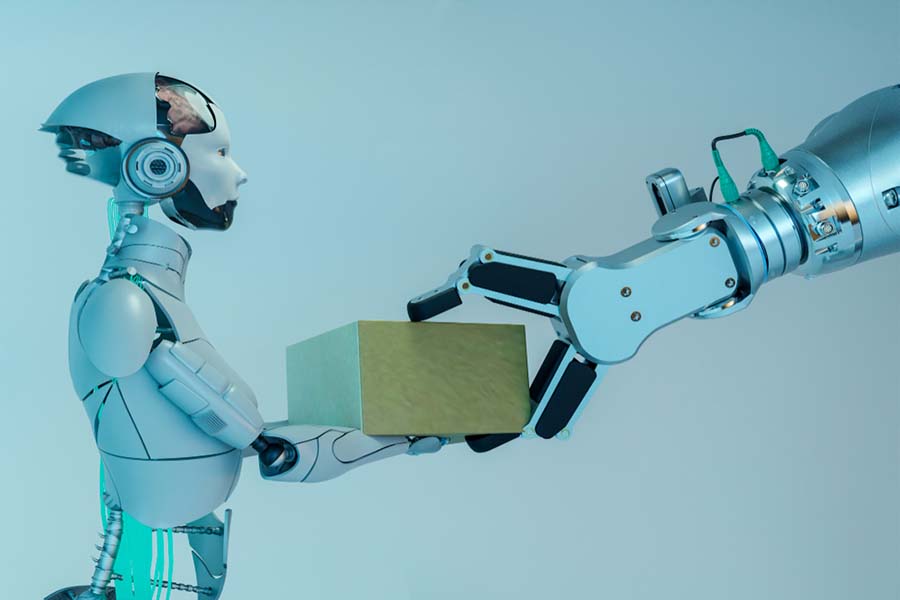
4. Safety and Trust in Human-Robot Collaboration
4.1 AI-Enhanced Safety Mechanisms
Safety is central to collaboration. AI enhances safety by enabling:
- Real-time collision prediction
- Dynamic speed and force adjustment
- Context-aware risk assessment
These capabilities allow cobots to operate safely even in close proximity to humans.
4.2 Building Human Trust
Trust is not only a technical issue but also a psychological one. AI-driven transparency—such as predictable behavior and explainable actions—helps workers feel confident and comfortable working alongside robots.
5. Strategic Value: Why AI-Powered Cobots Are a Competitive Advantage
5.1 Flexibility in a Volatile Market
Modern markets demand customization, short product cycles, and rapid change. AI-integrated cobots enable manufacturers to:
- Switch tasks quickly
- Adapt to new products without major retooling
- Scale automation incrementally
This flexibility is a decisive advantage in competitive environments.
5.2 Productivity Without Workforce Displacement
Unlike traditional automation, collaborative robotics emphasizes augmentation rather than replacement. Humans focus on judgment, creativity, and problem-solving, while robots handle repetitive or physically demanding tasks.
This synergy improves productivity while maintaining workforce stability.
5.3 Faster Return on Investment (ROI)
AI-enabled cobots reduce:
- Programming and integration time
- Downtime due to errors or variability
- Training costs for operators
These factors contribute to faster ROI compared to conventional automation systems.
6. Applications Across Industries
6.1 Manufacturing and Assembly
In manufacturing, AI-powered cobots assist with:
- Complex assembly with variable components
- Quality inspection using vision systems
- Machine tending and material handling
Their ability to adapt makes them ideal for high-mix, low-volume production.
6.2 Logistics and Warehousing
Cobots equipped with AI support:
- Order picking and sorting
- Palletizing with mixed loads
- Human-guided navigation in dynamic spaces
They enhance efficiency without requiring fully automated warehouses.
6.3 Healthcare and Laboratories
In healthcare, collaborative robots assist with:
- Sample handling and preparation
- Sterilization and logistics
- Rehabilitation and physical therapy
AI ensures precision, safety, and adaptability in sensitive environments.
7. Integration with Digital Manufacturing Ecosystems
7.1 AI Cobots and Smart Factories
AI-integrated cobots are key components of smart factories. They connect with:
- Manufacturing execution systems (MES)
- Digital twins
- Predictive maintenance platforms
This connectivity enables data-driven optimization across the production lifecycle.
7.2 Learning Across Fleets
Cloud-enabled AI allows cobots to:
- Share performance data
- Learn collectively across deployments
- Receive continuous updates
Such collective intelligence accelerates improvement and scalability.
8. Workforce Transformation and Skills Evolution
8.1 New Roles for Human Workers
As AI-powered cobots take on physical tasks, human roles shift toward:
- Robot supervision and coordination
- Process optimization
- Data analysis and continuous improvement
This evolution demands reskilling but also creates higher-value jobs.
8.2 Democratizing Automation
Intuitive AI interfaces reduce reliance on specialized programmers. Line workers can teach robots tasks directly, democratizing automation and increasing organizational agility.
9. Challenges and Limitations
9.1 Data and Training Requirements
AI systems require high-quality data. Collecting, labeling, and maintaining this data remains a challenge, particularly in unstructured environments.
9.2 Reliability and Edge Cases
While AI improves adaptability, it can struggle with rare or unforeseen scenarios. Ensuring consistent performance under all conditions is critical for industrial deployment.
9.3 Standardization and Interoperability
The robotics ecosystem remains fragmented. Achieving interoperability across hardware, software, and AI frameworks is essential for widespread adoption.
10. Regulation, Ethics, and Responsibility
10.1 Safety Standards and Certification
As cobots become more autonomous, regulatory frameworks must evolve to address:
- AI-driven decision-making
- Shared human-robot responsibility
- Accountability in case of failure
Clear standards will be essential to maintain trust and safety.
10.2 Ethical Considerations
Ethical concerns include:
- Worker surveillance through AI systems
- Bias in AI decision-making
- Transparency in human-robot collaboration
Addressing these issues proactively will shape public acceptance.
11. The Road Ahead: Toward Cognitive Collaboration
11.1 From Task Execution to Goal Understanding
Future AI-powered cobots will move beyond executing tasks to understanding goals. Humans may specify what needs to be done, while robots determine how to do it.
11.2 Continuous Learning in the Physical World
Advances in reinforcement learning and simulation will enable cobots to:
- Learn safely through virtual environments
- Transfer skills from simulation to reality
- Improve continuously during operation
This capability will further reduce deployment barriers.
12. Long-Term Impact on Global Competitiveness
12.1 A New Benchmark for Industrial Excellence
Companies that successfully integrate AI-powered collaborative robots will gain:
- Greater operational resilience
- Faster innovation cycles
- Improved worker satisfaction
These advantages will define industrial leaders in the coming decade.
12.2 Redefining the Human-Machine Relationship
The rise of collaborative robots signals a broader shift in how humans interact with machines—not as masters or competitors, but as partners.
Conclusion: Collaboration as the New Automation Paradigm
The integration of collaborative robots and artificial intelligence marks a turning point in the evolution of automation. What began as a solution for safe human-robot interaction has become a strategic lever for flexibility, productivity, and innovation.
AI-powered cobots are no longer optional enhancements; they are becoming core competitive assets. By enabling intelligent collaboration, adaptive behavior, and seamless integration into digital ecosystems, these systems redefine what automation can achieve.
In the years ahead, the organizations that thrive will not be those that automate the most, but those that collaborate the best—leveraging the complementary strengths of humans and intelligent machines. In this new era, collaborative robots integrated with AI are not just tools of efficiency; they are catalysts of industrial transformation and long-term competitiveness.