









Introduction
Robotics has become one of the most transformative forces shaping modern military operations and a wide range of unconventional applications. What began as rudimentary remotely controlled machines has evolved into sophisticated, semi-autonomous and increasingly autonomous systems capable of operating in complex, hostile, and unpredictable environments. Today, robots are deployed not only on traditional battlefields, but also in intelligence gathering, logistics, disaster response, counterterrorism, border security, nuclear decommissioning, space exploration, and humanitarian missions.
The evolution of robotics in military and unconventional domains reflects broader technological progress in artificial intelligence (AI), sensors, communications, materials science, and energy systems. At the same time, it raises profound strategic, ethical, legal, and societal questions. As robots assume greater roles in decision-making and physical action, they redefine how power is projected, how risks are managed, and how humans interact with machines under extreme conditions.
This article provides an in-depth, professional analysis of the evolution of robots in military and unconventional applications. It traces historical development, examines key technological drivers, explores current and emerging use cases across domains, and assesses the strategic, ethical, and future implications of robotic systems in environments where stakes are exceptionally high.
1. Early Foundations: From Remote Control to Battlefield Utility
1.1 Origins in Military Engineering
The earliest military robots were not autonomous machines but remotely operated devices designed to reduce human exposure to danger. During the mid-20th century, militaries experimented with radio-controlled vehicles for reconnaissance and explosive delivery. These systems were limited by rudimentary control mechanisms, unreliable communications, and lack of real-time situational awareness.
Nevertheless, the motivation was clear: use machines to perform tasks too dangerous for soldiers. This principle remains central to military robotics today.
1.2 Cold War Era Developments
During the Cold War, advances in electronics and control theory led to more capable unmanned systems. Militaries invested heavily in:
- Remote-controlled reconnaissance vehicles
- Early unmanned aerial vehicles (UAVs) for surveillance
- Automated missile guidance systems
While autonomy remained minimal, these technologies laid the groundwork for future robotic platforms by proving the strategic value of unmanned systems.
2. The Rise of Unmanned Aerial Systems
2.1 UAVs as the First Scalable Military Robots
Unmanned aerial vehicles represent the most mature and widely deployed class of military robots. Initially used for reconnaissance, UAVs rapidly expanded into roles such as:
- Intelligence, surveillance, and reconnaissance (ISR)
- Target acquisition and tracking
- Communication relay
- Precision strike operations
The combination of persistent presence, reduced pilot risk, and operational flexibility made UAVs indispensable.
2.2 Autonomy and Network-Centric Warfare
Modern UAVs increasingly rely on AI for:
- Autonomous navigation
- Real-time object recognition
- Adaptive mission planning
Network-centric architectures allow multiple UAVs to share data and coordinate actions, transforming them from isolated platforms into integrated robotic systems.
3. Ground Robots and the Modern Battlefield
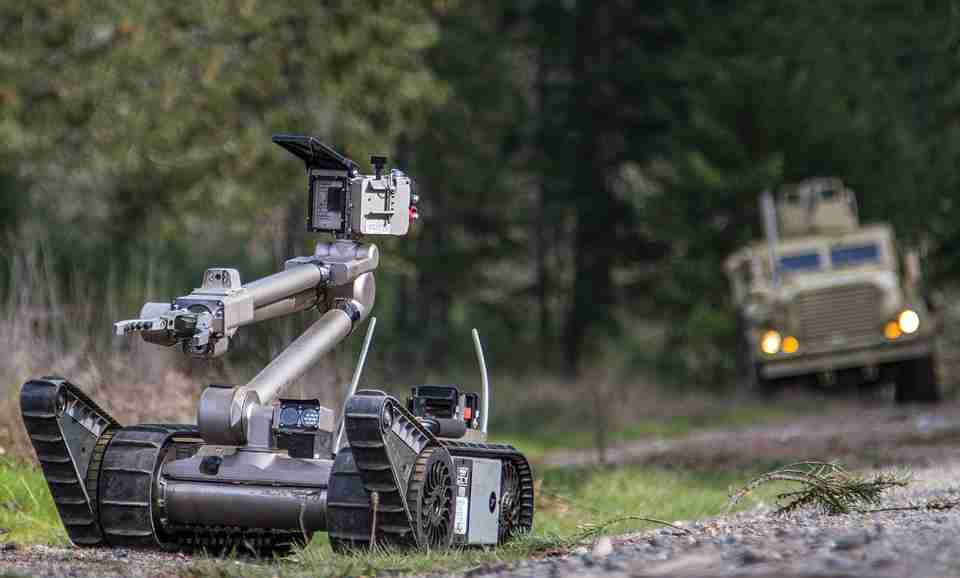
3.1 Explosive Ordnance Disposal (EOD) Robots
One of the earliest and most successful ground robot applications is explosive ordnance disposal. EOD robots are designed to:
- Inspect suspicious objects
- Disarm or detonate explosives remotely
- Operate in confined and hazardous environments
Their widespread adoption demonstrates the tangible life-saving value of robotics in military contexts.
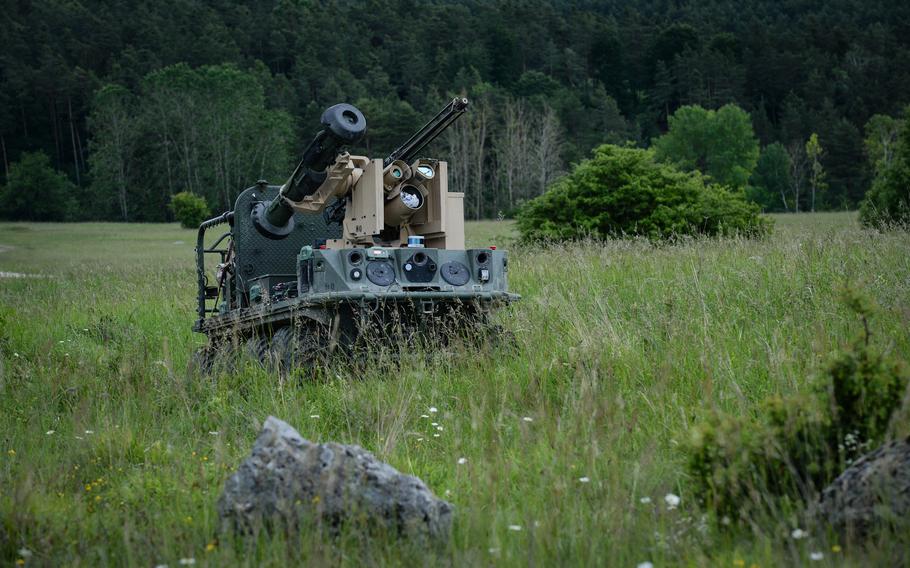
3.2 Unmanned Ground Vehicles (UGVs)
Beyond EOD, unmanned ground vehicles have expanded into roles such as:
- Logistics and resupply
- Reconnaissance and patrol
- Casualty evacuation
- Direct fire support in limited scenarios
Advances in mobility, perception, and control have enabled UGVs to operate in rough terrain and urban environments, though full autonomy remains challenging.
4. Maritime and Underwater Robotics
4.1 Unmanned Surface and Underwater Vehicles
Naval forces increasingly rely on unmanned surface vehicles (USVs) and unmanned underwater vehicles (UUVs) for:
- Mine countermeasures
- Anti-submarine warfare
- Surveillance and reconnaissance
- Infrastructure inspection
Operating in maritime environments presents unique challenges, including communication constraints, pressure, corrosion, and limited GPS availability.
4.2 Strategic Importance of Underwater Robotics
Underwater robots play a critical role in protecting undersea infrastructure such as cables and pipelines. Their ability to operate discreetly and persistently makes them strategic assets in modern naval competition.
5. AI and Autonomy: Transforming Military Robotics
5.1 From Teleoperation to Autonomous Decision-Making
Early military robots depended entirely on human operators. Today, AI enables varying degrees of autonomy:
- Assisted autonomy for navigation and stabilization
- Supervised autonomy for task execution
- Limited autonomous decision-making in constrained scenarios
The progression toward autonomy is driven by the need for faster response times and reduced cognitive load on human operators.
5.2 Swarm Robotics and Distributed Systems
Swarm robotics represents a paradigm shift. Rather than relying on a single complex platform, militaries explore large numbers of simpler robots that cooperate through decentralized algorithms. Potential advantages include:
- Redundancy and resilience
- Cost-effectiveness
- Saturation of adversary defenses
Swarm concepts are being tested across aerial, ground, and maritime domains.
6. Robotics in Intelligence, Surveillance, and Reconnaissance
6.1 Persistent Sensing and Data Collection
Robots excel at persistent monitoring. Autonomous systems can:
- Patrol borders and perimeters
- Monitor contested regions
- Collect environmental and electronic intelligence
This capability enhances situational awareness while minimizing human exposure.
6.2 Multi-Modal Sensing and Fusion
Modern military robots integrate visual, infrared, radar, acoustic, and electronic sensors. AI-driven sensor fusion transforms raw data into actionable intelligence, enabling faster and more informed decisions.
7. Logistics, Maintenance, and Support Roles
7.1 Autonomous Logistics
Logistics is a critical yet vulnerable component of military operations. Robots are increasingly used for:
- Autonomous convoy operations
- Supply delivery in contested environments
- Warehouse automation at military bases
By reducing reliance on human drivers and manual labor, robotics improves efficiency and survivability.
7.2 Maintenance and Repair Robots
Robotic systems assist in inspecting and maintaining complex equipment, including aircraft, vehicles, and infrastructure. In hazardous or remote locations, robots can perform repairs that would otherwise require risky human intervention.
8. Unconventional Applications Beyond the Battlefield
8.1 Disaster Response and Humanitarian Missions
Robots developed for military use often transition into civilian disaster response. In earthquakes, nuclear accidents, and industrial disasters, robots can:
- Search for survivors
- Map hazardous environments
- Handle dangerous materials
Their ability to operate where humans cannot makes them invaluable tools in humanitarian contexts.
8.2 Counterterrorism and Law Enforcement
Robotic platforms support counterterrorism operations by providing reconnaissance, negotiation support, and non-lethal intervention capabilities. Precision and remote operation reduce risk to both security personnel and civilians.
8.3 Nuclear, Chemical, and Biological Hazards
Robots are essential in environments contaminated by radiation, chemicals, or biological agents. Tasks include sampling, decontamination, and infrastructure stabilization—roles that would be life-threatening for humans.
9. Space and Extreme Environment Robotics
9.1 Military Interests in Space Robotics
While space robotics is often associated with scientific exploration, military interest is growing. Robots may be used for:
- Satellite servicing and inspection
- Space debris removal
- Situational awareness in orbit
These capabilities intersect with national security and space domain awareness.
9.2 Lessons from Extreme Environments
Robots designed for space, deep sea, or polar regions contribute technologies—such as robust autonomy and energy efficiency—that feed back into military and unconventional applications.
10. Human–Robot Interaction in High-Risk Environments
10.1 Trust and Reliability
Effective deployment of military robots depends on operator trust. Systems must be predictable, explainable, and reliable, especially in life-or-death situations.
10.2 Cognitive Load and Interface Design
Advanced human–machine interfaces, including augmented reality and intuitive controls, help operators manage complex robotic systems without overload.
11. Ethical, Legal, and Strategic Considerations
11.1 Autonomous Weapons and Moral Responsibility
The potential use of autonomous lethal systems raises fundamental ethical questions:
- Who is responsible for machine decisions?
- How can compliance with international humanitarian law be ensured?
- Should machines be allowed to make life-and-death decisions?
These debates are central to the future of military robotics.
11.2 International Regulation and Arms Control
Efforts to regulate autonomous weapons systems reflect concerns about escalation, accountability, and unintended consequences. However, technological asymmetries and strategic competition complicate consensus.
12. Strategic Implications for Global Security
12.1 Changing Nature of Warfare
Robotics alters military strategy by:
- Reducing human casualties
- Increasing operational tempo
- Expanding the battlespace into new domains
These changes challenge traditional doctrines and force structures.
12.2 Asymmetric Advantages and Proliferation Risks
Robotic technologies can level the playing field for smaller actors, enabling asymmetric tactics. At the same time, proliferation raises risks of misuse by non-state actors.
13. Future Trends in Military and Unconventional Robotics
13.1 Greater Autonomy with Human Oversight
The near-term future likely emphasizes “human-on-the-loop” systems, where humans supervise autonomous operations and retain ultimate authority.
13.2 Integration of Generative and Cognitive AI
Advances in AI reasoning and learning will enable robots to adapt to novel situations, coordinate more effectively, and understand intent—both human and adversarial.
13.3 Convergence of Military and Civilian Robotics
Technological boundaries between military and civilian robotics will continue to blur, accelerating innovation while raising governance challenges.
14. Societal and Cultural Impacts
14.1 Public Perception and Acceptance
Societal attitudes toward military robots influence policy and adoption. Transparency, ethical frameworks, and clear communication are essential to maintaining public trust.
14.2 Workforce Transformation
As robots assume hazardous roles, military and security personnel increasingly focus on supervision, analysis, and strategic decision-making rather than direct physical engagement.
Conclusion
The evolution of robots in military and unconventional applications reflects a broader transformation in how technology intersects with security, risk, and human responsibility. From early remote-controlled devices to advanced AI-enabled systems, robots have progressively assumed roles once considered uniquely human—operating in environments defined by danger, uncertainty, and moral complexity.
These systems offer undeniable benefits: reduced risk to human life, enhanced situational awareness, and expanded operational capabilities. At the same time, they challenge existing ethical frameworks, legal norms, and strategic doctrines. The future of military and unconventional robotics will depend not only on technological progress, but on thoughtful governance, international cooperation, and responsible design.
As robotics continues to evolve, its role in military and unconventional domains will likely expand further—shaping how societies manage conflict, respond to disasters, and operate in the most extreme environments imaginable. The central challenge will be ensuring that these powerful tools serve human values, enhance security, and contribute to stability rather than undermine it.