









Introduction
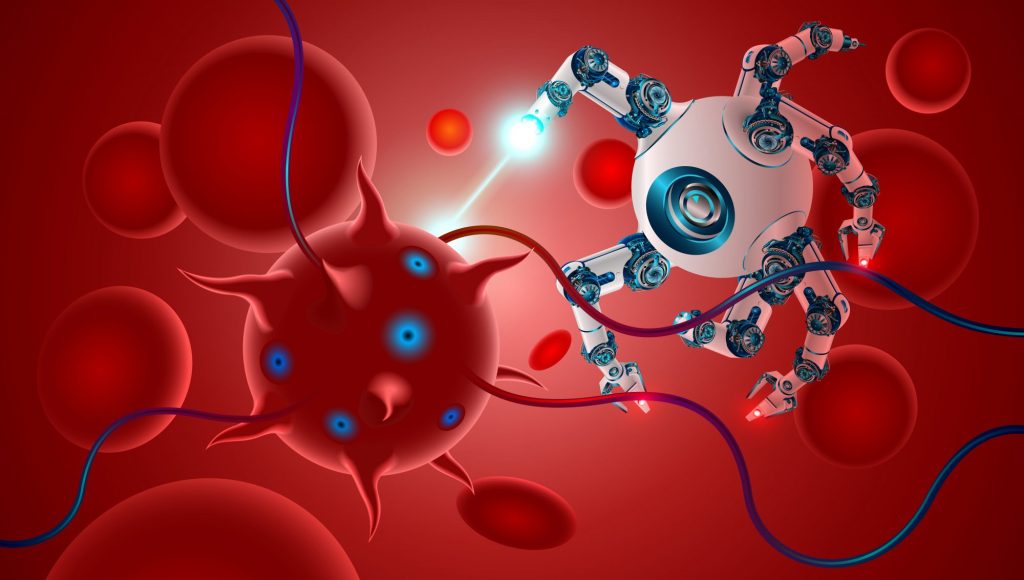
Among the many frontiers of modern robotics, microrobots capable of operating inside the human body represent one of the most ambitious, interdisciplinary, and potentially transformative directions. These tiny machines—often ranging from millimeters down to micrometers in scale—are designed to navigate complex biological environments such as blood vessels, organs, and tissues, performing tasks that were previously impossible or extremely risky with conventional medical tools.
The concept of in vivo microrobots has evolved from science fiction into an active field of scientific research and early-stage clinical experimentation. Enabled by advances in microfabrication, materials science, biomedical engineering, control systems, artificial intelligence, and medical imaging, these systems promise to revolutionize healthcare by enabling:
- Minimally invasive diagnosis and therapy
- Targeted drug delivery with unprecedented precision
- Localized surgical interventions
- Real-time sensing and monitoring inside the body
- Reduced patient trauma and recovery time
This article presents a comprehensive, professional, and structured analysis of microrobots designed for operation inside the human body. It explores the scientific foundations, engineering approaches, actuation and control strategies, medical applications, ethical and regulatory challenges, and future development pathways of this rapidly evolving domain.
1. Defining In Vivo Microrobots
1.1 What Are In Vivo Microrobots?
In vivo microrobots are artificial, controllable micro-scale systems capable of operating within living organisms, particularly the human body. Unlike traditional surgical instruments or implantable medical devices, these microrobots are:
- Mobile rather than fixed
- Actively controllable or semi-autonomous
- Designed to interact directly with biological tissues and fluids
- Often retrieved or biodegraded after completing their mission
They may operate individually or as part of a swarm, depending on the medical objective.
1.2 Why Size Matters in the Human Body
The human body is a highly constrained, dynamic, and delicate environment. At small scales:
- Blood flow becomes a dominant force
- Viscosity outweighs inertia
- Mechanical access is severely limited
- Tissue damage risks increase rapidly with tool size
Microrobots overcome these constraints by matching the scale of biological structures, allowing them to move through capillaries, ducts, and interstitial spaces that are inaccessible to conventional devices.
2. Historical Evolution and Scientific Foundations
2.1 From Conceptual Vision to Experimental Reality
The idea of medical microrobots can be traced back to visionary concepts in the mid-20th century. However, practical progress only became possible with:
- The development of micro-electro-mechanical systems (MEMS)
- Advances in medical imaging technologies
- Improvements in external field generation and control
- Breakthroughs in biocompatible materials
Early prototypes were largely proof-of-concept systems, demonstrating basic locomotion or navigation in simplified environments. Today, research has progressed toward functional microrobots tested in animal models and simulated clinical scenarios.
2.2 Interdisciplinary Nature of the Field
In vivo microrobotics sits at the intersection of multiple disciplines:
- Robotics and control theory
- Biomedical engineering
- Materials science and chemistry
- Medicine and physiology
- Artificial intelligence and data science
Progress depends not on a single breakthrough, but on coordinated advances across all these domains.
3. Locomotion and Actuation Inside the Human Body
3.1 The Challenge of Actuation at Micro Scale
Traditional motors and batteries are impractical at micrometer scales. As a result, in vivo microrobots rely on non-conventional actuation mechanisms, often powered externally.
Key requirements include:
- Precise controllability
- Biocompatibility
- Minimal heat generation
- Safe interaction with tissues
3.2 Magnetic Actuation
Magnetic actuation is currently the most widely researched approach for in vivo microrobots.
Advantages:
- Magnetic fields penetrate biological tissue safely
- No onboard power source is required
- Precise control through external electromagnetic systems
Applications:
- Steering microrobots through blood vessels
- Rotating helical swimmers inspired by bacterial flagella
- Positioning robots for localized drug release
Magnetic microrobots can be guided using MRI-like systems, electromagnetic coils, or portable magnetic controllers.
3.3 Bioinspired and Fluidic Locomotion
Some microrobots mimic biological locomotion strategies:
- Flagella-like propulsion
- Undulatory swimming
- Surface crawling using cilia-inspired structures
These designs are particularly effective in low-Reynolds-number environments, such as blood or mucus.
3.4 Chemical and Hybrid Actuation
Experimental approaches include:
- Chemical reactions that generate propulsion
- Hybrid systems combining biological cells with artificial structures
While promising, these methods face challenges related to controllability, safety, and predictability.
4. Materials and Biocompatibility
4.1 Requirements for In Vivo Use
Materials used in medical microrobots must satisfy strict criteria:
- Non-toxic and biocompatible
- Chemically stable or safely biodegradable
- Mechanically suitable for soft tissue interaction
- Compatible with medical imaging modalities
4.2 Soft and Flexible Materials
Soft robotics plays a critical role in in vivo microrobotics:
- Reduced risk of tissue damage
- Better conformity to anatomical structures
- Improved navigation in deformable environments
Materials include:
- Hydrogels
- Elastomers
- Shape-memory polymers
4.3 Biodegradable Microrobots
A key research direction involves biodegradable microrobots that dissolve after completing their task, eliminating the need for retrieval and reducing long-term risk.
5. Sensing, Imaging, and Localization
5.1 The Localization Problem
Knowing where a microrobot is inside the body is one of the most difficult challenges. Common solutions include:
- External imaging systems (MRI, ultrasound, X-ray)
- Magnetic field-based localization
- Optical tracking in transparent or semi-transparent tissues
Each approach involves trade-offs between resolution, safety, cost, and real-time capability.
5.2 Embedded Sensing
Advanced microrobots may include:
- Chemical sensors for pH or biomarkers
- Mechanical sensors for force or pressure
- Temperature sensors for thermal monitoring
Due to size constraints, sensing capabilities are often minimal and heavily optimized.
6. Control Strategies and Intelligence
6.1 External Control Systems
Most current in vivo microrobots rely on external human-in-the-loop control, where clinicians guide robots using imaging feedback and control interfaces.
6.2 Toward Semi-Autonomous Operation
Future systems aim to incorporate:
- AI-based navigation assistance
- Adaptive control algorithms
- Limited onboard decision-making
This shift is essential for:
- Reducing cognitive load on clinicians
- Improving precision and repeatability
- Enabling coordinated swarm behavior
6.3 Swarm Microrobotics in Medicine
Swarm approaches enable:
- Parallelized drug delivery
- Redundancy and fault tolerance
- Collective sensing and action
Medical swarms can adapt to complex environments where single robots would fail.
7. Key Medical Applications
7.1 Targeted Drug Delivery
Microrobots can transport drugs directly to disease sites, such as tumors or localized infections.
Benefits include:
- Higher therapeutic concentration at target sites
- Reduced systemic side effects
- Dynamic control over dosage and timing
This approach is especially promising in oncology and chronic disease treatment.
7.2 Minimally Invasive Surgery
Microrobots enable surgical interventions without large incisions, including:
- Localized tissue ablation
- Removal of small obstructions
- Precise manipulation in confined spaces
This reduces trauma, pain, and recovery time.
7.3 Diagnostics and Biopsy
Microrobots can:
- Collect tissue samples
- Measure local biochemical signals
- Perform early disease detection
They enable diagnostics at resolutions previously unattainable.
7.4 Vascular and Gastrointestinal Applications
Navigation through blood vessels or the gastrointestinal tract allows:
- Treatment of blockages
- Localized monitoring
- Targeted therapy delivery
8. Safety, Ethics, and Regulation
8.1 Patient Safety
Key safety concerns include:
- Unintended tissue damage
- Loss of control or localization
- Long-term biocompatibility
Redundant control and fail-safe mechanisms are essential.
8.2 Ethical Considerations
Ethical questions arise around:
- Informed consent
- Data privacy from in vivo sensing
- Potential misuse or dual-use technologies
Transparent governance frameworks are critical.
8.3 Regulatory Pathways
Medical microrobots must comply with stringent regulatory standards, requiring:
- Extensive preclinical testing
- Clear risk-benefit analysis
- Long-term monitoring plans
Regulatory agencies are still adapting to this emerging technology.
9. Industrial and Clinical Translation Challenges
Despite strong academic progress, large-scale clinical adoption faces obstacles:
- High development and validation costs
- Integration with existing medical workflows
- Training requirements for clinicians
- Limited reimbursement models
Bridging the gap between laboratory prototypes and clinical products remains a central challenge.
10. Future Directions and Long-Term Vision
10.1 AI-Driven Personalized Microrobotics
Future systems may adapt behavior based on:
- Patient-specific anatomy
- Real-time physiological data
- Personalized treatment goals
10.2 Biohybrid Microrobots
Combining living cells with artificial structures may enable:
- Self-healing capabilities
- Enhanced biocompatibility
- Novel locomotion and sensing mechanisms
10.3 Fully Integrated Medical Microrobot Ecosystems
Long-term visions include:
- Networks of microrobots coordinated with macro-scale medical robots
- Continuous in vivo monitoring systems
- Autonomous therapeutic interventions
Conclusion
Microrobots capable of operating inside the human body represent one of the most profound technological shifts in modern medicine and robotics’s future. By merging robotics, biology, and artificial intelligence at unprecedented scales, these systems offer the potential to transform how diseases are diagnosed, treated, and managed.
Although significant challenges remain—particularly in safety, control, regulation, and clinical integration—the trajectory is clear. In vivo microrobotics will move from experimental research to practical medical tools, enabling precision medicine, minimally invasive therapy, and entirely new models of healthcare delivery.
In the coming decades, these tiny machines may fundamentally redefine the relationship between technology and the human body, making healthcare more precise, less invasive, and more personalized than ever before.