









Abstract
The convergence of Information Technology (IT) and Operational Technology (OT) represents a critical paradigm shift in modern industrial systems. Traditionally, IT and OT operated in silos: IT focused on enterprise data, analytics, and software systems, while OT managed industrial processes, control systems, and machinery operations. The integration of these domains enables real-time data-driven decision-making, predictive maintenance, and optimized production workflows, laying the foundation for advanced concepts such as Digital Twin (DT) technology. Digital twins, virtual representations of physical assets, processes, or systems, leverage IT/OT convergence to simulate, monitor, and optimize operations in real-time. This article provides a comprehensive, professional analysis of IT/OT convergence, digital twin architecture, implementation strategies, benefits, challenges, and future trends. Emphasis is placed on industrial applications, smart manufacturing, and the role of emerging technologies such as AI, IoT, and edge computing.
1. Introduction
Industrial transformation is increasingly driven by data-centric strategies and automation. IT/OT convergence and digital twin technology are central to achieving Industry 4.0 objectives, including:
- Real-time monitoring and predictive analytics
- Process optimization and operational efficiency
- Reduced downtime and maintenance costs
- Enhanced safety and regulatory compliance
- Accelerated product development and testing
While IT has traditionally focused on enterprise systems, cloud computing, and business intelligence, OT has been responsible for programmable logic controllers (PLCs), SCADA systems, robotics, and manufacturing execution systems (MES). The integration of these domains, supported by IoT, AI, and high-speed communication networks, enables end-to-end visibility across production, supply chains, and operational assets.
Digital twin technology emerges as a natural extension of IT/OT convergence, providing a virtual, dynamic model of physical systems that reflects real-time operational data and enables simulation, prediction, and optimization.
2. Understanding IT/OT Convergence
2.1 Definitions
- Information Technology (IT): Focuses on data management, enterprise systems, cybersecurity, and software applications.
- Operational Technology (OT): Manages physical processes, machinery, industrial control systems, and automation devices.
- IT/OT Convergence: The seamless integration of IT and OT systems to enable real-time data sharing, analytics, and coordinated decision-making across organizational layers.
2.2 Drivers of Convergence
- Digitalization of industrial assets: Sensors, smart devices, and IoT nodes generate real-time data.
- Data-driven decision-making: Analytics, AI, and cloud computing enable predictive and prescriptive insights.
- Operational efficiency demands: Integration reduces latency in decision-making and process optimization.
- Cybersecurity concerns: Unified IT/OT approaches enhance monitoring and threat response.
2.3 Benefits of IT/OT Convergence
| Benefit | Description |
|---|---|
| Real-time operational visibility | Unified dashboards and alerts integrating enterprise and production data |
| Predictive maintenance | AI models predict machine failures, reducing downtime |
| Process optimization | Simulation and analytics identify inefficiencies in production workflows |
| Enhanced collaboration | IT and OT teams share data and insights, accelerating problem resolution |
| Regulatory compliance | Integrated monitoring ensures adherence to standards and safety protocols |
3. Digital Twin Technology
3.1 Definition and Scope
A Digital Twin is a virtual model of a physical asset, system, or process that mirrors its real-time performance and behavior. Digital twins leverage sensor data, simulations, and AI algorithms to enable:
- Performance monitoring and diagnostics
- Predictive analytics and maintenance
- Operational optimization and scenario testing
Digital twins can exist at multiple scales:
- Component-level: Motors, sensors, or valves
- System-level: Entire production lines or machinery clusters
- Enterprise-level: Full facility or supply chain simulations
3.2 Core Components
- Physical Asset: Sensors and devices generating real-time data.
- Digital Model: Virtual representation of the physical system, including geometry, behavior, and operational parameters.
- Data Interface: Connectivity between sensors, cloud systems, and simulation models (IoT, edge computing, OPC UA protocols).
- Analytics Engine: AI, machine learning, and simulation algorithms for predictive insights.
- User Interface: Visualization tools for monitoring, control, and decision-making.
3.3 Types of Digital Twins
- Descriptive: Reflects real-time status of assets
- Diagnostic: Identifies causes of failures or inefficiencies
- Predictive: Forecasts future behavior and potential failures
- Prescriptive: Suggests optimal actions for performance improvement
4. Architecture of IT/OT Convergence with Digital Twins
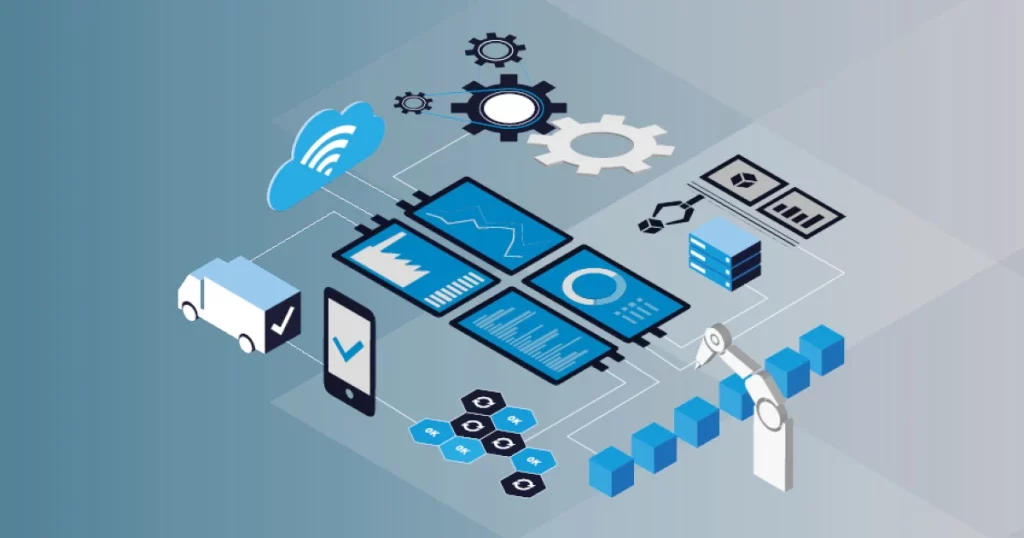
4.1 Data Layer
- Sensors and IoT devices collect real-time operational data.
- Edge computing nodes preprocess data to reduce latency and network load.
- Cloud systems store, aggregate, and analyze historical data.
4.2 Integration Layer
- Communication protocols (OPC UA, MQTT, REST APIs) enable interoperability between IT and OT systems.
- Data normalization and standardization allow consistent analytics across heterogeneous devices.
4.3 Analytics Layer
- AI/ML models for predictive maintenance, anomaly detection, and optimization.
- Simulation engines test scenarios in virtual environments before real-world implementation.
- Digital twins provide real-time visualization and “what-if” scenario analysis.
4.4 Application Layer
- MES, ERP, and SCADA systems interact with digital twins for decision-making.
- Dashboards provide actionable insights for operators, engineers, and management.
- Alerts and automated control loops improve responsiveness and operational efficiency.
5. Implementation Strategies
5.1 Phased Integration
- Assessment: Identify critical assets, data sources, and pain points.
- Pilot Projects: Deploy small-scale digital twins on key machines or lines.
- Full Deployment: Scale IT/OT integration across facilities or supply chains.
- Continuous Improvement: Refine models, analytics, and workflows based on operational feedback.
5.2 Best Practices
- Start with high-value processes where predictive insights reduce costs.
- Ensure cross-functional collaboration between IT and OT teams.
- Implement robust cybersecurity measures to protect integrated systems.
- Use standardized data protocols and open interfaces for interoperability.
5.3 Key Technologies Supporting Implementation
- Industrial IoT (IIoT): Connects physical assets to cloud and analytics platforms.
- AI and Machine Learning: Enables predictive maintenance and operational optimization.
- Edge Computing: Processes data locally to reduce latency and improve responsiveness.
- AR/VR Interfaces: Enhance digital twin visualization and operator training.
6. Applications in Industry
6.1 Smart Manufacturing
- Digital twins optimize production lines, balancing throughput, quality, and energy efficiency.
- AI-driven simulations predict machine failures and optimize maintenance schedules.
- IT/OT convergence enables real-time monitoring of entire factories, integrating ERP, MES, and SCADA systems.
6.2 Energy and Utilities
- Digital twins model power grids, energy distribution networks, and renewable energy sources.
- Predictive analytics reduce downtime and improve grid resilience.
- Convergence of IT/OT enables automated response to anomalies, reducing operational risk.
6.3 Healthcare and Life Sciences
- Hospitals implement digital twins for medical devices, patient flows, and facility management.
- Simulation of equipment usage and predictive maintenance ensures reliability.
- Integrated IT/OT systems facilitate compliance, traceability, and operational efficiency.
6.4 Logistics and Supply Chain
- Warehouse robots and autonomous vehicles leverage digital twins for route optimization.
- Real-time inventory tracking improves demand forecasting and operational flexibility.
- IT/OT convergence enables adaptive logistics systems that respond to environmental changes or disruptions.
7. Benefits and Value Creation
| Benefit | Impact |
|---|---|
| Operational Efficiency | Reduced downtime, improved throughput, and optimized resource usage |
| Predictive Maintenance | Minimizes equipment failures, extends asset lifecycle |
| Cost Reduction | Lower operational and maintenance costs through data-driven insights |
| Risk Mitigation | Early detection of anomalies and cyber-physical threats |
| Innovation Acceleration | Virtual testing accelerates new product and process development |
| Sustainability | Optimized energy usage and reduced waste contribute to green operations |
8. Challenges and Limitations
8.1 Data Quality and Integration
- Legacy OT systems may lack sensors or standardized data formats.
- Data silos hinder real-time analytics and simulation accuracy.
8.2 Cybersecurity Concerns
- IT/OT convergence increases the attack surface for cyber threats.
- Secure communication, authentication, and monitoring are critical.
8.3 Skill Gaps
- Engineers need expertise in IT, OT, AI, and simulation.
- Workforce development programs are necessary for effective deployment.
8.4 Cost and ROI
- Initial investment in sensors, computing infrastructure, and software can be high.
- ROI depends on accurate targeting of high-impact processes and operational efficiency gains.
9. Emerging Trends
9.1 AI-Enhanced Digital Twins
- Integration of reinforcement learning and predictive analytics enhances operational intelligence.
- Autonomous decision-making allows robots, machinery, and systems to self-optimize.
9.2 Cloud-Native Digital Twins
- Multi-site synchronization enables enterprise-wide visibility and cross-facility optimization.
- Data from global operations inform predictive models and workflow standardization.
9.3 Edge-Integrated Twins
- Low-latency, on-site computation enables real-time control in critical processes.
- Edge computing reduces dependency on cloud connectivity and mitigates network failures.
9.4 Digital Twin Ecosystems
- Integration across suppliers, manufacturers, and logistics partners creates interconnected digital twin networks.
- Enables end-to-end visibility, optimized supply chains, and collaborative innovation.
10. Future Outlook
The convergence of IT and OT, coupled with digital twin technology, represents a paradigm shift in industrial operations. Future developments include:
- Fully autonomous factories and smart cities using synchronized digital twin models.
- AI-driven predictive systems controlling complex networks of machines and processes.
- Enhanced human-machine collaboration through augmented reality and immersive interfaces.
- Integration of sustainability metrics into operational optimization, aligning with ESG goals.
By leveraging IT/OT convergence, organizations can transform from reactive operations to proactive, intelligent ecosystems, achieving significant operational, financial, and strategic advantages.
11. Conclusion
IT/OT convergence and digital twin technology constitute foundational elements of modern Industry 4.0 strategies. Their integration enables:
- Real-time monitoring and predictive analytics
- Enhanced operational efficiency and asset utilization
- Strategic decision-making supported by simulation and AI insights
- Risk mitigation and sustainable operations
Despite challenges such as cybersecurity, integration complexity, and workforce skill gaps, organizations that successfully implement IT/OT convergence with digital twins position themselves for competitive advantage, operational excellence, and long-term resilience.
As industries continue to embrace smart manufacturing, autonomous operations, and connected ecosystems, IT/OT convergence and digital twins will remain central to the digital transformation of the global economy.