









Introduction
Robotics has undergone a remarkable evolution over the past few decades. Once confined to laboratory experiments and controlled industrial settings, robots are increasingly entering real-world environments, performing tasks that range from industrial automation to service assistance, healthcare, and even social interaction. This transition from the laboratory to practical application represents not just a technological achievement but also a societal transformation, as robots begin to influence the way humans live, work, and interact.
Historically, robotic development focused on precision, repeatability, and the optimization of mechanical and computational systems under tightly controlled conditions. Early robotic systems, such as the Unimate industrial arm of the 1960s, were limited to structured, predictable environments. Today, the field of robotics is expanding into unstructured, dynamic, and human-centric spaces, driven by advances in artificial intelligence (AI), sensor technologies, material science, and control systems.
This article explores the ongoing transition of robots from laboratories to real-world applications. It will examine the key technological enablers, the domains in which robots are being deployed, the challenges and limitations of real-world applications, and the future prospects for robotics as an integral part of human society.
1. Historical Perspective: From Laboratory Prototypes to Industrial Automation
The journey of robotics from concept to reality began in research laboratories, where early pioneers developed the foundations of mechanical manipulation, control theory, and machine intelligence. Laboratory robots were initially designed for repetitive and deterministic tasks, such as assembly line operations and experimental research.
1.1 Early Laboratory Robots
In the 1950s and 1960s, laboratory robots were primarily focused on automation of mechanical processes. The Unimate robot, created by George Devol and Joseph Engelberger, marked the first industrial robot deployed for welding and material handling in automotive factories. Despite its success, the Unimate operated exclusively in controlled environments and required significant safety measures to protect human workers.
Laboratory robots of this era were characterized by:
- Fixed trajectories: Robots could perform only pre-programmed sequences of motion.
- Limited sensing: Interaction with the environment was minimal, as sensors were rudimentary or absent.
- High reliability under controlled conditions: While effective in predictable scenarios, these robots could not adapt to variability.
1.2 The Rise of Intelligent Robotics
By the 1980s and 1990s, research in artificial intelligence and sensor technologies enabled robots to handle more complex tasks. Researchers began integrating vision systems, force sensors, and early AI algorithms into robotic platforms, allowing for adaptive behavior in laboratory experiments.
Notable laboratory innovations included:
- Autonomous mobile robots (AMRs): Early prototypes could navigate controlled spaces, such as warehouses or office corridors.
- Robotic arms with force feedback: These systems allowed for delicate manipulation tasks, such as handling fragile objects or performing precision assembly.
- Humanoid robots: Projects like Honda’s P2 and P3 humanoids explored bipedal locomotion and human-like interaction, laying the groundwork for service robots.
Despite these advancements, robots remained largely confined to experimental setups, with limited ability to operate in unpredictable or dynamic environments outside the lab.
2. Technological Enablers of Real-World Robotic Applications
The transition from laboratory prototypes to practical real-world applications has been driven by a convergence of multiple technological domains. Key enablers include advanced sensing systems, AI and machine learning, improved actuation, and connectivity.
2.1 Advanced Sensing Systems
Modern robots are equipped with a range of sensors that allow them to perceive and interact with complex environments. These include:
- LiDAR and depth cameras: Providing 3D mapping and obstacle detection for autonomous navigation.
- Force-torque sensors: Enabling robots to manipulate objects with dexterity, essential for tasks in manufacturing and healthcare.
- Proximity and tactile sensors: Allowing robots to interact safely with humans and adapt to unexpected contacts.
- Multimodal sensing: Combining vision, auditory, and haptic inputs for more sophisticated perception and decision-making.
These sensing technologies allow robots to move from predictable, controlled environments into dynamic, human-centric spaces.
2.2 Artificial Intelligence and Machine Learning
AI has been transformative in enabling robots to perform tasks in unstructured environments. Machine learning algorithms, particularly deep learning, allow robots to:
- Recognize objects and people in complex settings.
- Adapt their actions based on environmental feedback.
- Optimize task performance through reinforcement learning.
For example, robotic vacuum cleaners such as the iRobot Roomba use AI-driven mapping to navigate homes efficiently, demonstrating how laboratory innovations in navigation and perception can be translated into consumer applications.
2.3 Actuation and Mobility Advances
Robotic mobility has advanced significantly, moving beyond stationary arms to versatile, mobile systems. Key developments include:
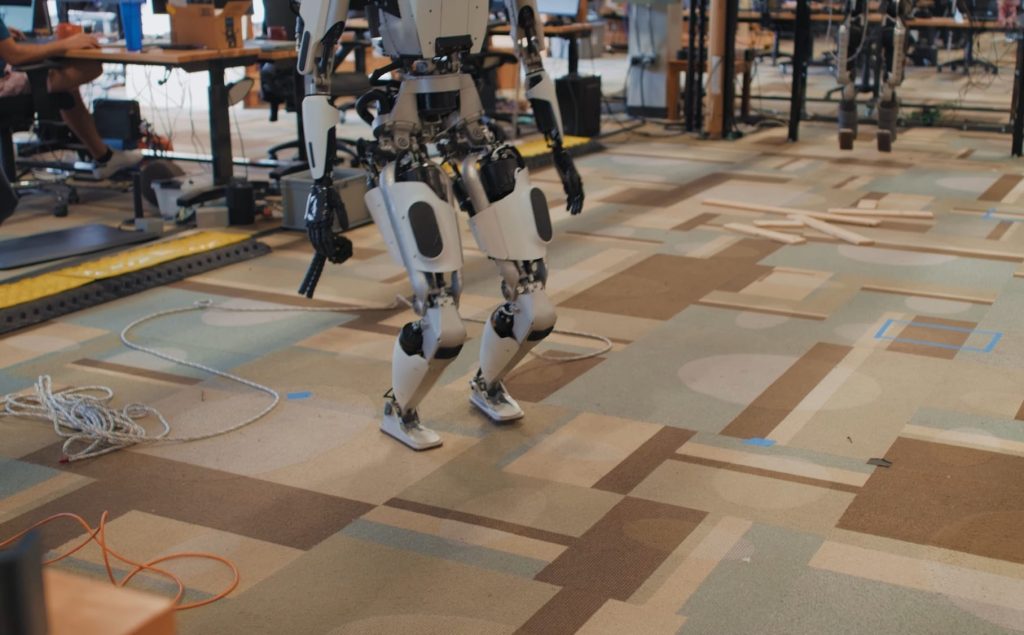
- Legged locomotion: Enabling robots to traverse uneven terrains, inspired by animals and humans. Boston Dynamics’ Spot robot exemplifies this approach.
- Soft robotics: Utilizing flexible materials and bio-inspired designs to safely interact with humans and fragile objects.
- Compact and energy-efficient actuators: Increasing autonomy and operational time in field applications.
These advancements allow robots to perform tasks that were previously impossible outside controlled laboratory settings.
2.4 Connectivity and IoT Integration
Integration with the Internet of Things (IoT) has enabled robots to operate as part of connected systems. Real-time data exchange allows robots to:
- Coordinate with other robots or devices.
- Receive updates and task instructions remotely.
- Optimize operations based on environmental and operational data.
This connectivity is critical for applications in smart factories, autonomous logistics, and healthcare environments, where robots must interact with dynamic systems in real time.
3. Domains of Real-World Robotic Applications
Robots are now being deployed across a wide spectrum of domains, each presenting unique challenges and opportunities.
3.1 Industrial Automation
The industrial sector remains a major domain for robotic deployment. Modern manufacturing facilities utilize collaborative robots (cobots) alongside human workers to perform tasks such as assembly, quality inspection, and material handling. Cobots differ from traditional industrial robots in that they are designed to operate safely alongside humans, using advanced sensors and compliant actuation to minimize the risk of injury.
3.2 Healthcare Robotics
Robotics in healthcare encompasses surgical assistance, rehabilitation, and eldercare. Surgical robots, such as the da Vinci Surgical System, enable minimally invasive procedures with high precision. Rehabilitation robots provide personalized therapy through adaptive algorithms and real-time monitoring of patient progress. In eldercare, social robots assist with companionship, medication reminders, and mobility support, addressing the growing demand for care in aging populations.
3.3 Service and Domestic Robots
Service robots perform tasks in public spaces, retail environments, and homes. Examples include robotic delivery systems, cleaning robots, and customer service robots equipped with AI for interaction. These applications highlight the importance of human-robot interaction, requiring robots to navigate complex social and spatial environments safely and intuitively.
3.4 Agricultural and Environmental Robotics
Robots are increasingly deployed in agriculture for tasks such as crop monitoring, precision spraying, and harvesting. These robots leverage AI for plant recognition and decision-making under variable environmental conditions. Environmental robots perform tasks such as ocean monitoring, pollution detection, and disaster response, where human access may be limited or hazardous.
3.5 Autonomous Vehicles
Self-driving cars and drones represent a significant real-world application of robotics. These systems combine perception, navigation, and AI decision-making to operate in dynamic, unpredictable environments, with profound implications for transportation, logistics, and urban planning.
4. Challenges and Limitations in Real-World Deployment
Despite significant progress, transitioning robots from laboratories to real-world applications is not without challenges.
4.1 Safety and Human-Robot Interaction
Ensuring safety is paramount, particularly in environments where robots interact closely with humans. Challenges include:
- Predicting human behavior in dynamic environments.
- Developing fail-safe mechanisms for unexpected events.
- Designing intuitive interfaces that allow humans to communicate effectively with robots.
4.2 Robustness and Reliability
Real-world environments are unpredictable. Robots must handle variability in lighting, terrain, object shapes, and human behavior. Achieving reliability under such conditions remains a major engineering and AI challenge.
4.3 Ethical and Social Considerations
The integration of robots into society raises ethical questions, including:
- Job displacement and economic impact.
- Privacy concerns with AI-powered robots.
- Responsibility and liability for autonomous decisions.
Addressing these concerns is critical for the broader acceptance and adoption of robotic technologies.
4.4 Cost and Scalability
High development and deployment costs can limit the adoption of advanced robots. Scaling production and creating cost-effective solutions remain significant hurdles, particularly for small- and medium-sized enterprises.
5. Future Prospects
The future of robotics in real-world applications is promising. Key trends include:
- Swarm robotics: Coordinated groups of robots working collectively to perform complex tasks.
- Human-robot collaboration: Enhanced AI and interaction models to enable seamless cooperation.
- Autonomous decision-making: Robots capable of ethical reasoning and complex problem-solving.
- Bio-inspired and soft robotics: Creating safer and more adaptable robots for unstructured environments.
As robotics technology continues to advance, the distinction between laboratory research and practical application will become increasingly blurred. Robots will become integral partners in industry, healthcare, service, and daily life.
Conclusion
The transition of robots from laboratory prototypes to real-world applications marks a pivotal evolution in robotics. Enabled by advances in AI, sensing, actuation, and connectivity, robots are increasingly capable of performing tasks in complex, dynamic, and human-centric environments. While challenges remain—ranging from safety and reliability to ethical and social concerns—the potential benefits are immense.
From industrial automation and healthcare to agriculture, service industries, and autonomous transportation, robots are no longer confined to controlled environments. They are becoming practical, adaptable, and collaborative agents, reshaping the way humans live and work. As this evolution continues, it is clear that the laboratory and the real world are converging, paving the way for a future where robots are ubiquitous, intelligent, and socially integrated.