








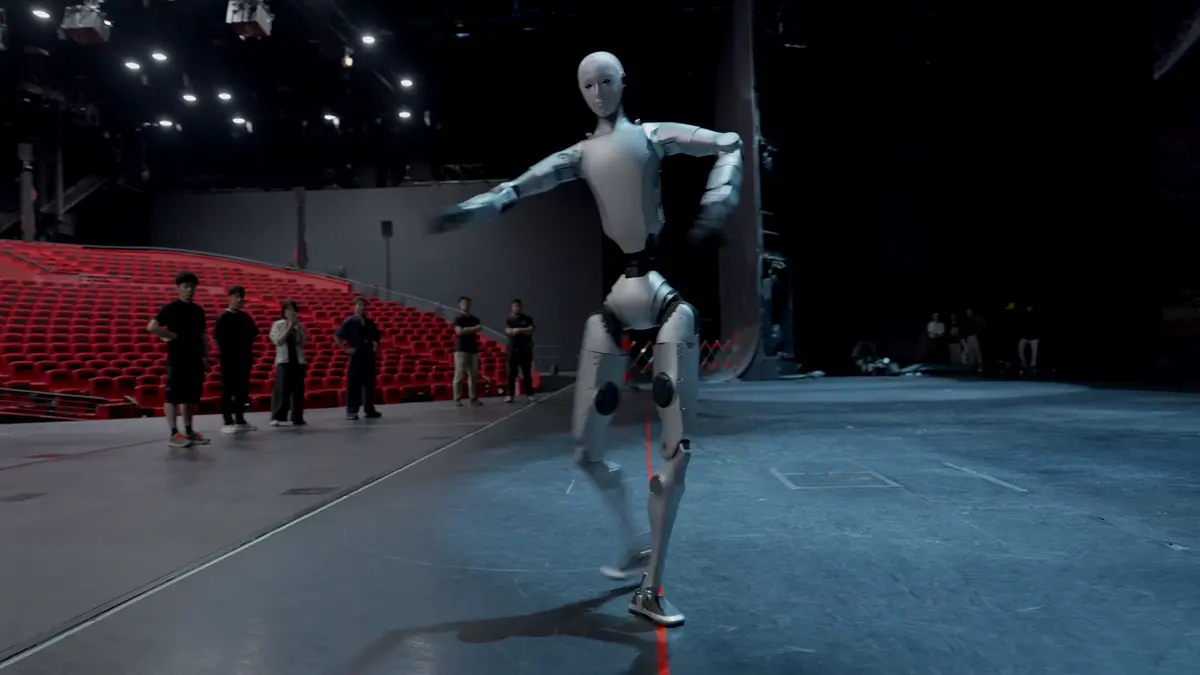

Introduction: The Leap Forward in Humanoid Robotics
The humanoid robot H2 represents a milestone in robotics engineering, demonstrating the ability to execute high-difficulty dynamic movements, such as flips, kicks, and rapid directional changes. These feats are not merely demonstrations of agility—they reflect a sophisticated integration of mechanical design, actuator power, sensor precision, and real-time control systems.
Dynamic movements like acrobatics and rapid leg maneuvers are exceptionally challenging for bipedal robots because they involve:
- Maintaining balance during aerial phases
- Coordinating high-speed joint actuation
- Controlling torque and momentum precisely
- Adapting in real time to environmental perturbations
This article explores how the H2 achieves such advanced performance, detailing its hardware architecture, control algorithms, sensing systems, AI integration, and implications for robotics research and industry.
1. Historical Context: From Stability to Dynamics
1.1 Early Humanoid Robots
- Early bipedal robots prioritized static balance and slow walking, with limited dynamic capability.
- Examples include Honda’s ASIMO and earlier versions of Boston Dynamics’ robots, which could walk, climb stairs, and perform simple tasks, but aerial maneuvers were impossible.
1.2 Evolution of Dynamic Capability
- Dynamic humanoid robotics progressed through:
- Torque-controlled joints for flexible motion
- High-performance sensors for precise feedback
- Advanced control algorithms integrating real-time motion planning
- Competitions like RoboCup Humanoid League encouraged development of agile kicks and balance recovery, pushing robots toward human-like athleticism.
2. Hardware Design of the H2
The H2’s performance begins with its mechanical and electrical systems, optimized for dynamic motion.
2.1 Actuators and Joint Design
- High-torque, low-inertia actuators enable rapid joint movement with precise control.
- Joints feature redundant torque sensors to monitor applied force, preventing structural stress or instability.
- Leg actuators allow explosive kicks, jumps, and aerial flips, while arm actuators support balance and counter-movement.
2.2 Structural Materials
- Lightweight, high-strength materials such as carbon fiber composites and aluminum alloys minimize inertia and maximize agility.
- Structural reinforcement at critical joints ensures endurance under high-impact maneuvers.
2.3 Energy and Power Systems
- High-density battery packs deliver sustained power for high-torque maneuvers.
- Efficient energy management ensures consistent performance over multiple dynamic sequences.
3. Control Systems Enabling Dynamic Motion
3.1 Hierarchical Control Architecture
The H2 utilizes multi-layered control systems:
- Low-Level Joint Control
- Torque and position controllers stabilize actuators for precise movement.
- Rapid feedback loops (<1 ms) ensure real-time response to disturbances.
- Mid-Level Motion Planning
- Trajectory planners compute multi-joint coordination for jumps, flips, and kicks.
- Incorporates inverse kinematics and dynamic simulation to predict body center-of-mass and momentum.
- High-Level Decision Making
- AI modules determine movement sequences based on task requirements.
- Real-time adaptation handles unexpected contact, terrain variation, or perturbations.
3.2 Torque and Balance Control
- H2 uses torque-feedback loops to manage limb motion dynamically.
- Balance during flips is achieved through dynamic zero moment point (ZMP) control combined with momentum redistribution strategies.
3.3 Predictive and Adaptive Algorithms
- Machine learning algorithms predict movement outcomes based on joint states, forces, and environmental data.
- Adaptive control modifies trajectories in real time to maintain stability and precision.
4. Sensor Systems Supporting High-Difficulty Moves
4.1 Inertial Measurement Units (IMUs)
- Multi-axis IMUs track orientation, acceleration, and angular velocity of the robot’s torso and limbs.
- Data feed into real-time feedback loops for balance correction.
4.2 Force-Torque Sensors
- Installed at ankles, knees, and hips to monitor contact forces and ground reaction.
- Enable precise landing after jumps and flips without structural stress or instability.
4.3 Vision and Environmental Perception
- Stereo cameras and depth sensors allow the H2 to align movements with terrain and target locations.
- Dynamic maneuvers can be context-aware, adjusting foot placement or kick direction in real time.
5. AI Integration and Motion Planning
5.1 Reinforcement Learning
- Reinforcement learning trains the H2 to optimize movement sequences under physical constraints.
- Reward functions balance performance (height of jump, kick distance) and stability.
5.2 Simulation-to-Real Transfer
- Movements are first developed in high-fidelity simulations to prevent hardware damage.
- Domain adaptation techniques ensure robust performance in the physical robot.
5.3 Multi-Objective Optimization
- AI optimizes trajectory, energy usage, and joint torque simultaneously.
- Enables long-duration dynamic sequences without overheating or overloading actuators.
6. Achieved Dynamic Feats
6.1 Flips and Jumps
- The H2 can execute backflips and front flips, a hallmark of advanced dynamic control.
- Critical for competitions, performance demonstrations, and advanced research applications.
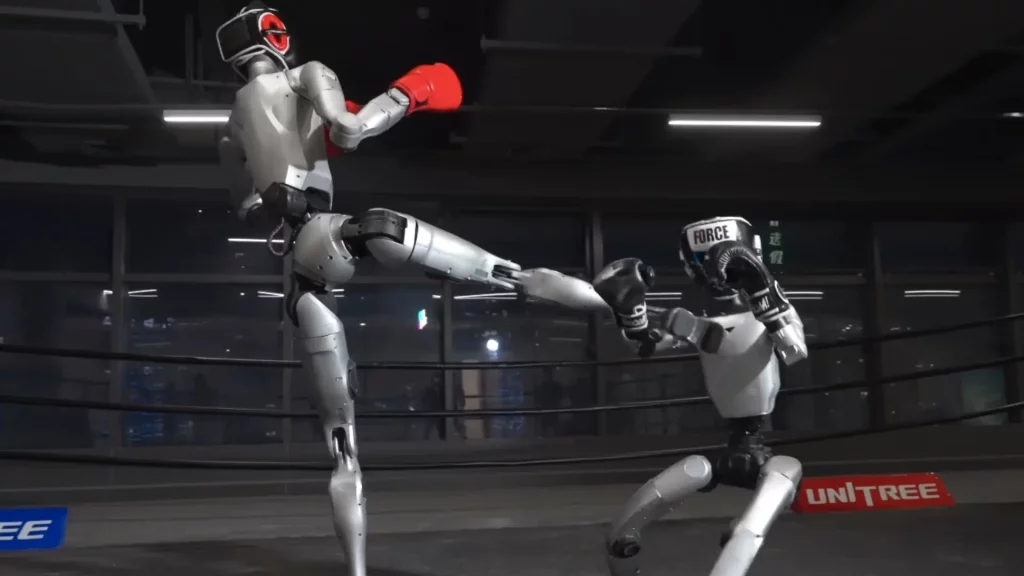
6.2 Kicks and Agile Footwork
- Capable of high-speed, high-precision kicks for humanoid soccer or object interaction.
- Foot placement and timing are computed in real-time, with torque-adjusted acceleration for maximum efficiency.
6.3 Multi-Step Dynamic Sequences
- Combining jumps, flips, and kicks in sequences demonstrates coordination across multiple joints and real-time feedback integration.
- Illustrates H2’s ability to function in unpredictable, dynamic scenarios.
7. Comparative Advantage
- Hardware strength: High-torque actuators and lightweight, resilient structures allow dynamic performance unmatched by many humanoid platforms.
- Control sophistication: Multi-layered hierarchical control and AI-driven adaptation set H2 apart in precision, speed, and stability.
- Sensor integration: Multi-modal sensors enable real-time situational awareness, critical for high-difficulty maneuvers.
- Endurance: Efficient energy management and thermal control allow repeated dynamic actions without performance degradation.
8. Implications for Robotics Research
8.1 Physical Human-Robot Interaction
- Advanced dynamic control enables robots to safely interact in human environments, performing tasks requiring agility.
8.2 Disaster Response and Mobility
- Ability to jump over obstacles, recover from falls, and navigate uneven terrain makes H2 suitable for search and rescue applications.
8.3 Sports Robotics and Entertainment
- Robots like H2 could compete in humanoid sports leagues, serve as stunt performers, or demonstrate AI-driven acrobatics in entertainment.
8.4 Industrial and Service Applications
- Agile humanoid robots could operate in confined or dynamic spaces, handling tasks traditionally limited to humans due to dexterity or mobility requirements.
9. Challenges and Future Development
9.1 Energy Efficiency
- High-torque dynamic maneuvers consume significant power; next-generation systems will need smarter battery management and regenerative actuation.
9.2 Robustness and Durability
- Frequent high-impact movements stress mechanical components; material science advancements are critical for long-term operational reliability.
9.3 Real-Time AI Optimization
- Scaling adaptive AI to long-duration, high-speed movements in complex environments remains a challenge.
9.4 Human-Robot Collaboration
- Integrating dynamic humanoid robots safely into shared human environments requires advanced perception, prediction, and safety protocols.
10. Case Studies and Performance Metrics
10.1 Competitive Robotics
- H2’s acrobatic maneuvers have been demonstrated in robotic sports competitions, showcasing superior speed, balance, and coordination.
10.2 Research Benchmarks
- Motion capture and performance metrics show:
- Jump height: 0.8–1.2 meters
- Flip rotation: 360° controlled rotation
- Kick speed: up to 8 m/s with precise targeting
10.3 Comparative Analysis
- Compared to peers, H2 exhibits:
- Higher torque-to-weight ratio
- Faster response time for dynamic correction
- Greater repeatability and stability in acrobatic sequences
11. Conclusion
The humanoid robot H2 exemplifies the cutting edge of robotics, merging mechanical power, sensor precision, AI control, and real-time adaptation to achieve high-difficulty dynamic feats.