









Introduction
For much of modern history, robots have been defined by their strength, precision, and endurance rather than their sensitivity or perception. Industrial robots excel at repetitive, high-precision tasks, yet they remain largely unaware of the nuanced physical and sensory characteristics of the world around them. Compared to humans—who rely on touch, proprioception, vision, hearing, and contextual awareness to interact fluidly with their environment—robots have traditionally operated with limited and fragmented sensory inputs.
This imbalance is now changing. Advances in materials science, sensor technology, artificial intelligence, and cognitive robotics are enabling robots to gradually acquire tactile and perceptual capabilities that more closely resemble those of humans. These developments represent a fundamental shift in robotics, transforming machines from rigid, force-driven tools into sensitive, perceptive, and adaptive agents capable of safe, dexterous, and intelligent interaction with the physical world.
This article explores the evolution of robotic touch and perception, the technologies driving this transformation, applications across industries, the advantages and challenges of human-like sensing, and the broader implications for human–robot interaction and autonomous systems.
1. Why Human-Like Touch and Perception Matter
1.1 The Central Role of Sensory Intelligence
Human intelligence is deeply embodied. Our ability to manipulate objects, navigate environments, and interact socially depends on continuous sensory feedback. Touch allows us to assess texture, pressure, temperature, and material properties. Perception enables us to integrate sensory signals into a coherent understanding of context.
Robots lacking rich sensory input must rely on rigid assumptions about their environment. This limits their effectiveness in:
- Unstructured or dynamic settings
- Tasks involving delicate or variable objects
- Close collaboration with humans
Enhancing robotic touch and perception is therefore essential for expanding robotic autonomy and usability.
1.2 From Force to Feeling
Traditional robots primarily sense force and position. While sufficient for industrial automation, these signals provide only a coarse understanding of physical interaction. Human-like tactile perception, by contrast, enables:
- Detection of subtle contact changes
- Differentiation between materials
- Anticipation of slippage or deformation
This transition—from force measurement to perceptual sensing—marks a critical milestone in robotics.
2. Understanding Tactile and Perceptual Capabilities
2.1 Tactile Sensing
Tactile sensing refers to a robot’s ability to perceive physical contact through sensors distributed across its body or end-effectors. Advanced tactile systems can detect:
- Pressure and force distribution
- Shear and vibration
- Texture and surface roughness
- Temperature and thermal flow
These capabilities allow robots to interact with objects in a nuanced and responsive manner.
2.2 Proprioception and Body Awareness
Proprioception is the sense of body position and movement. For robots, this involves:
- Joint position and velocity sensing
- Torque feedback
- Internal state estimation
Enhanced proprioception allows robots to move more smoothly, maintain balance, and coordinate complex motions.
2.3 Multimodal Perception
Human perception is inherently multimodal, combining touch, vision, hearing, and contextual reasoning. Similarly, next-generation robots integrate:
- Vision systems for object recognition and spatial awareness
- Tactile sensors for physical interaction
- Auditory sensors for environmental cues
- AI models for contextual interpretation
The fusion of these modalities enables richer and more robust perception.
3. Technological Foundations
3.1 Advanced Sensor Materials
Breakthroughs in materials science have enabled the development of flexible, stretchable, and highly sensitive tactile sensors. These materials allow sensors to conform to complex shapes, including robotic hands and arms.
3.2 Electronic Skin (E-Skin)
Electronic skin mimics the sensory properties of human skin by embedding dense networks of sensors across a robot’s surface. E-skin enables:
- Whole-body tactile awareness
- Detection of light touch and pressure
- Improved safety in human–robot interaction
E-skin is a key enabler of human-like tactile perception.
3.3 High-Resolution Vision Systems
Advances in computer vision and depth sensing enhance robotic perception by:
- Identifying objects and their properties
- Estimating distance and motion
- Understanding scene context
When combined with tactile feedback, vision enables predictive and adaptive manipulation.
3.4 Artificial Intelligence and Sensor Fusion
AI algorithms integrate data from multiple sensors into coherent perceptual models. Techniques such as deep learning and probabilistic inference allow robots to:
- Interpret complex sensory patterns
- Learn correlations between touch and vision
- Adapt perception based on experience
Sensor fusion is essential for achieving human-like perception.
4. Learning Through Touch and Interaction
4.1 Tactile-Based Learning
Humans often learn by touching and manipulating objects. Similarly, robots can use tactile feedback to:
- Infer object properties
- Refine grasping strategies
- Detect anomalies during manipulation
This experiential learning enhances adaptability.
4.2 Simulation and Self-Improvement
Robots increasingly use simulation environments to learn tactile interactions safely and efficiently. AI-generated data augments physical experience, accelerating learning and improving generalization.
4.3 Continuous Perceptual Adaptation
Through reinforcement learning and self-supervised learning, robots continuously refine their perceptual models, gradually improving sensitivity and accuracy.
5. Applications Across Industries
5.1 Manufacturing and Assembly
Robots with advanced tactile perception can:
- Handle delicate or flexible components
- Detect misalignment or defects through touch
- Adjust force dynamically during assembly
This enables higher-quality, more flexible manufacturing.
5.2 Healthcare and Medical Robotics
In healthcare, tactile sensing is critical for:
- Minimally invasive surgery
- Rehabilitation and physical therapy
- Safe patient handling
Robots with human-like touch can perform procedures with greater precision and safety.
5.3 Service and Domestic Robots
Household and service robots benefit from enhanced perception by:
- Safely interacting with people
- Manipulating everyday objects
- Adapting to cluttered, unpredictable environments
Human-like touch is essential for trust and usability in domestic settings.
5.4 Logistics and Warehousing
Tactile-aware robots can:
- Handle fragile goods
- Detect packaging integrity
- Optimize grasping and placement
This reduces damage and increases efficiency.
5.5 Exploration and Hazardous Environments
In space, underwater, or disaster scenarios, tactile perception allows robots to:
- Assess terrain and structural integrity
- Manipulate unknown objects
- Operate safely in environments inaccessible to humans
6. Benefits of Human-Like Tactile and Perceptual Abilities
6.1 Improved Dexterity and Precision
Robots can perform tasks requiring fine motor skills, approaching human-level dexterity.
6.2 Enhanced Safety
Sensitive tactile feedback allows robots to detect unintended contact and respond appropriately, reducing the risk of injury.
6.3 Greater Autonomy
Rich perception enables robots to operate independently in unstructured environments without constant human supervision.
6.4 Natural Human–Robot Interaction
Robots that perceive touch and context more like humans can interact more intuitively, improving collaboration and acceptance.
7. Challenges and Limitations
7.1 Sensor Complexity and Cost
High-resolution tactile systems require dense sensor arrays and advanced materials, increasing cost and complexity.
7.2 Data Processing and Integration
Processing large volumes of sensory data in real time remains computationally demanding.
7.3 Durability and Reliability
Tactile sensors must withstand wear, contamination, and environmental stress while maintaining accuracy.
7.4 Interpretation and Meaning
Sensing touch is only part of the challenge; interpreting tactile data meaningfully requires sophisticated AI models.
8. Case Studies
8.1 Robotic Hands with Tactile Feedback
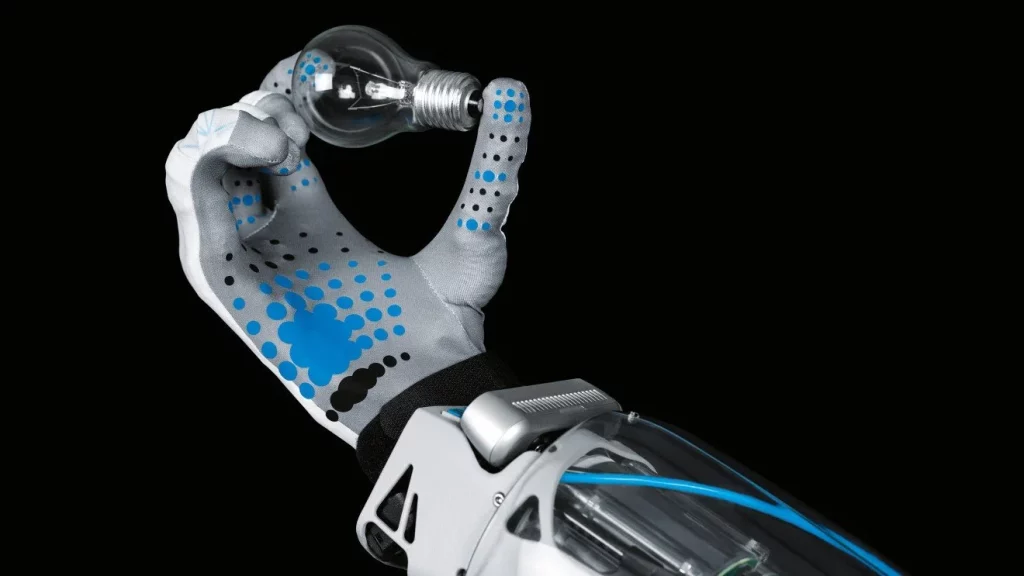
Advanced robotic hands equipped with tactile sensors can adjust grip force dynamically, enabling reliable manipulation of objects with varying shapes and textures.
8.2 Medical Robotic Systems
Surgical robots with enhanced tactile feedback improve precision and reduce tissue damage, supporting safer and more effective procedures.
8.3 Collaborative Industrial Robots
Cobots equipped with tactile sensing detect human contact instantly, allowing safe operation in shared workspaces.
9. The Future of Robotic Touch and Perception
9.1 Toward Full-Body Sensory Awareness
Future robots will possess distributed tactile sensing across their entire structure, similar to human skin.
9.2 Integration with Cognitive Models
Touch and perception will be tightly integrated with reasoning and planning, enabling robots to understand not just how the world feels, but what it means.
9.3 Social and Emotional Touch
Research is exploring how robots might interpret and respond to social touch, enhancing emotional intelligence and interaction quality.
9.4 Ethical and Societal Implications
As robots become more perceptive, questions arise about privacy, trust, and the boundaries of human–machine interaction.
Conclusion
The gradual acquisition of human-like tactile and perceptual capabilities represents one of the most profound transformations in robotics. By moving beyond rigid force control toward rich sensory awareness, robots become more dexterous, safer, and more autonomous. These capabilities unlock new applications across manufacturing, healthcare, services, and exploration, fundamentally reshaping how robots interact with the world and with humans.
While challenges in cost, durability, and data interpretation remain, the trajectory is clear. Future robots will not merely see and move—they will feel, perceive, and understand their physical surroundings in ways increasingly similar to humans. This evolution brings robotics closer to true embodied intelligence, paving the way for a new era of intelligent, perceptive, and collaborative machines.